Batteries explained: LiFePO4, lithium-ion and lead-acid
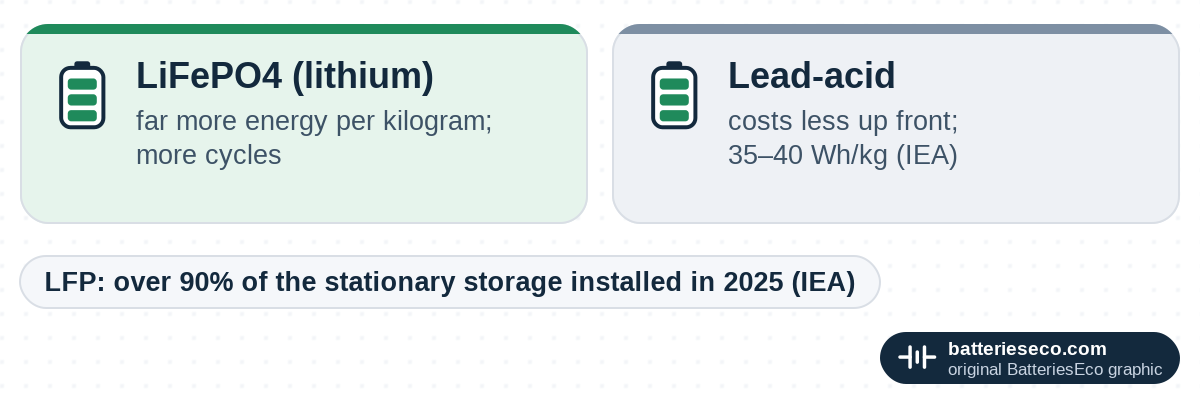
Batteries for a home, an RV or a portable power station are mostly lithium-ion, such as lithium iron phosphate (LiFePO4), or lead-acid. LiFePO4 stores far more energy per kilogram and lasts more cycles, while lead-acid costs less up front. This section explains each type, how much of a battery’s capacity you can really use and what wears it out.
The main battery types
| Type | Energy per kilogram | What to know |
|---|---|---|
| Lithium iron phosphate (LiFePO4, LFP) | Up to 205 Wh/kg for the latest cells, according to the International Energy Agency (IEA) 1 | No cobalt or nickel; more stable than nickel-rich chemistries, according to the IEA 2 |
| Lithium-ion NMC (nickel manganese cobalt) | Up to 265 Wh/kg 1 | More energy per kilogram and per liter than LFP 3 |
| Lead-acid (flooded, AGM, gel) | 35 to 40 Wh/kg 4 | Victron rates its AGM deep-cycle batteries at 400 cycles at 80% discharge, with no end-of-life capacity given 5 |
LiFePO4 has taken over battery storage: the IEA puts it at over 90% of the stationary storage installed worldwide in 2025 6. Our guide to LiFePO4 batteries covers its strengths, its limits and its voltage chart.
Our lithium-ion guide explains how LFP differs from NMC and the other lithium chemistries. Our lithium vs AGM and lead-acid guide compares lithium with the older battery types.
Rated capacity and usable energy
A battery’s energy in watt-hours is its capacity in amp-hours times its nominal voltage. So a 12.8 V, 100 Ah LiFePO4 battery holds 1,280 Wh (our calculation). Our kWh guide explains the conversion.
You can’t always use all of it. Germany’s auto club ADAC says only 30% to 75% of a lead-acid battery’s capacity should be used, depending on the type and the discharge current. A LiFePO4 battery can be discharged almost 100% 7.
What wears a battery out
Batteries wear with use and with age. Sandia National Laboratories cycled small commercial cells for several years.
In that study, the LFP cells reached, or were projected to reach, 2,500 to 9,000 equivalent full cycles before falling to 80% of their capacity 8. Heat ages them too. The International Renewable Energy Agency gives a rule of thumb: every rise of about 18 °F (10 °C) above the design operating temperature halves the calendar life of lithium-ion storage 9.
Cold weather
Cold cuts the capacity you can draw. Victron rates its 100 Ah LiFePO4 Smart battery at 80 Ah at 32 °F (0 °C), at a discharge current of up to 1C.
It only allows charging at 41 °F (5 °C) and above 10. Charging a LiFePO4 battery below freezing is the bigger risk: our LiFePO4 guide explains why.
The battery management system (BMS)
A BMS measures each cell’s voltage, balances the cells and keeps the battery within safe limits. That’s how a chapter of the Department of Energy’s storage handbook, by authors from Sandia and Saft, describes it 11.
Stanford researchers add that estimating the state of charge is one of its key jobs. It’s a hard job with LiFePO4, because its resting voltage barely changes with the state of charge 12.
Safety
France’s industrial-risk institute INERIS points out that LFP batteries, like every current lithium-ion chemistry, can go into thermal runaway and are not intrinsically safe 13. Our lithium-ion guide sums up what lab tests found about overheating.
All the guides in this section
Understand
Choose
Use and maintain
Sources
- Global EV Outlook 2026 - Electric vehicle batteries (section "Emerging battery chemistry and designs")
- Batteries and Secure Energy Transitions (World Energy Outlook Special Report), sections 1.2 and 2.3.2
- Global EV Outlook 2025 - Electric vehicle batteries
- Batteries and Secure Energy Transitions (World Energy Outlook Special Report), sections 1.2, 2.3.2 and 2.3.6
- Gel and AGM Batteries datasheet
- Global EV Outlook 2026 - Electric vehicle batteries
- Nachrüstung von Stromspeicher- und Ladelösungen für Campingfahrzeuge (33109 BOE)
- Degradation of Commercial Lithium-Ion Cells as a Function of Chemistry and Cycling Conditions
- Electricity Storage and Renewables: Costs and Markets to 2030
- Lithium Battery 12,8V & 25,6V Smart datasheet
- U.S. DOE Energy Storage Handbook, Chapter 3: Lithium-Ion Batteries, section 2.1.3 Modular Design
- Advancing SOC estimation in LiFePO4 batteries: Enhanced dQ/dV curve and short-pulse methods
- Profil de risque des batteries Li-ion LFP (Ineris-213996-2761939-v1.0)