How long will a power station or battery run my appliances?
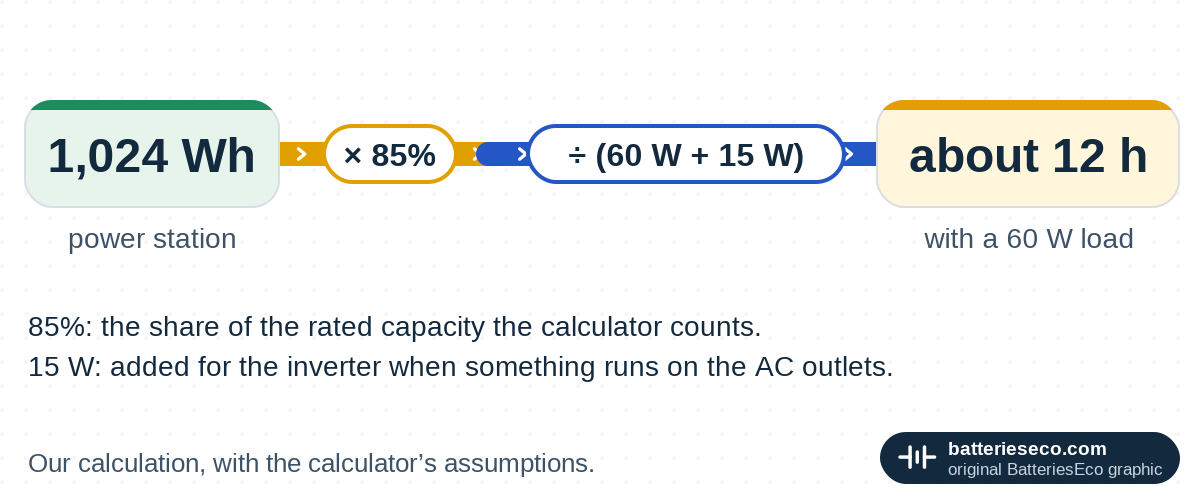
Runtime is the usable energy divided by the power your appliances draw. For a portable power station, the calculator counts 85% of the rated capacity and adds 15 W for the inverter whenever something runs on the AC outlets.
With those assumptions, a 1,024 Wh station runs a 60 W load for about 12 hours (our calculation).
Updated
- Estimated usable energy
- 870 Wh
- Power drawn from the battery, including the inverter
- 75 W
Check your power station or inverter manual to make sure its output power covers all the appliances running at the same time, including their start-up surges.
A power station’s runtime comes down to two numbers: the energy its battery can actually deliver, and the average power your appliances draw from it. The calculator divides one by the other, and the answer shows whether a portable power station will get you through a night without power or a weekend away.
Is your battery labeled in amp-hours or milliamp-hours? Turn that into watt-hours first with our watts, amps, Ah and Wh converter.
How the runtime estimate works
Usable energy, not the label
In 2025, Germany’s auto club ADAC tested eight portable power stations rated 768 to 1,440 Wh. Their usable capacity was, on average, a good 10% to 15% below the manufacturer’s rated capacity 1.
So for a power station, the calculator counts 85% of the rated capacity, the 15% end of ADAC’s range. It treats that 85% as already including the inverter’s conversion losses, so it adds no inverter efficiency on top (our modeling choice).
For a separate battery with an inverter, it counts part of the capacity depending on the chemistry.
For a LiFePO4 battery it uses 80%. That’s the depth of discharge at which Victron rates its Lithium Battery Smart for 2,500 cycles before it falls to 80% of nominal capacity 2.
For an AGM or gel lead-acid battery it uses 50%: Victron rates its AGM deep-cycle batteries for 600 cycles at 50% depth of discharge 3.
What the inverter costs
An inverter draws power as soon as it’s switched on. ADAC measured up to about 30 W for the built-in inverter alone on some stations 1.
The calculator adds 15 W whenever an appliance runs on an AC outlet: Bluetti’s manual gives the self-consumption of its AC180 power station as about 15 W 4. You can’t change this value.
For a separate battery, the calculator assumes an inverter efficiency of 88% and adds 6 W of idle draw whenever an appliance runs on an AC outlet. Victron’s datasheet for its Phoenix VE.Direct inverters (250 to 1,600 VA) gives a maximum efficiency of 87% to 92%, depending on the model and battery voltage 5. It lists an idle draw of 4.2 W to 12 W 5.
The power your appliances draw
Enter each appliance’s average power over the whole period, including the time it’s off. A fridge doesn’t run all the time: its compressor starts and stops, so its average is well below its running power.
The calculator adds up the average power of every appliance you enter, as if they all ran together nonstop. For a separate battery, it divides the power of the AC appliances by the inverter efficiency. An appliance on a 12 V or USB output skips the inverter.
Runtime (hours) = usable energy (Wh) ÷ power drawn from the battery (W). The result is shown in hours (to one decimal below 10 hours) and in days once it reaches 48 hours.
What common appliances draw on average
Our calculation: if you know an appliance’s yearly use in kWh, divide it by 8.76 to get its average power in watts. A 365-day year has 8,760 hours.
| Appliance | Average power | Where it comes from (sums: our calculation) |
|---|---|---|
| Main (most-used) refrigerator, US home | 70.4 W | 617 kWh a year on average per household in 2020, from the EIA’s Residential Energy Consumption Survey 6; 617,000 Wh ÷ 8,760 h |
| Refrigerator-freezer, England | 44.5 W | 390 kWh a year on average, from week-long measurements in a 2015 field trial of 998 cold appliances for the UK government 7; same sum |
| CPAP without humidifier | 15 W | ResMed’s 2015 guide gives 0.70 A to 1.66 A at 12 V for an AirSense 10 on its DC/DC converter, depending on pressure, which is 8.4 W to 19.9 W 8; 15 W falls within that range |
| CPAP with heated humidifier | 50 W | Same guide: 3.44 A to 4.59 A with the humidifier set to 8, or 41.3 W to 55.1 W 8; 50 W falls within that range |
| 12 V compressor cooler | 11.8 W | Dometic rates its CFX3 35 at 0.98 Ah per hour on 12 V, at 90 °F (32 °C) outside and 39 °F (4 °C) inside, which is 11.8 W 9 |
These are averages or makers’ figures: use your own appliances’ figures if you have them. A new refrigerator-freezer can use far less than the measured average: the UK government’s Home Energy Model assumes 137 kWh a year for an efficient new one 10.
Our calculation: 137 kWh ÷ 8.76 is about 15.6 W. On a 1,024 Wh station, the calculator would run that fridge-freezer for about 28 hours (1,024 Wh × 0.85 = 870 Wh, ÷ (15.6 W + 15 W)), compared with 15 hours for the England average in the next table.
Runtimes for three station sizes
Our calculation, with each appliance on an AC outlet except the cooler, which runs on the 12 V output:
| Appliance | 512 Wh | 1,024 Wh | 2,048 Wh |
|---|---|---|---|
| Main US refrigerator (70.4 W) | 5.1 hours | 10 hours | 20 hours |
| Refrigerator-freezer, England (44.5 W) | 7.3 hours | 15 hours | 29 hours |
| CPAP without humidifier (15 W) | 15 hours | 29 hours | 2.4 days |
| CPAP with heated humidifier (50 W) | 6.7 hours | 13 hours | 27 hours |
| 12 V compressor cooler on the 12 V output (11.8 W) | 37 hours | 3.1 days | 6.1 days |
The CPAP figures come from ResMed’s guide, which gives the current at 12 V through its own DC/DC converter 8. The calculator treats them as if the CPAP were plugged into an AC outlet.
That 2015 guide lists the AirSense 10 only with the DC/DC converter, not with an inverter. It also says ResMed heated humidifiers other than those it lists must not be used with inverters 11.
Follow your device’s manual. Bluetti’s AC180 manual also says the station isn’t suitable for equipment that depends heavily on a reliable power supply and involves personal safety, such as medical equipment 4.
Our calculation: with a separate 100 Ah LiFePO4 battery at 12.8 V (1,280 Wh) and an inverter, the same US refrigerator runs about 12 hours. On a 100 Ah AGM battery at 12 V (1,200 Wh), it runs about 7 hours, because the calculator uses only half of a lead-acid battery’s capacity.
What the estimate doesn’t account for
- Temperature. The calculator assumes room temperature. When it’s discharged at up to 1C (a current equal to the rated amp-hours), Victron rates its 100 Ah Lithium Battery Smart at 80 Ah at 32 °F (0 °C) and 50 Ah at −4 °F (−20 °C) 12.
- Battery age. It starts from a new battery’s capacity. Victron, for example, says its Lithium Battery Smart keeps at least 80% of its nominal capacity after 2,500 cycles at 80% depth of discharge 2.
- Maximum output power. It doesn’t check that the station or inverter can power everything at once. Check the manufacturer’s rated output power, including start-up surges: in Bluetti’s AC180 manual, some appliances with a motor or compressor can start at 2 to 4 times their rated power 4.
- The station’s own electronics on DC. When only the 12 V output is used, the calculator counts nothing for the screen or the battery management system (BMS).
- Appliances that don’t run all the time. A laptop used a few hours a day isn’t on around the clock, but the calculator counts it as running nonstop, so enter its average over the whole period, as the method above asks.
For why a LiFePO4 battery can be discharged deeper than a lead-acid one, see our batteries section. The rest of our tools are in the calculators section.
Sources
- Mobile Powerstations im ADAC Test: Nur die Hälfte schneidet gut ab
- Lithium Battery 12,8V & 25,6V Smart datasheet
- Gel and AGM Batteries datasheet
- BLUETTI AC180 Portable Power Station User Manual (EN/DE, P/N 17.0303.0532-01A1; PDF created 2023-03-22, modified 2023-05-09)
- Phoenix Inverter VE.Direct 250VA - 1600VA datasheet
- Table CE5.3b Detailed household site electricity end-use consumption, part 2—averages, 2020 (2020 Residential Energy Consumption Survey)
- Study of Over-Consuming Household Cold Appliances: Field trial report (Report Number HPR187-1003)
- Battery guide (Technical Services, document 198103/4)
- Dometic CFX3 35 - product page, technical specifications
- Lighting, cooking, electrical appliances, and incidental heat losses in the Home Energy Model: FHS assessment. A technical explanation of the assumptions (HEMFHS-TP-05, v2.0)
- Battery guide (Technical Services, document 198103/4, 2015-08): Inverters, Minimum inverter requirements, Converters
- Lithium Battery 12,8V & 25,6V Smart datasheet