Off-grid solar systems: what’s in one, how to size it for winter, and when you need a generator
An off-grid solar system powers a home or cabin with no grid connection: panels, a charge controller, a battery bank, an inverter for household AC power and often a generator for the darkest weeks.
Size it for the worst month, not the yearly average: in our PVWatts and PVGIS runs, 1 kW of panels tilted at 35° facing south makes about 2,240 Wh a day in December in Boston but about 720 Wh in Edinburgh, compared with 3,960 and 3,700 Wh in June. The battery has to cover the days without sun; a 1999 IEA guide to lead-acid batteries sizes small systems for 3 to 7 days.
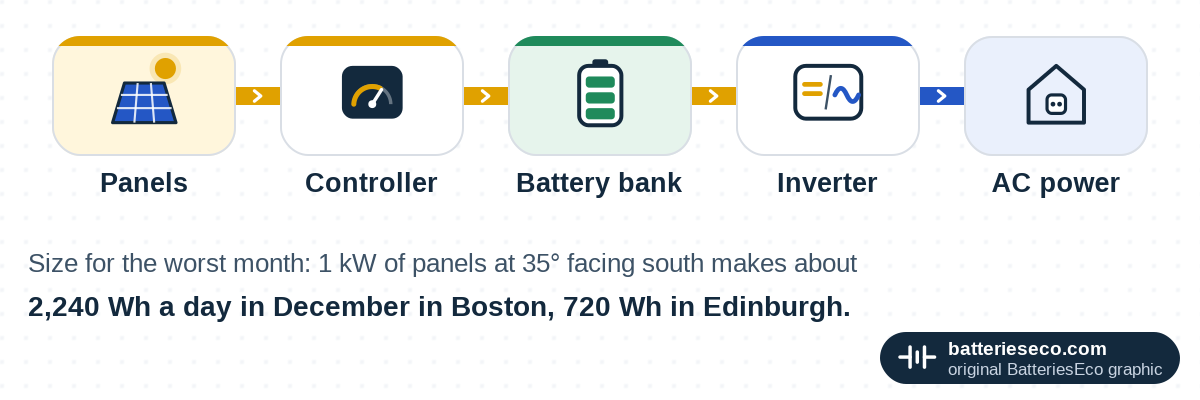
Our reading: an off-grid solar system is sized for winter. Its panels have to cover your use in the month they make the least, unless something else such as a generator fills the gap. Its battery has to carry the days without sun.
For small stand-alone systems, the IEA’s PV program guide to lead-acid batteries (1999) says the battery is normally sized to hold 3 to 7 days of energy use without sunshine 1.
The parts of an off-grid solar system
Our reading: an off-grid system serves a home, a cabin or a workshop with no grid connection. It gets no power from outside, so everything it uses comes from its panels, its battery and, often, a generator.
Besides the solar modules, a 1997 DOE fact sheet produced by NREL lists what a stand-alone system may need 2:
- a charge controller
- batteries
- an inverter for AC loads
- safety disconnects and fuses
- a grounding circuit and wiring
The same fact sheet adds that PV can be combined with other generators, such as wind, hydro or diesel, to charge the batteries 2.
A grid-tied solar system won’t do the job. The DOE says solar systems generally depend on the grid and are designed to switch off when it fails 3.
As we read it, off-grid you need an inverter built to run without a grid: see the inverter section below.
Sizing for the darkest month
Here is what 1 kW of panels makes per day in our runs of NREL’s PVWatts (NREL is now the National Laboratory of the Rockies) for US state capitals and the EU’s PVGIS for UK cities. Each run assumes 14% losses, with the panels open-racked in the US runs and free-standing in the UK ones.
| City | June, tilted 35° south | December, tilted 35° south | December, vertical south |
|---|---|---|---|
| Phoenix, AZ | 5,160 Wh | 4,397 Wh | 4,326 Wh |
| Denver, CO | 4,877 Wh | 3,703 Wh | 3,884 Wh |
| Nashville, TN | 4,003 Wh | 2,919 Wh | 2,861 Wh |
| Boston, MA | 3,960 Wh | 2,242 Wh | 2,484 Wh |
| Saint Paul, MN | 4,460 Wh | 2,316 Wh | 2,616 Wh |
| Olympia, WA | 4,057 Wh | 1,203 Wh | 1,252 Wh |
| London, England | 4,087 Wh | 1,171 Wh | 1,397 Wh |
| Manchester, England | 3,690 Wh | 910 Wh | 1,116 Wh |
| Edinburgh, Scotland | 3,697 Wh | 719 Wh | 926 Wh |
Our calculation: monthly output ÷ days in the month. US figures are AC output per kW of panels (PVWatts version 8, typical-year weather); UK figures are per kWp, kilowatt-peak, the panels’ rated power (PVGIS 5.3, 2005-2023 weather).
Our calculation from the table shows:
- The north loses most. A 35° panel makes about 5 times as much in June as in December in Edinburgh and 3.4 times as much in Olympia, compared with 1.2 times in Phoenix.
- Steeper panels help in winter. A vertical panel facing south beats a 35° panel in December in Denver, Boston, Saint Paul, Olympia and the three UK cities, though in the same runs, not shown in the table, it makes far less in June.
These runs model a grid-connected system that feeds an inverter, not a battery 4 5. For an off-grid PV and battery system, PVGIS uses a lower performance ratio of 0.67, which takes in battery and inverter losses and component wear 5.
As we read it, an off-grid home gets less usable energy out of each kW than these figures.
Our calculation, for a cabin using 1,000 Wh a day: covering December takes about 450 W of panels at 35° in Boston (1,000 ÷ 2,242 Wh per kW). In Edinburgh it takes about 1,390 W (1,000 ÷ 719). Neither figure counts the off-grid losses just mentioned.
Tilt and shade are explained in our solar panels section, and the charge controller in our MPPT vs PWM guide.
Battery size and days without sun
The battery stores the day’s production for the night and carries you through cloudy stretches. The 1997 DOE fact sheet calls the number of cloudy days it must cover “days of autonomy” 2.
For lead-acid, the IEA guide bases its sizing on only 40% of the battery’s nominal energy content: 50% discharge in the worst conditions, and an end of life at 80% of capacity 1. Those rules were written for lead-acid, not LiFePO4.
Our calculation, for a load of 1,000 Wh a day: 3 to 7 days of autonomy means storing 3,000 to 7,000 Wh. On the IEA’s 40% basis for lead-acid, that’s a nominal 7,500 to 17,500 Wh of battery (3,000 ÷ 0.4 and 7,000 ÷ 0.4). The guide’s own example goes higher above 40° latitude, which takes in Boston and Edinburgh 1.
NREL’s quick check counts in hours of autonomy: 10 kWh of storage serving an average load of 2 kW lasts 5 hours 6. For off-grid homes, its rule of thumb is up to several days of autonomy 6.
Our lithium vs AGM guide explains how much of each battery type you can use, and our runtime calculator turns a battery’s capacity and your loads into hours.
Off-grid inverters and inverter-chargers
Our reading: if a generator also has to charge the battery, an inverter-charger combines both jobs in one box.
Victron’s MultiPlus-II, for example, is an inverter-charger. For the 48/3000 model of its 230 V range, the manual gives these figures 7:
| MultiPlus-II 48/3000 | Manual’s figure |
|---|---|
| Continuous power at 77 °F (25 °C) | 2,400 W |
| Peaks | up to 5,500 W |
| No-load draw | 11 W |
| No-load draw in AES mode | 7 W |
| No-load draw in search mode | 2 W |
Our calculation, for an inverter left idling through a 31-day December: 11 W of no-load draw adds up to 264 Wh a day (11 × 24), more than a quarter of the cabin’s 1,000 Wh budget above, and to 8.2 kWh over the month (264 × 31). In search mode, the same days cost 48 Wh each (2 W × 24).
In its general description, Victron says AES cuts no-load consumption by about 20% and search mode by about 70% 7; the table gives this model’s own specified figures.
Our reading: US homes run on 120/240 V, so check the North American version of any model.
The battery voltage follows the inverter size. Victron’s wiring guide gives preferred upper inverter power limits, in volt-amperes (VA), for each system voltage: up to 3,000 VA at 12 V, up to 5,000 VA at 24 V, and 5,000 VA and up at 48 V 8. Its reason: a higher voltage means lower currents and thinner cables 8.
Our inverter guide explains sizing and starting surges.
Adding a generator for winter
In our view, a generator can stand in for the extra panels December would otherwise take.
NREL’s related rule of thumb is written for power outages 6. Rare, long outages may be served more economically by a generator, it says, while batteries are typically best for frequent, short ones 6.
Victron’s MultiPlus-II can start and stop a generator automatically, at a set battery voltage or state of charge, through its programmable relay 7.
Size the generator for the charger, not just the loads. Victron’s suggested minimums for its own inverter-chargers are a 5 kVA generator for a 3,000 VA model and 8 kVA for a 5,000 VA model 9. It says an inverter-type generator should be at least 30% larger than an equivalent AVR model, because surge loads overload it more easily 9.
The CPSC says a portable generator must run outside only, at least 20 feet from the house, with its exhaust pointed away from the home and other buildings 10. A CPSC staff report links generators to an estimated 892 non-fire carbon monoxide deaths in the US from 2012 to 2022 11.
Who should design and install it
An off-grid system combines a battery bank, high DC currents, a 120 V or 230 V inverter and, often, a generator.
In our view, have it designed and installed by a qualified installer or electrician, and check your local rules on permits and inspections.
Sources
- Lead-Acid Battery Guide for Stand-Alone Photovoltaic Systems (Report IEA-PVPS 3-06:1999)
- Photovoltaics: Basic Design Principles and Components (FS 231)
- Solar and Resilience Basics
- PVWatts Version 5 Manual (Technical Report NREL/TP-6A20-62641)
- PVGIS 5 user manual
- Energy 101: Storage (presentation, NLR/PR-7A40-100986)
- MultiPlus-II 230V manual, French edition (32424-MultiPlus-II___Quattro-II-pdf-fr), Rev 14 - 07/2026
- Wiring Unlimited (rev 04 - 08/2026), section 4.1 Cable selection
- MultiPlus Generator FAQ (Victron documentation wiki, multiplus_faq)
- As Winter Storms Threaten Millions in the US, CPSC Issues Safety Tips to Help Families Prevent Carbon Monoxide Poisoning and Fires (Release 26-149)
- Non-Fire Carbon Monoxide Deaths Associated with the Use of Consumer Products: 2022 Annual Estimates