Lithium (LiFePO4) vs AGM, gel and flooded lead-acid batteries
A lithium iron phosphate (LiFePO4) battery gives you more of its rated capacity, lasts several times as many cycles in the makers’ ratings and weighs about half as much for the same energy. Lead-acid batteries (flooded, AGM and gel) cost less up front, but they shouldn’t be discharged deeply and don’t like being left partly charged. Swapping one for the other means checking the charger and, in a vehicle, the alternator.
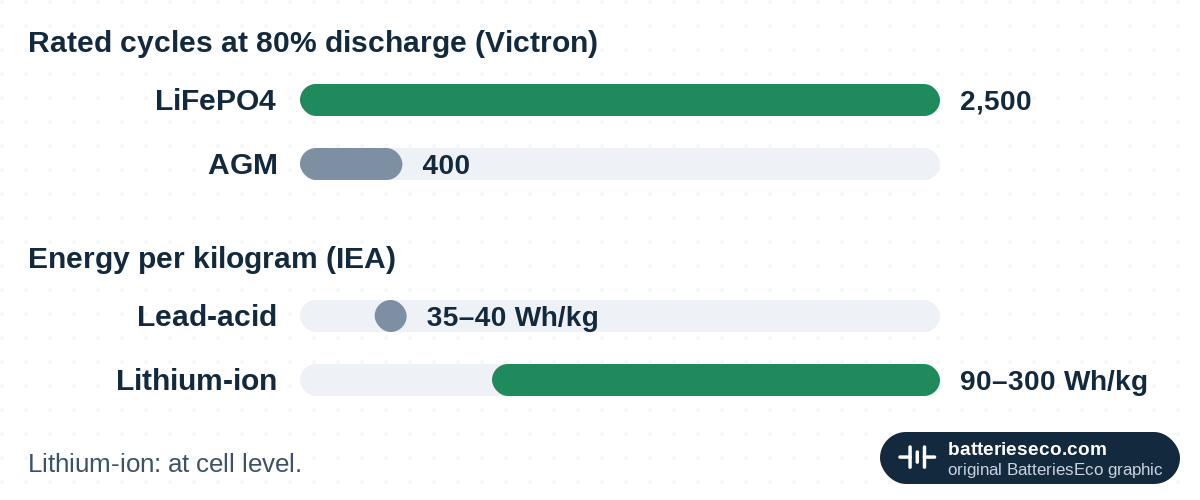
Our reading of the figures below: in the lithium vs AGM choice, a LiFePO4 battery gives you more usable capacity and far more cycles at close to half the weight. Lead-acid costs less up front.
Victron’s own pair shows the cycle gap. The maker gives its Lithium Battery Smart (LiFePO4, or LFP) 2,500 cycles at 80% depth of discharge, to 80% of nominal capacity 1, and its AGM deep-cycle battery 400 cycles at 80% discharge 2.
How flooded, AGM and gel batteries differ
Flooded (wet), AGM and gel batteries are the three main kinds of lead-acid, and all three use lead plates and sulfuric acid. A flooded battery holds its acid as a liquid, an AGM (absorbent glass mat) battery soaks it into fiberglass mats and a gel battery thickens it into a gel.
Flooded batteries need their water topped up regularly, while sealed (valve-regulated) gel and AGM batteries need no water and no special ventilation, according to the International Renewable Energy Agency (IRENA) 3.
Sealed doesn’t mean they never vent: IRENA says the valve releases gas once the pressure inside passes 100 millibars 3. Trojan says its AGM and gel batteries still release gas, though much less than flooded ones, and that batteries must be charged in a properly ventilated area 4.
Germany’s auto club ADAC explains that a sealed, maintenance-free starting battery recombines hydrogen and oxygen inside the cell and vents excess pressure through a channel, which should be routed outside 5.
Deep-cycle or starting battery?
A starting battery (SLI, for starting, lighting and ignition) is built for short bursts of high current. Starting a car typically takes less than 5% of its capacity, according to battery maker Optima 6.
Deep-cycle use typically discharges 60% to 70% or more. An SLI battery used that way wears out faster the deeper it’s cycled 6.
As we read it, “deep cycle” describes how a battery is built and used, not its chemistry: Victron sells AGM and gel deep-cycle batteries 2, and a LiFePO4 battery can be discharged almost completely 5.
How much of each battery you can actually use
The amp-hour (Ah) rating printed on a battery doesn’t tell you how much you can take out. According to ADAC, a full discharge often damages a lead-acid battery.
ADAC says only 30% to 75% of a lead-acid battery’s capacity should be used, depending on the type and the discharge current 5:
- no more than 30% for a standard sealed, maintenance-free (starting-type) battery
- 55% for an EFB (enhanced flooded battery)
- occasionally over 70% for a gel battery
A LiFePO4 battery, by ADAC’s account, can be discharged almost 100% 5.
For large stationary lead-acid batteries, Pacific Northwest National Laboratory (PNNL) also says it may be advisable to limit depth of discharge to 80%, to avoid long periods below 20% charge, which cause irreversible sulfation 7.
How fast you discharge matters too. PNNL notes that most lead-acid amp-hour ratings are for a 50- to 100-hour discharge, so less of the rated capacity is available at higher rates 7.
For the stationary batteries it studied, usable capacity is at most 61.0% for a 2-hour discharge, 70.6% over 4 hours and 86.2% over 10 hours 7. Victron rates its AGM and gel batteries at the 20-hour rate 2.
The German RV magazine promobil fully drained one battery of each type on an RV load profile, in a test published in May 2024 8:
| promobil test | Rated | Delivered | Lasted |
|---|---|---|---|
| AGM | 120 Ah | 72 Ah | 1 day and 7 hours |
| LiFePO4 | 110 Ah | 110 Ah | 2 days and 6 hours |
Our calculation: the AGM’s 72 Ah is 60% of its rated capacity. That’s what it delivered in this test, not a safe depth of discharge.
Lead-acid voltage chart
A rested lead-acid battery’s voltage says more about its state of charge than a LiFePO4 battery’s does: LiFePO4’s open-circuit voltage curve is flat, which makes voltage-based estimates uncertain 9. Trojan says its batteries must sit idle for at least 6 hours, and preferably up to 24 hours, for an accurate reading 10. Its table for 12 V batteries:
| State of charge | Flooded | AGM | Gel |
|---|---|---|---|
| 100% | 12.73 V | 12.84 V | 12.84 V |
| 75% | 12.54 V | 12.66 V | |
| 50% | 12.10 V | 12.24 V | 12.36 V |
| 25% | 11.94 V | 12.00 V | |
| 0% | 11.64 V | 11.82 V |
Trojan lists flooded-battery voltages in 10% steps: 12.50 V at 80%, 11.81 V at 30% and 11.51 V at 10%, for example 10.
Our reading: these are Trojan’s values for its own batteries, and they only apply to a battery at rest, with no charge or load.
For a LiFePO4 battery, see the LiFePO4 voltage chart.
Cycle ratings and assumptions
| Battery | Rated or assumed cycles | Source |
|---|---|---|
| Victron AGM deep cycle | 400 at 80% discharge, 600 at 50%, 1,500 at 30%; no temperature, current or end-of-life capacity given | Manufacturer datasheet 2 |
| Victron gel deep cycle | 500, 750 and 1,800 at the same depths, with the same conditions missing | Manufacturer datasheet 2 |
| Victron Lithium Battery Smart (LiFePO4) | 2,500 at 80% depth of discharge, 3,000 at 70%, 5,000 at 50%, to 80% of nominal capacity; no temperature or current given | Manufacturer datasheet 1 |
| Stationary lead-acid, 2 V cells | 1,370 at 80% depth of discharge, to 80% of rated energy; half that for 12 V modules | PNNL assumptions, 2022 7 |
Our calculation, assuming one cycle to 80% discharge every day: Victron’s AGM would reach its rated 400 cycles at 80% discharge in just over 13 months (400 × 12 ÷ 365). Its LiFePO4 Smart would reach 2,500 cycles at 80% depth of discharge in just over 82 months (2,500 × 12 ÷ 365).
Across the stationary storage products it reviewed in 2017, IRENA put lead-acid at 250 to 2,500 equivalent full cycles, compared with 500 to 20,000 for lithium-ion cells 3. According to PNNL, 2 V lead-acid cells at 80% depth of discharge deliver, over their lifetime, 57% of the energy an LFP battery does under the same conditions 7.
Round-trip efficiency and charge times
Some of the energy you put into a battery never comes back out. IRENA gives flooded lead-acid a round-trip efficiency of 70% to 90%, and lithium-ion cells a central range of 92% to 96% 3. Victron puts its LiFePO4 Smart batteries at 92% and an average lead-acid battery at 80% 1.
Our calculation, on Victron’s figures: if your solar panels put 1,000 Wh into the battery over a day, you get 920 Wh back from its LiFePO4 Smart and 800 Wh from an average lead-acid battery.
Victron also says lead-acid charging gets especially inefficient above 80% charge 11. In solar systems run between 70% and 100% charged, it puts efficiency at 50% or less 11. That’s a manufacturer’s claim with no published test method.
The charge times below are manufacturers’ figures, not test results. Mastervolt says the last 20% of charge takes around four hours with flooded, gel and AGM batteries 12. It caps the charge current at 50% of capacity for its gel batteries and 30% for its AGM ones 12.
For its Lithium Battery Smart, Victron recommends a charge current of 0.5C, a current of half the rated amp-hours: 50 A on a 100 Ah battery 13. At that current, it says, an empty battery is recharged in 2 hours, and absorption takes 2 more 13.
Our calculation: that’s 4 hours from empty to the end of absorption (2 + 2) for the Victron lithium battery, close to the time Mastervolt gives for just the last 20% of a lead-acid charge.
How much lighter is lithium?
Per kilogram, lead-acid batteries store 35 to 40 Wh, the International Energy Agency (IEA) says in its 2024 report, compared with about 90 to 300 Wh/kg at cell level for lithium-ion batteries 14. Two batteries from one maker show the gap.
Victron’s 12 V 90 Ah AGM deep-cycle battery weighs 27 kg (about 60 lb) 15. Its 12.8 V 100 Ah LiFePO4 Smart, rated at 1,280 Wh, weighs 14 kg (about 31 lb) 16.
Our calculation: that’s about 40 Wh/kg for the AGM (90 Ah × 12 V ÷ 27 kg) and 91 Wh/kg for the lithium battery (1,280 Wh ÷ 14 kg). So the lithium battery is about half the weight for the same rated energy.
As we read it, the gap is wider still for the same usable energy.
Lithium and lead-acid in the cold
Both chemistries lose capacity in the cold. Victron rates its 100 Ah LiFePO4 Smart, discharged at up to 1C (a current equal to the rated amp-hours, 100 A here), at 80 Ah at 32 °F (0 °C) and 50 Ah at −4 °F (−20 °C) 17.
Universal Power Group’s datasheet for its small UB1270 AGM gives 85% of its capacity at 32 °F (0 °C) and 65% at 5 °F (−15 °C) 18. Trojan says that at 0 °F (−18 °C) its lead-acid batteries deliver 50% of their capacity, compared with 100% at 80 °F (27 °C) 4.
Our reading: the bigger difference is charging, and it depends on the model.
Victron only allows its LiFePO4 Smart batteries to charge at 41 °F (5 °C) and above 17. Liontron’s datasheet allows its LX 100 Ah to charge at 32 °F (0 °C) and above 19.
On the lead-acid side, the UB1270 AGM may be charged from 32 °F to 104 °F (0 °C to 40 °C) 18. Mastervolt says its gel and AGM batteries shouldn’t be charged below −4 °F (−20 °C) 12.
Storage and self-discharge
Lead-acid batteries don’t like sitting discharged. According to IRENA, flooded batteries sulfate if stored discharged for a long time, and sealed gel and AGM batteries shouldn’t be stored discharged either 3.
Trojan says its batteries should never be stored unless fully charged 4. Victron says an LFP battery, by contrast, doesn’t need to be fully charged the way lead-acid does 11.
Lead-acid also discharges on the shelf: under 2% a month at 68 °F (20 °C) for Victron’s AGM and gel batteries, doubling with every 18 °F (10 °C) rise 2. Victron rates its Lithium NG LiFePO4 batteries at no more than 3% a month at 77 °F (25 °C) 20.
What they cost
Up front, lead-acid costs less. In promobil’s May 2024 article, a typical 95 Ah AGM cost about 170 euros in Germany and a LiFePO4 of similar capacity about 900 euros 8. These are rough German prices from 2024, with no model or terms given.
For large US grid systems, PNNL estimated in 2022 that lead-acid’s levelized cost of storage was high because of its low cycle life 21.
Our reading: to compare batteries on the market, you need three numbers from their datasheets: the usable energy per cycle, the rated cycles at that depth of discharge and the price. Our kWh guide shows how to turn amp-hours into watt-hours.
Replacing a lead-acid battery with LiFePO4
Our reading: replacing a lead-acid battery with a LiFePO4 takes more than a new battery. Check these first:
- The charger. Lead-acid chargers can damage its batteries, Super B says, and it tells you not to use them 22. Liontron’s LX series manual allows one only if it’s set to the right voltage and has no desulfation mode 23.
- The alternator, in a vehicle. ADAC says a DC-DC (battery-to-battery) charger is practically mandatory when the starting battery is lead-acid 5. On Victron’s account, a lithium battery’s low internal resistance makes the alternator deliver a high current 24.
- Mixing batteries. Liontron’s manual says a LiFePO4 battery should never be connected directly to a lead-acid battery 23. Renogy’s manual for its Core Series 100 Ah Mini says not to connect batteries of different chemistries in parallel or in series 25.
Which battery fits which use
Our reading of the figures above:
- LiFePO4 for daily use or deep cycling, as in a home battery, an off-grid cabin or an RV you use often. It gives more usable energy, far more cycles, about half the weight and fast charging.
- Lead-acid (AGM or gel) for a small load, a battery you rarely use or a tight budget, as long as you keep it charged between uses. A flooded battery also needs its water level checked.
In our view, LiFePO4 also asks for a charger and a charging setup suited to it (see the checklist above). If the battery sits in the cold, you need a way to charge it there too: some, like Victron’s Lithium Battery Smart, only charge at 41 °F (5 °C) and above.
If LiFePO4 is your pick, our LiFePO4 guide goes deeper into that chemistry. The other battery guides are in our batteries section.
Sources
- Lithium Battery 12,8V & 25,6V Smart datasheet
- Gel and AGM Batteries datasheet
- Electricity Storage and Renewables: Costs and Markets to 2030
- User’s Guide: Trojan deep-cycle flooded, AES, AGM and gel batteries (2023005), sections 3.8, 5, 6 and 7
- Nachrüstung von Stromspeicher- und Ladelösungen für Campingfahrzeuge (33109 BOE)
- OPTIMA Batteries, « Deep-Cycle vs. Starting Batteries » (FAQ, EMEA site)
- 2022 Grid Energy Storage Technology Cost and Performance Assessment (Energy Storage Grand Challenge Cost and Performance Assessment 2022, PNNL-33283)
- AGM- vs. Lithiumakku: Welche Wohnmobil-Bordbatterie ist besser?
- Advancing SOC estimation in LiFePO4 batteries: Enhanced dQ/dV curve and short-pulse methods
- User’s Guide: Trojan deep-cycle flooded, AES, AGM and gel batteries (2023005), Table 7 and section 9.4
- Batteries Lithium Battery Smart 12,8 et 25,6 volts (fiche technique, FR)
- Charging batteries (technical background page)
- Lithium Smart Battery Manual, rev 21 - 01/2026 (EN)
- Batteries and Secure Energy Transitions (World Energy Outlook Special Report), sections 1.2, 2.3.2 and 2.3.6
- Gel and AGM Batteries datasheet
- 12,8 & 25,6 Volt Lithium-Iron-Phosphate Batteries Smart — datasheet (EN)
- Lithium Battery 12,8V & 25,6V Smart datasheet
- UB1270 Sealed Lead-Acid Battery (AGM) datasheet, UPG No. 40800
- Datenblatt LIONTRON LiFePO4 Smart BMS 12,8V 100Ah (LISMART12100LX) and 12,8V 100Ah Arctic (LISMART12100LX-A)
- Batteries Lithium NG 12,8, 25,6 et 51,2 V — fiche technique (FR)
- 2022 Grid Energy Storage Technology Cost and Performance Assessment (Energy Storage Grand Challenge Cost and Performance Assessment 2022, PNNL-33283)
- Usage & Maintenance Manual: charging and storage instructions applicable to Super B energy and starter batteries (Version V1.0, January 2026)
- Bedienungsanleitung Lithium LiFePO4 Batterien LX Smart BMS Serie 12,8V
- Orion XS 12/12-50A DC-DC battery charger – manual (2 General; 3.3 Cable and fuse recommendations; 6 Technical data)
- RENOGY Core Series 12.8V 100Ah Mini Lithium Iron Phosphate Battery w/Self-heating Function (RBT12100LFP-H) User Manual, version A0, November 25, 2024 (EN/DE)