What is a kWh? Kilowatt-hours, watt-hours and amp-hours, explained
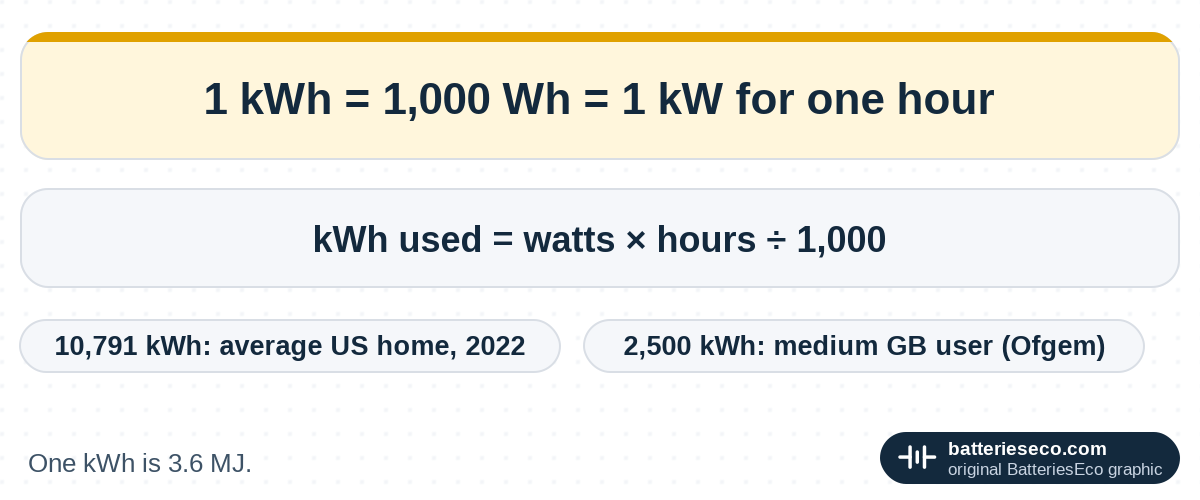
A kilowatt-hour (kWh) is a unit of energy: 1,000 watt-hours, or one kilowatt sustained for one hour. To find how many kWh something uses, multiply its power in watts by the hours it runs, then divide by 1,000. It’s the unit your utility bills you by, and the one to use when you compare batteries.
Energy, not power
A watt (W) measures power: how fast a device is using electricity at a given moment. A watt-hour (Wh) measures energy, the amount used over time. One watt-hour is one watt used for one hour.
A kilowatt-hour is 1,000 watt-hours, or one kilowatt running for an hour 1 2. One kWh equals 3.6 million joules (3.6 MJ) 2, and the joule is the SI unit of energy 3. For how volts and amps combine into watts, see our electricity basics overview.
The difference matters when you shop for a battery or a portable power station. A portable power station’s spec sheet usually gives both numbers. The capacity in Wh tells you how long it can run your devices.
The output in watts tells you how much power it can deliver at once. A power station with a high output but a small capacity can run a heater only briefly. One with a large capacity but a low output can keep a laptop going for a long time, yet can’t run the heater at all (our reading of the two units).
How to calculate kWh
Energy in watt-hours = power in watts × time in hours. Divide by 1,000 to get kilowatt-hours. The US Energy Information Administration (EIA) gives this example: a 40-watt bulb left on for five hours uses 200 Wh, or 0.2 kWh 1.
A few more examples, calculated the same way (our calculation):
- A 1,500 W heater running flat out for two hours uses 3 kWh
- A 10 W LED bulb on for 100 hours uses 1 kWh
- A device that draws 1 W around the clock uses 8.76 kWh a year (8,760 hours)
That last example is why small always-on loads add up. A fridge cycles on and off, so the wattage on its label says little about its daily use. An annual kWh figure, if the manufacturer lists one, is a better guide (our reading).
Watt-hours and amp-hours
Battery capacity is also given in amp-hours (Ah). An amp-hour figure on its own isn’t energy: you need the voltage too. Because a watt is a volt times an amp 3, watt-hours = amp-hours × volts (our reading of the unit definitions).
- A 100 Ah lithium iron phosphate (LiFePO4) battery sold as a “12-volt” battery is really 12.8 volts nominal: four 3.2 V cells in series, according to Victron 4. It stores 100 × 12.8 = 1,280 Wh, or 1.28 kWh (our calculation)
- The same 100 Ah at 25.6 V, the “24-volt” version with eight cells 4, holds twice as much: 2,560 Wh (our calculation)
- Phone power banks are rated in milliamp-hours (mAh). Divide by 1,000 to get Ah. Then multiply by the battery’s nominal voltage, not the USB output voltage: 10,000 mAh at 3.7 V works out to 37 Wh (our calculation)
So two batteries with the same Ah rating can store very different amounts of energy. Compare batteries in Wh or kWh, or in Ah only when their voltages match.
How many kWh does a home use?
In the United States, residential customers bought about 863 kWh of electricity a month on average in 2024, according to the EIA 5. EIA’s FAQ on home electricity use gives an annual figure for 2022: 10,791 kWh, or about 899 kWh a month.
Louisiana was highest at 14,774 kWh a year and Hawaii lowest at 6,178 kWh 6. These are purchases from the utility: a home with net-metered solar panels can use a lot more electricity than it buys 6.
In Great Britain, the energy regulator Ofgem uses typical consumption figures to show typical annual bills under its price cap. From July 1, 2026, a medium user on a standard single-rate meter is assumed to use 2,500 kWh a year (1,600 for a low user, 3,800 for a high user).
A medium user on a multi-rate meter, such as Economy 7, is assumed to use 3,400 kWh 7. These are benchmarks for comparing bills, not a measured average for any one home 7.
What a kWh costs
Utilities bill electricity by the kilowatt-hour. In the United States, the average residential price in August 2026 was 18.16 cents per kWh, a preliminary figure from the EIA. It varied widely by state that month, from 12.72 cents in Nevada to 47.18 cents in Hawaii 8.
In England, Scotland and Wales, from October 1 to December 31, 2026, the price cap for a default tariff paid by Direct Debit averages 26.32 pence per kWh for electricity, plus a standing charge of 54.83 pence a day. No VAT applies to electricity during that period 9.
How to write kWh correctly
The symbol is kWh: a lowercase k for kilo (1,000), a capital W because the watt is named after a person, and a lowercase h for hour. These follow the style rules of the International System of Units (SI) 3.
Strictly speaking, the rules separate two multiplied units with a space or a centered dot, so kW h or kW·h; kWh, without the space, is the form Eurostat and the EIA use 2 1. Watch out for kW/h: a slash means “per,” so it would describe a change in power per hour, not an amount of energy (our reading).
Sources
- Electricity explained: Measuring electricity
- Glossary: Kilowatt-hour (kWh) — Statistics Explained
- Le Système international d’unités (SI), 9e édition 2019, version V4.01 (juin 2026), §5.4 (écriture des symboles), tableaux 4, 7 et 8
- Lithium Battery 12,8V & 25,6V Smart datasheet
- Electric Sales, Revenue, and Average Price, Table 5A: 2024 Average Monthly Bill - Residential
- How much electricity does an American home use? (EIA FAQ)
- Review of typical domestic consumption values: decision
- Electric Power Monthly, Table 5.6.A. Average Price of Electricity to Ultimate Customers by End-Use Sector, by State, August 2026 and 2025
- Changes to energy price cap between 1 October and 31 December 2026