Portable power stations: what they are, what a "solar generator" is and what to check
A portable power station packs a battery, an inverter and its own chargers into a single unit: you charge it from an outlet, a car or solar panels, then plug your appliances into it. A "solar generator" is a marketing name makers use for a power station sold with solar panels, not a fuel generator. Check two numbers: the capacity in watt-hours tells you how long it runs, and the output in watts tells you what it can power at once.
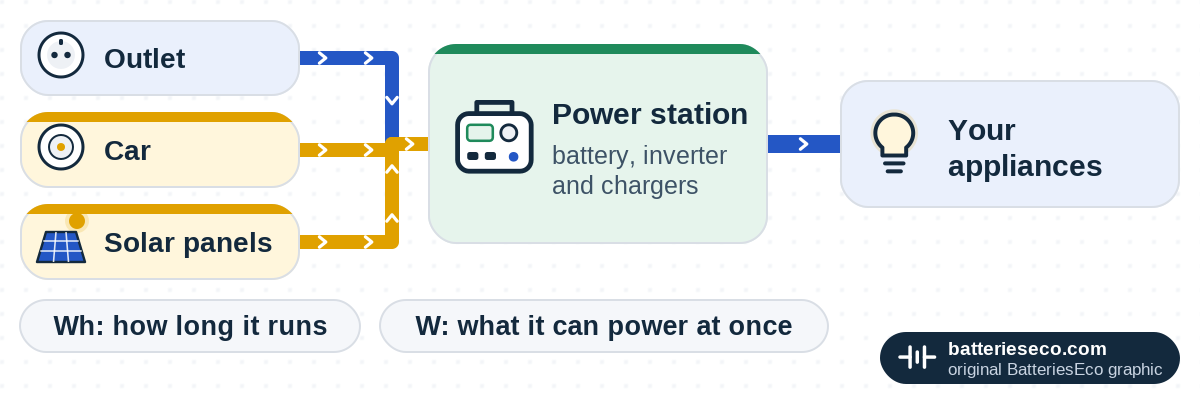
What’s inside a portable power station
Open up a portable power station and you’d find a battery, an inverter that makes household AC power, and the chargers that refill the battery. According to its manual, EcoFlow’s DELTA 3 Plus pairs a 1,024 Wh LFP (lithium iron phosphate, or LiFePO4) battery with up to 1,800 W from its 120 V outlets in the US 1. Bluetti lists 1,152 Wh and an 1,800 W pure sine wave inverter for its AC180 2.
The "solar generator" name
Makers often sell these with solar panels as a “solar generator.” EcoFlow defines a solar generator as one or more solar panels combined with a battery, with an inverter turning the stored DC into AC 3. Jackery’s US page for the Explorer 1000 v2 uses the same name 4.
Our reading: a solar generator burns no fuel. It’s a power station plus panels, so you recharge it rather than refuel it.
Watt-hours, watts and what you actually get
The capacity in watt-hours (Wh) tells you how long the station can run your devices, and the output in watts (W) tells you how much it can power at once, as our kWh guide explains. To turn those two numbers into hours for your own appliances, try our runtime calculator.
You get less than the rated capacity. In 2025, Germany’s auto club ADAC tested eight European (230 V) power stations from 768 to 1,440 Wh 5, all with LFP cells 6. Their usable capacity was on average 10% to 15% below the maker’s figure, or a little more, and some of their built-in inverters alone drew up to about 30 W when switched on 5.
Our calculation: an inverter drawing 30 W, left on for a full day with nothing plugged in, uses 30 × 24 = 720 Wh. That’s nearly all of the 768 Wh rating of the smallest station ADAC tested.
Ways to recharge it
Most stations charge from a wall outlet, a car outlet and solar panels. EcoFlow’s manual gives the DELTA 3 Plus up to 1,500 W from a US outlet and up to 500 W per solar port, 1,000 W in total 1. Our charging guide covers the LiFePO4 batteries used in many of them.
Switching over when the power fails
Some stations work as an uninterruptible power supply (UPS): plugged into the wall, they switch a device to battery when the power fails. EcoFlow lists a 10 ms switchover for the DELTA 3 Plus 1, and StorageReview measured just over 8 ms on a US unit 7. Bluetti quotes 20 ms or less for the AC180 and recommends testing the feature before you rely on it, to avoid data loss 2.
Our reading: if you’d use a station to keep a computer or a modem going through an outage, check its switchover time before you buy. Our guide to choosing a power station explains what those milliseconds mean for a computer.
Is it safe?
According to UL Standards & Engagement’s page for Edition 3 (published September 24, 2025), the UL 2743 standard covers portable power packs in the US and Canada, including their built-in inverters and their charging 8.
As we read it, ask the seller whether a station carries that listing before you buy.
In 2025, the UK’s Office for Product Safety and Standards reported two power station imports rejected at the border for electrical faults. One had socket-outlets that didn’t meet BS 1363 and left live parts within reach 9; the other’s sockets were unearthed (ungrounded) when it ran on battery 10.
The LFP cells used in all eight stations ADAC tested 6 can still go into thermal runaway 11, overheating that feeds on itself. What to watch for is in our lithium battery fire safety guide.
All the guides in this section
Sources
- EcoFlow DELTA 3 Plus User Manual (English, multi-region, examples based on the US version; PDF linked from manuals.ecoflow.com/us)
- BLUETTI AC180 Portable Power Station User Manual (multi-region table JP/US/CN/EU/UK/AU; PDF linked from bluettipower.com/pages/user-guides)
- Générateur solaire EcoFlow (EcoFlow France page /pages/solar-generators, read 2026-10-30)
- Jackery Portable Power Station Explorer 1000 v2 (US product page, jackery.com: headline, tech specs, kits)
- Mobile Powerstations im ADAC Test: Nur die Hälfte schneidet gut ab
- Mobile Powerstations 2025: per-model test result pages (Bluetti AC180P, Ecoflow Delta 3 Plus, Allpowers R1500, Anker Solix C800 Plus, DJI Power 1000, Fossibot F1200, Jackery Explorer 1000 v2, Ective BlackBox 10)
- EcoFlow DELTA 3 Plus Review (StorageReview, 2 January 2025)
- UL 2743 Portable Power Packs (product page with scope and summary of topics, UL Standards & Engagement standards shop)
- Product Safety Report: VTOMAN FlashSpeed 1000 Portable Power Station sold via Amazon (2506-0145)
- Product Safety Report: AFERIY Portable Power Station (2505-0172)
- Profil de risque des batteries Li-ion LFP (Ineris-213996-2761939-v1.0)