How to choose a portable power station: capacity, output, chemistry, UPS and storage
Size a portable power station by its watt-hours for how long it runs and its watts for what it can power at once, including start-up surges. Expect about 10% to 15% less usable energy than the label says, a bigger shortfall at very light loads and some idle draw from the inverter.
Look for LFP cells, the charging inputs you’ll use and outlets that meet your country’s rules. If you need a UPS, check that its switchover is fast enough for your devices, and follow the maker’s storage advice.
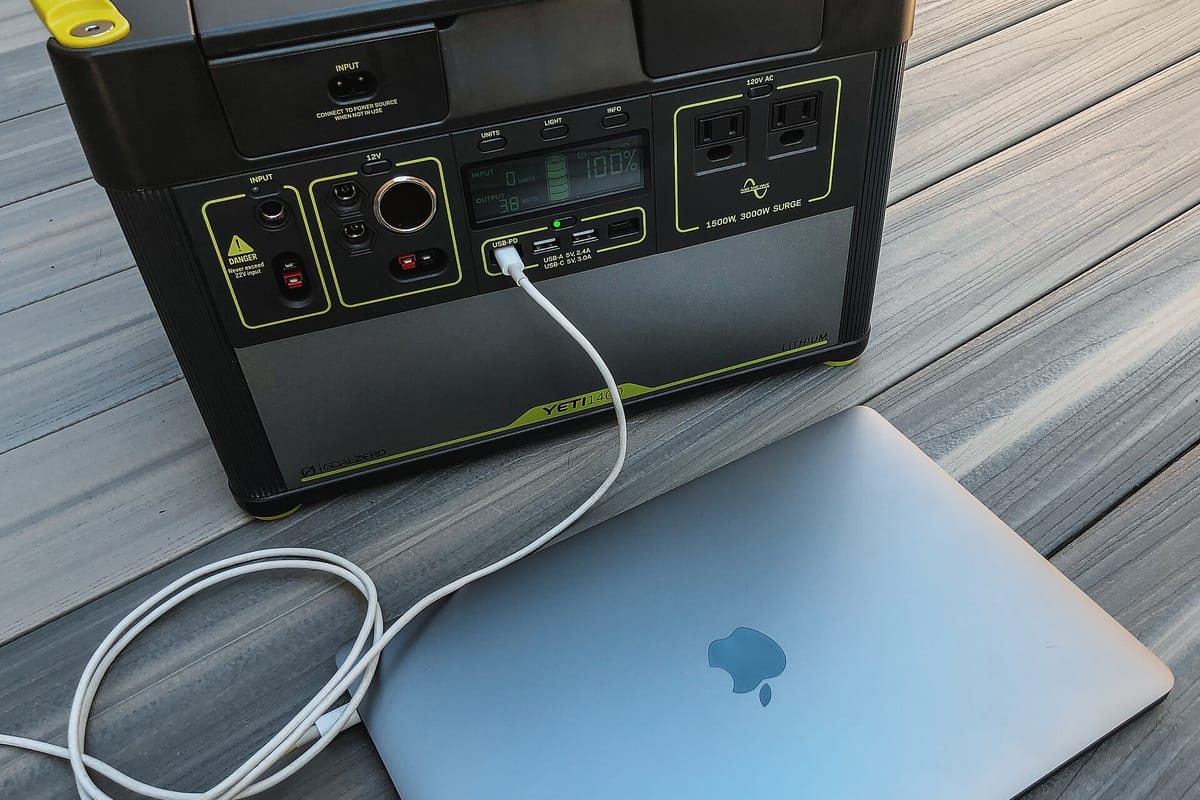

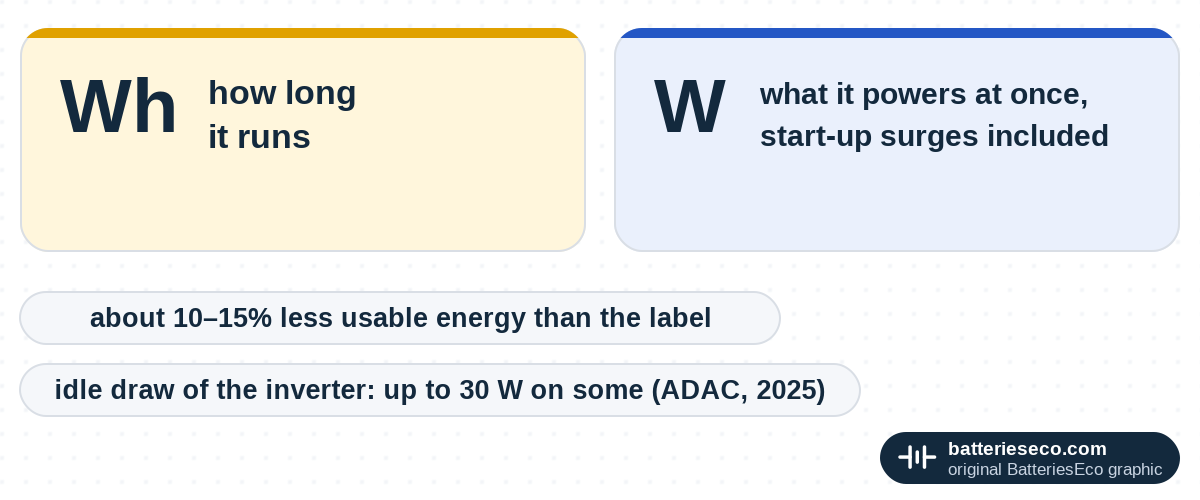
Before you buy a portable power station, compare its watt-hours (Wh) with how long you need power and its watts (W) with what you’ll plug in at once. Then allow for losses. In its 2025 test of eight stations, Germany’s auto club ADAC found usable capacity on average 10% to 15% below the maker’s figure, or a little more, and some built-in inverters drew up to about 30 W on their own 1.
Capacity, output and start-up surges
- Output and surge: EcoFlow rates its DELTA 3 Plus at 1,800 W total AC output with a 3,600 W surge, at 120 V for the US and Canada 2. Bluetti rates its AC180 at 1,800 W with a 2,700 W surge 3. Bluetti’s manual warns that some devices with a motor or compressor can draw 2 to 4 times their rated power at start-up 3.
- Capacity: Jackery’s US page for the Explorer 1000 v2 lists 1,024 Wh in its headline but 1,070 Wh (30.4 Ah at 35.2 V) in its tech specs 4.
Our reading: check both numbers against what you’ll plug in. For anything with a motor or compressor, compare 2 to 4 times its rated power with the surge figure, not the continuous output. When a product page disagrees with itself, go by the technical specifications and the manual.
Our runtime calculator estimates how many hours a station will run the appliances you enter.
Why you get less than the label says
The eight stations ADAC tested ranged from 768 to 1,440 Wh 1. ADAC, which bought its test units anonymously, says usable capacity is always lower than the rated figure 5.
Our calculation: if the label’s capacity would keep a device running through a 10-hour night, 10% to 15% less energy stops it after about 8.5 to 9 hours (10 × 0.85 and 10 × 0.9), or a little sooner.
Very light loads can fare even worse. In a 2023 test of one small 151 Wh station, the German tech site heise measured 108 Wh at about 100 W but only 74 Wh when charging a power bank and a phone 6.
Power the inverter uses by itself
Switching on the AC outlets costs energy even with nothing plugged in. ADAC measured up to about 30 W for some stations’ built-in inverters alone 1. Turn the AC outlets off when you’re not using them, as ADAC advises 5.
Our calculation: at 30 W, AC outlets left running over a 48-hour weekend use 30 × 48 = 1,440 Wh. That’s the rating of the largest station in ADAC’s test.
Bluetti lists about 15 W of idle draw for its AC180 3. Anker’s French product page claims, based on Anker’s own tests, 10 W of standby draw for the SOLIX S2000 7.
In our view, most of the maker documents we read don’t give this figure.
LFP cells and cycle life
All eight stations in ADAC’s 2025 test used LFP cells 8. Makers rate their cycle life under their own conditions.
According to its manual, which gives no test conditions, the EcoFlow DELTA 3 Plus keeps 80% or more of its capacity after 4,000 charge cycles 2. Jackery rates the Explorer 1000 v2 at 4,000 cycles to 70% or more of its capacity 4. Our LiFePO4 guide explains why LFP cells usually last more charge cycles than NMC and NCA cells.
Charging times and weight
| Station (US edition) | Battery | AC charging | Solar input | Weight | Source |
|---|---|---|---|---|---|
| EcoFlow DELTA 3 Plus | 1,024 Wh LFP | Up to 1,500 W from a 100-120 V outlet | 500 W per port, 1,000 W total (11-60 V) | About 27.6 lb (12.5 kg) | Manufacturer’s manual 2 |
| Bluetti AC180 | 1,152 Wh LiFePO4 | Up to 1,440 W at 120 V (at 50 °F to 86 °F) | 500 W (12-60 V, 10 A max) | About 36 lb (16.4 kg) | Manufacturer’s manual 3 |
| Jackery Explorer 1000 v2 | 1,070 Wh LiFePO4 (tech specs) | 1.58 hours on its AC adapter, per Jackery | Two 8 mm inputs, 400 W max combined | About 23.8 lb (10.8 kg) | Manufacturer’s product page 4 |
For the Explorer 1000 v2, Jackery gives 1.58 hours on AC (about an hour and 35 minutes), and 7.5 hours on solar in the specs of its kit with a SolarSaga 200W panel, without saying how much sun 4.
In our view, charging times on product pages can come without test conditions. If a solar panel will be your only charger on a camping trip, don’t count on a solar charging time that doesn’t state its sun conditions.
Using it as a UPS for a computer or modem
In UPS mode, the station sits between the outlet and your device and switches to battery when the power fails. The switchover time matters.
In 2023, StorageReview measured switchover times of about 8.7 ms to about 38.5 ms on six power stations, one unit each, with an idle workstation as the load 9. It notes that many desktop computers are designed with a minimum hold-up time of 16 ms 9, meaning how long the power supply keeps the computer running after the power drops. It advises testing devices first with stations that switch in 13 to 16 ms 9.
Our reading: if you want a desktop computer to stay on when the power fails mid-task, compare a station’s switchover figure with that 16 ms before you rely on it.
In a 2025 review of one US EcoFlow DELTA 3 Plus, StorageReview measured just over 8 ms, compared with EcoFlow’s listed 10 ms 10. DJI says the UPS function of its Power 1000 V2 doesn’t support 0 ms switching and must not be used with devices that need it, such as medical equipment 11.
Safety listings and recalls
In the US and Canada, UL 2743 is the standard for portable power packs, including their built-in inverters and charging 12.
Our reading: none of the three US maker documents we read shows a UL 2743 listing, so ask the seller or check the certifier’s listing directory.
In the UK, a July 2025 Office for Product Safety and Standards report records that a VTOMAN FlashSpeed 1000 power station was rejected at the border because live parts could be reached through socket-outlets that didn’t meet BS 1363, the UK plug-and-socket standard 13. A June 2025 report records another border rejection: an AFERIY station whose sockets weren’t marked Class II (double-insulated) and were unearthed (ungrounded) when it ran on battery 14.
Big brands get recalled too. In October 2025, Health Canada published a recall of the EcoFlow Delta Max 2000 sold in Canada because it may overheat and catch fire; the fix is a free firmware update 15.
Apps and auto-off timers
Some stations are controlled from an app, such as DJI’s Power 1000 V2, which connects to the DJI Home app over Bluetooth and Wi-Fi 11. By default its AC output switches off if it powers nothing for more than 30 minutes, and the timer can be changed in the app 11. Holding the AC button keeps it on for loads that cycle on and off, like a fridge 11.
Storing it between uses
Three makers, three sets of storage advice:
- Bluetti says to charge the AC180 to 40% to 60% and store it powered off if it won’t be used for more than 3 months 3.
- Anker’s guide for the SOLIX C1000 says to keep it charged and top it up to 100% every 3 months 16.
- DJI advises storing the Power 1000 V2 at about 60% for long periods 11.
As we read it, they don’t agree, and your own station’s manual is the one to follow. Our batteries section covers what wears a battery out in storage, and our power stations section explains what a power station is and what makers mean by a “solar generator.”
Sources
- Mobile Powerstations im ADAC Test: Nur die Hälfte schneidet gut ab
- EcoFlow DELTA 3 Plus User Manual (English, multi-region, examples based on the US version; PDF linked from manuals.ecoflow.com/us)
- BLUETTI AC180 Portable Power Station User Manual (multi-region table JP/US/CN/EU/UK/AU; PDF linked from bluettipower.com/pages/user-guides)
- Jackery Portable Power Station Explorer 1000 v2 (US product page, jackery.com: headline, tech specs, kits)
- Mobile Powerstations im ADAC Test 2025: Nur die Hälfte schneidet gut ab (test method, buying tips)
- Flashfish E200 mit 200 Wh für 103 Euro – die günstigste Powerstation im Test (published 20.10.2023)
- Station électrique portable Anker SOLIX S2000 (product page, ankersolix.com/fr: highlights, footnotes and FAQ)
- Mobile Powerstations 2025: per-model test result pages (Bluetti AC180P, Ecoflow Delta 3 Plus, Allpowers R1500, Anker Solix C800 Plus, DJI Power 1000, Fossibot F1200, Jackery Explorer 1000 v2, Ective BlackBox 10)
- Portable Power Stations Actually Work Pretty Well as a UPS (StorageReview, 27 October 2023)
- EcoFlow DELTA 3 Plus Review (StorageReview, 2 January 2025)
- DJI Power 1000 V2 Guide d’utilisateur v1.0 (2025.07), French edition; DJI Power 1000 V2 Especificaciones and FAQ (dji.com, Spanish pages)
- UL 2743 Portable Power Packs (product page with scope and summary of topics, UL Standards & Engagement standards shop)
- Product Safety Report: VTOMAN FlashSpeed 1000 Portable Power Station sold via Amazon (2506-0145)
- Product Safety Report: AFERIY Portable Power Station (2505-0172)
- EcoFlow Delta Max 2000 Power Stations recalled due to risk of serious burn injury and fire hazard (RA-78357)
- Anker SOLIX C1000/C1000X Portable Power Station GUIDE DE L’UTILISATEUR (A1761)_FR (France) (Anker support article)