RV, camper van and boat power: house batteries, solar, shore power and inverters
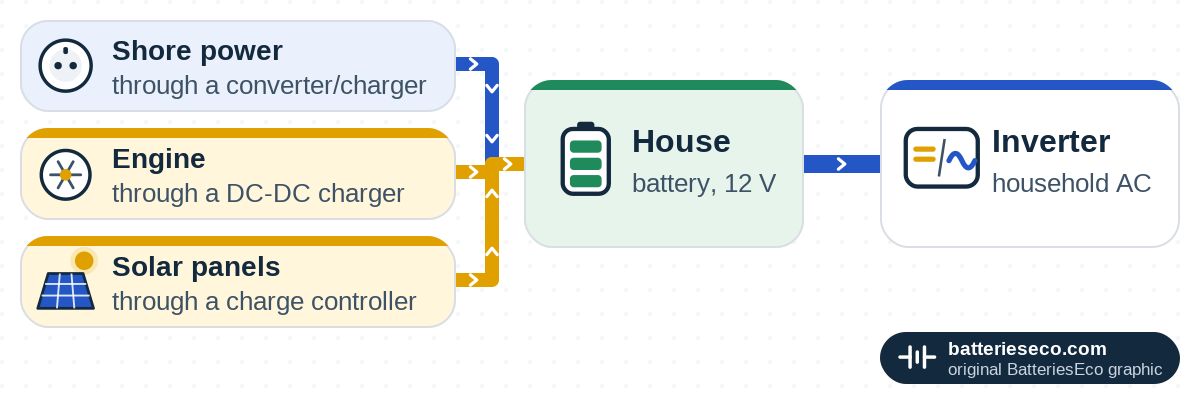
An RV, a camper van or a boat runs its lights, water pump and fridge controls from a house battery, usually 12 V, separate from the starting battery. You charge it from shore power through a converter/charger, from the engine (through a DC-DC charger with a lithium battery), or from solar panels through a charge controller, and an inverter makes household AC power from it. This section explains each part and what to check.
The house battery
The house battery is the one you live off when the engine is off and you’re not plugged in. Germany’s auto club ADAC says that, in practice, most lithium house batteries in vehicles are LiFePO4 with a built-in BMS.
It also says a LiFePO4 battery can be discharged almost 100%, while lead-acid should be discharged by only 30% to 75% of its capacity, depending on the type and the discharge current 1. Our RV batteries guide covers sizing, the BMS, charging and storage.
Charging the house battery
There are three main ways to charge a house battery (our reading):
- Shore power, through the RV’s converter/charger. WFCO says its auto-detect converters detect the battery type and charge a lithium battery at 14.6 V 2, while Progressive Dynamics says its PD9200 is a lead-acid charger not directly compatible with LiFePO4 3.
- The engine, through the alternator. With a lithium house battery and a lead-acid starting battery, ADAC says a DC-DC charger between the two is practically a must 1.
- Solar panels, through a charge controller. Our RV and van solar guide shows what a roof panel makes by season in US and UK cities.
Shore power
At a campground in the US or Canada, you plug into a pedestal. A 30 amp, 120 V service gives at most 3,600 W (30 A × 120 V) 4, and Southwire rates its 50 amp, 120/240 V surge protector at 12,000 W 5.
In the UK, campsite hookups are 230 V, and most Camping and Caravanning Club sites provide 16 A, according to the Club’s 2016 data sheet 6. Our shore power guide covers adapters, surge protectors and EMS units.
Household power from the battery
To run household appliances from the 12 V battery, you need an inverter. Our inverter guide explains pure sine vs modified sine, sizing and how much current an inverter pulls from a 12 V battery. A portable power station is the all-in-one alternative for a van without a built-in system.
Safety
Wiring a 12 V, 24 V or 48 V system, installing a shore power inlet or connecting an inverter to the battery is electrical work: these guides explain the choices and the checks, not the wiring. Have a qualified RV technician, marine electrician or electrician do it (our reading). Our lithium battery fire safety guide covers the warning signs of a battery in trouble.
All the guides in this section
Sources
- Nachrüstung von Stromspeicher- und Ladelösungen für Campingfahrzeuge (33109 BOE)
- Product Manual WF-9800-AD Deck Mount Converter Charger (Rev: 7/24); WFCO Frequently Asked Questions page
- Frequently Asked Questions (Progressive Dynamics, Inc.)
- RV Living On 30 Amps: Understanding Your RV’s Electrical System
- Installation & Operating Instructions, Surge Guard RV Power Protection, Model 34950 50A Portable / Model 34930 30A Portable (505-00152A)
- Data Sheet 30: Electricity for campers and caravanners, Using electricity on a campsite (revised March 2016)