RV and van solar: how much power you need, what a panel makes by season, and what to buy
Size RV or van solar from your daily use in watt-hours and the season you travel in. In our PVWatts and PVGIS runs, a 100 W panel lying flat makes about 550 to 615 Wh a day in June in Phoenix, Sacramento or Denver, but under 120 Wh a day in December in Boston and under 50 Wh in London.
An MPPT controller gets more from the panel than PWM, especially in cool weather.
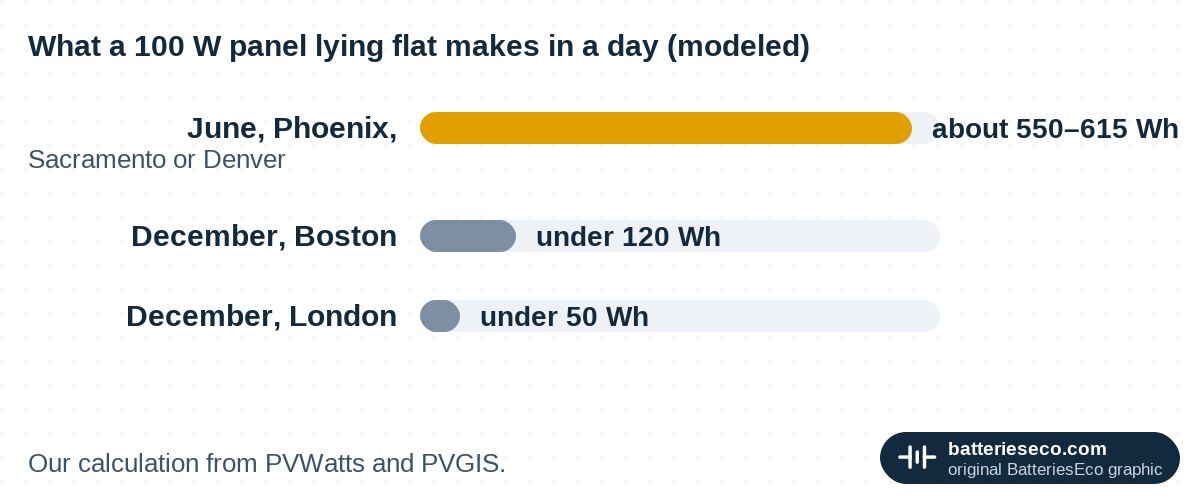
To size RV or van solar, compare your daily use in watt-hours with what a panel makes in the season you travel.
Our calculation from PVWatts and PVGIS runs, with the method under the table below: a 100 W panel lying flat makes 613 Wh a day in June in Phoenix. In a London December, it makes 46 Wh a day.
How a roof panel charges the battery
A solar panel makes DC power, and a charge controller regulates it for the battery. A panel sold as “12 V” actually runs at a higher voltage: Renogy specifies 18.6 V at maximum power for its RNG-100D-SS rigid 100 W panel and 20.7 V for its RNG-100DB-H flexible one 1.
Victron’s SmartSolar MPPT 75/10 to 100/20 controllers only start charging once the panel’s voltage is at least 5 V above the battery’s 2.
A panel doesn’t make 120 V or 230 V power: for that you need an inverter running off the battery. The battery, the converter and shore power are covered in our guides to RV, van and boat power.
How much solar does an RV need?
Our reading: start with your daily use, not your roof space.
- Add up your daily use in watt-hours. Multiply each appliance’s power by its hours of use. Our runtime calculator shows typical figures for a fridge and other loads.
- Check what 100 W of solar makes where and when you travel. The table below gives the daily output of 100 W of solar lying flat, as on an RV or van roof, for US and UK cities.
- Divide your daily use by that figure to get the panel power, and add some extra for cloudy stretches.
| Place | March | June | September | December |
|---|---|---|---|---|
| Phoenix, AZ | 433 Wh | 613 Wh | 442 Wh | 250 Wh |
| Sacramento, CA | 378 Wh | 615 Wh | 448 Wh | 155 Wh |
| Denver, CO | 397 Wh | 551 Wh | 405 Wh | 185 Wh |
| Austin, TX | 345 Wh | 503 Wh | 400 Wh | 229 Wh |
| Tallahassee, FL | 382 Wh | 439 Wh | 359 Wh | 229 Wh |
| Nashville, TN | 316 Wh | 460 Wh | 366 Wh | 170 Wh |
| Boston, MA | 335 Wh | 438 Wh | 339 Wh | 117 Wh |
| Olympia, WA | 219 Wh | 439 Wh | 297 Wh | 62 Wh |
| Plymouth, England | 230 Wh | 470 Wh | 276 Wh | 50 Wh |
| London, England | 210 Wh | 419 Wh | 254 Wh | 46 Wh |
| Manchester, England | 189 Wh | 378 Wh | 219 Wh | 34 Wh |
| Edinburgh, Scotland | 180 Wh | 374 Wh | 212 Wh | 22 Wh |
Our calculation: monthly output ÷ days in the month. US figures come from PVWatts version 8 (NSRDB typical-year weather), with 14% system losses and the panel flat and open-racked, as AC output after an inverter. UK figures come from PVGIS 5.3 (SARAH3 weather, 2005-2023 average), with 14% system losses, free-standing.
Both tools model a grid-connected system with an inverter. The PVWatts version 5 manual (2014) says so, and it puts default system losses at 14% 3.
For an off-grid PV and battery system, the PVGIS manual assumes a performance ratio of 0.67 instead, to include battery and inverter losses and component wear 4.
Our reading: these are typical or average months, and any given week can be much darker. What you can actually draw from the battery will also come in under the table’s figures.
Our calculation, for a camper van using 600 Wh a day in London and not counting the off-grid losses described above: about 145 W of flat panel covers June (419 Wh per 100 W). December, at 46 Wh per 100 W, would take about 1,300 W.
Our calculation for the same van heading south, again before off-grid losses: in Phoenix, about 100 W covers June (613 Wh). Even in December, a flat 100 W there makes 250 Wh a day, over twice Boston’s 117 Wh (250 ÷ 117 = 2.1).
Which charge controller for RV solar?
In Victron’s worked example, a PWM controller harvests 81 W from a 100 W, 36-cell panel charging a 13 V battery, 19% less than the 100 W an MPPT controller gets 5. That’s with the cells at 77 °F (25 °C). At 167 °F (75 °C), Victron finds the difference negligible 5.
In our view, MPPT matters most when the cells are cool, and the cooler months are also the ones where the table shows the least output.
Size the controller to the panels and the battery voltage. Renogy’s Rover Li MPPT controllers accept up to 100 V open-circuit from the panels 6. Renogy rates them for the solar power below 6.
| Rover Li model | Solar at 12 V | Solar at 24 V |
|---|---|---|
| 20 A | 260 W | 520 W |
| 30 A | 400 W | 800 W |
| 40 A | 520 W | 1,040 W |
Our calculation: the 1,300 W of flat panel from the London December example exceeds even what the 40 A model is rated for at 24 V (1,040 W).
Our reading: in a UK winter, plan another way to charge.
Victron’s SmartSolar manual warns that a panel’s open-circuit voltage rises below 77 °F (25 °C) 2.
As we read it, that means leaving headroom under the controller’s maximum.
Rigid or flexible panels
On its RV solar page (March 2026), Germany’s auto club ADAC quotes its technical expert, who recommends monocrystalline panels for RVs and sees semi-flexible panels as an option. He advises against fully flexible ones, which often break or develop other defects sooner or later 7.
Dirt costs output too: even with optimized cleaning, soiling cut global solar power production by at least 3% to 4% in 2018, according to one study 8.
Who should mount and wire the panels
Mounting panels means drilling into or bonding to the roof and running cables and fuses to the controller and battery. Some RV makers set roof-load limits. Dethleffs’ 2025 manual for its larger motorhomes (not its camper vans) gives a maximum roof load of 100 kg (about 220 lb) and says the roof isn’t designed for point loads 9.
In our view, check your RV’s manual and have the wiring done by a qualified installer.
Where all that solar ends up, the house battery, is the subject of our RV batteries guide.
Sources
- RNG-100DB-H 100W Flexible Monocrystalline Solar Panel datasheet (G3); RNG-100D-SS 100W Monocrystalline Solar Panel datasheet (V2.1); MTS-TMB Renogy Tilt Mount Bracket manual
- SmartSolar MPPT 75/10 up to 100/20 manual (technical specifications, installation); BlueSolar Monocrystalline Panels datasheet, current models; blog: Connecting different sized Victron Energy PV modules: series or parallel?
- PVWatts Version 5 Manual (Technical Report NREL/TP-6A20-62641)
- PVGIS 5 user manual
- Which solar charge controller: PWM or MPPT? (technical information)
- MPPT Solar Charge Controller Rover Li Series 12V/24V 20A/30A/40A (RNG-CTRL-RVR20/30/40) User Manual, Version B3
- Solaranlage fürs Wohnmobil: Darauf sollten Sie achten
- Techno-Economic Assessment of Soiling Losses and Mitigation Strategies for Solar Power Generation
- Bedienungsanleitung Motorcaravan 2025 (Dethleffs, Stand 24-07, DE)