Home solar and battery storage: how it works, hybrid vs AC-coupled, outage backup and lifespan
A home battery stores the solar power you don’t use during the day so you can use it in the evening, and it can also charge from the grid on a cheaper off-peak rate.
During a power shutoff, California’s utility regulator says a single-battery system can typically power priority appliances, such as the refrigerator, lights and a few outlets, for 24 to 48 hours. NREL’s 2025 Annual Technology Baseline assumes a 15-year lifetime for a representative home battery; Home Energy Scotland says batteries tend to last 10 to 15 years.
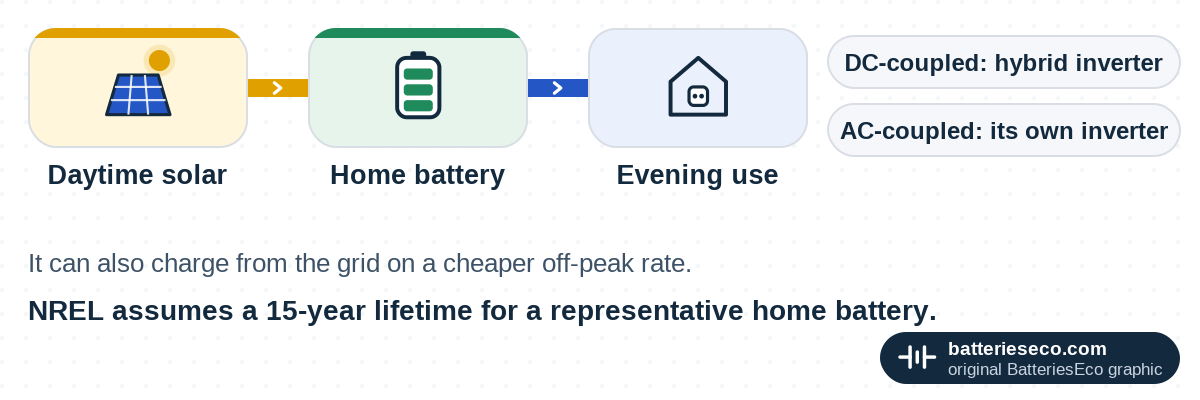
How a home battery works with solar
A home battery stores electricity for later use. With solar panels, it saves the midday surplus for the evening or early morning. It can also charge from the grid off-peak on a smart tariff (a time-of-use rate in the US), according to the UK government’s campaign page on home batteries 1.
The US Department of Energy defines solar-plus-storage as a battery charged by a connected solar system, so you can use solar power at night or during an outage 2.
In the UK, using the stored power often saves more than selling the surplus back to the grid, the government page says. But the benefit depends on your circumstances, and the costs can be high 1.
Home Energy Scotland adds that a battery doesn’t always pay for itself, and that a time-of-use tariff gets the most out of it 3.
Our reading: before you buy, check whether your utility or energy supplier offers a time-of-use rate.
Two ways to connect a battery to solar
The DOE describes two ways to add a battery to a solar system 2.
- DC-coupled: a bidirectional inverter connects the battery directly to the solar array.
- AC-coupled: the battery has its own bidirectional inverter, and the panels keep their own solar inverter.
In our view, that DC-coupled inverter is in practice often a “hybrid” inverter that handles both the panels and the battery.
HTW Berlin, a German university, reports that 90% of the home batteries installed in Germany in 2025 had a hybrid inverter and 10% were AC-coupled 4.
As we read it, if you already have panels, an AC-coupled battery can be added without replacing their solar inverter.
Battery size in kWh and kW
A battery is rated in two ways. NREL (now the National Laboratory of the Rockies) compares its energy capacity in kWh to a generator’s fuel tank, and its power in kW to the generator’s peak output 5.
The lab’s “hours of autonomy” metric is how long the battery can meet the average load: 10 kWh of storage serving an average load of 2 kW could last 5 hours 5. Our kWh guide explains the two units.
NREL’s 2025 Annual Technology Baseline models a representative home battery of 5 kW and 12.5 kWh, with LFP cells and 85% round-trip efficiency 6.
Our calculation: that battery would run 2.5 hours at its full 5 kW (12.5 ÷ 5), or about 6 hours at the lab’s 2 kW average load (12.5 ÷ 2). Like the lab’s example, it’s a simple ratio.
The same NREL slide deck gives a few rules of thumb, as a starting point 5.
- Each extra kWh of storage is generally worth less than the last.
- Batteries are typically best for frequent, short outages; infrequent, long outages may be served more economically by a generator.
- Off-grid homes typically store up to several days’ worth of energy, and grid-connected homes up to about a day’s.
For a home with no grid at all, see our off-grid solar guide.
Will a home battery keep the power on in an outage?
Solar panels alone don’t keep your lights on when the grid goes down. According to the DOE, solar systems generally need the grid to produce power, and for safety reasons they’re designed to switch off if it fails 7.
To run on their own, they need a properly configured inverter and storage 7. In the DOE’s example, such a system detects the outage, switches to “islanded” mode and reconnects when power returns 7.
California’s utility regulator, the CPUC, adds that some inverters give limited backup without a battery 8. Those work only while the panels are producing power, the CPUC says: nothing at night, and not suitable for powering some medical devices 8.
In an outage, the UK government says, some solar battery systems with backup capability can keep supplying power if they’re designed and configured to run independently of the grid 9.
The CPUC says a single-battery system can typically power priority appliances, such as the refrigerator, lights and a few outlets, for 24 to 48 hours 8.
How much a battery covers depends on what you run. Berkeley Lab and NREL modeled this for the DOE in 2022, with solar sized to produce a home’s full yearly use 10. The critical loads in their model included refrigeration, nighttime lights, computer and internet, well pump loads, heating and cooling 10.
Leaving out heating and cooling, solar with just 10 kWh of storage could fully cover a home’s critical loads through a 3-day outage in virtually all US counties and months 10. With heating and cooling, 10 kWh covered 86% of the critical load on average, and 30 kWh about 96% 10. Coverage was lowest where electric heating is common or cooling loads are large 10.
In our view, it’s worth asking the installer which circuits the battery will back up, and whether the panels keep recharging it during an outage.
How long a home battery lasts
NREL’s baseline gives that representative battery a 15-year lifetime 6. Home Energy Scotland says batteries tend to last 10 to 15 years, and advises factoring that into the payback period 3.
Lithium-ion is the most common type, according to the UK government page 1. Our batteries section explains the LFP chemistry and what wears a battery out.
Installation, permits and the grid operator
A home battery is wired into your home’s electrical system, and usually into its connection to the grid.
In the UK, planning permission isn’t generally required (check with your council), and the installer usually decides which battery is needed and where it goes 1. A UK system that connects to the grid must be reported to the Distribution Network Operator, by you or your installer 1.
Our reading: the wiring is a qualified installer’s job, and the permit rules where you live are worth knowing before it starts.
Once it’s running, the warning signs of a battery in trouble are in our guide to lithium battery fire safety.
Sources
- Install a battery (Clean Energy campaign)
- Solar-Plus-Storage 101
- Battery storage
- Stromspeicher-Inspektion 2026 (study PDF, Version 1.0, März 2026), Vorwort, section 1 (p. 12) and Tabelle 1-2 (pp. 13-14)
- Energy 101: Storage (presentation, NLR/PR-7A40-100986)
- Annual Technology Baseline 2025 - Residential Battery Storage
- Solar and Resilience Basics
- Public Safety Power Shutoff (PSPS) FAQs
- Power cuts (Be Ready)
- Evaluating the Capabilities of Behind-the-Meter Solar-plus-Storage for Providing Backup Power during Long-Duration Power Interruptions (Narrative Summary)