Electricity basics: watts, kilowatt-hours, volts and amp-hours
A handful of units explain most of what you’ll read about batteries, solar panels and power stations: power in watts, energy in watt-hours or kilowatt-hours, the volts and amps that combine into power, and battery capacity in amp-hours. This section covers each one with sample calculations.
Power and energy
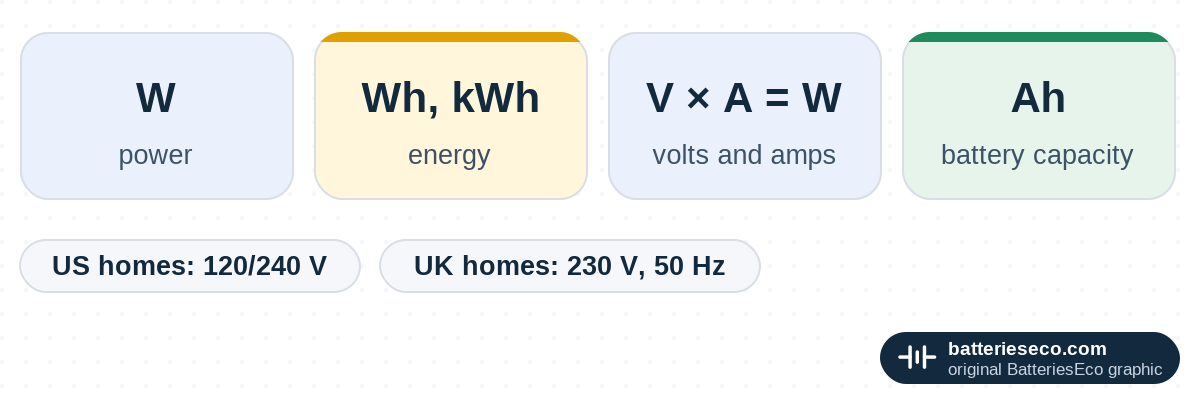
Power, measured in watts (W), is how fast a device uses electricity at a given moment. Energy, in watt-hours (Wh) or kilowatt-hours (kWh), is how much it uses over time: one kilowatt running for an hour is one kWh 1 2.
Your utility bills you for energy, and a battery stores it. A charger or an inverter is sized by the power it can handle (our reading). Our guide What is a kWh? works through the math with examples.
Volts, amps and watts
Power is voltage times current: watts = volts × amps, because the volt is defined as one watt per amp 3. So the same power takes less current at a higher voltage. A 1,500 W heater pulls 12.5 A from a 120 V outlet, and a 1,500 W heater made for 230 V pulls about 6.5 A (our calculation).
- In the United States, most homes get 120/240 V single-phase service, and the Department of Energy lists 110–120 V at 60 Hz as the US standard 4. NIST describes US power systems as running at a nominal 60 Hz 5.
- In the UK, regulations set household supply at 230 V and 50 Hz. The voltage may run from 6% below to 10% above that figure 6.
Amp-hours and battery capacity
Battery capacity is sometimes listed in amp-hours (Ah) instead of watt-hours. To compare two batteries, convert amp-hours to watt-hours by multiplying by the voltage: at 12.8 V, the nominal voltage of a “12-volt” lithium iron phosphate battery 7, 100 Ah comes to 1,280 Wh (our calculation). The amp-hours section of our kWh guide shows the same conversion for power banks.
All the guides in this section
Sources
- Electricity explained: Measuring electricity
- Glossary: Kilowatt-hour (kWh) — Statistics Explained
- Le Système international d’unités (SI), 9e édition 2019, version V4.01 (juin 2026), §5.4 (écriture des symboles), tableaux 4, 7 et 8
- Electric Power eTool, Illustrated Glossary: Distribution Systems (OSHA); Electricity 101 (DOE Office of Electricity)
- Time and frequency from electrical power lines (publication page and abstract)
- The Electricity Safety, Quality and Continuity Regulations 2002, regulation 27; The Electricity Safety, Quality and Continuity Regulations (Northern Ireland) 2012, regulation 28
- Lithium Battery 12,8V & 25,6V Smart datasheet