Power inverters explained: pure sine vs modified sine, sizing and what they draw from the battery
An inverter turns a battery’s DC power into the AC power of a household outlet. A pure sine wave inverter makes the same waveform as the grid; a modified sine wave one can make some devices misbehave.
Size it for everything running at once, with margin for motors that surge at start-up, and expect a large current from a 12 V battery. Even with nothing plugged in, Victron lists 4.2 W to 12 W of idle draw for its Phoenix VE.Direct inverters. Connecting one to a vehicle’s wiring is a job for a qualified installer.
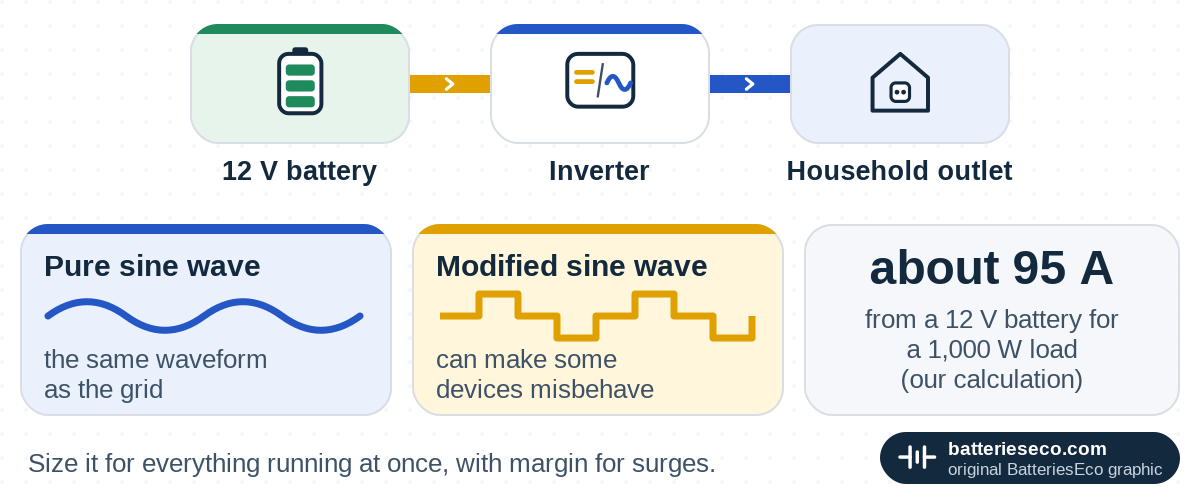
A power inverter turns the direct current (DC) of a battery into the alternating current (AC) of a household outlet: 120 V in the US, 230 V in the UK. Once switched on, it draws some power of its own: Victron lists 4.2 W to 12 W of idle draw for its Phoenix VE.Direct inverters, with nothing plugged in 1.
Pure sine wave vs modified sine wave
A pure sine wave inverter makes the same waveform as a household outlet 2.
As we read it, a modified sine wave inverter makes a stepped approximation of that waveform.
Samlex sells both kinds. In the manual for its SAM-1000-12 to SAM-3000-12 modified sine wave inverters, it lists examples of devices that may malfunction on that waveform and should be checked with the device’s manufacturer 3:
- clocks that use the power line for timekeeping, which won’t keep accurate time
- small battery chargers for hand tools, flashlights and shavers
- variable-speed hand tools, light dimmers and devices with temperature controls, such as electric blankets
- photo strobes and laser printers
It adds that inexpensive audio systems may buzz, and that some switch-mode power supplies (the compact kind found in many chargers and electronics) draw so much current at start-up that the inverter shuts down. Samlex also says these inverters aren’t tested for use with medical devices 3.
Running a CPAP machine
In its 2015 guide, ResMed sets a 150 W modified sine wave inverter as the minimum for several of its devices 2. With the heated humidifiers the guide lists, most of these devices (not the S9) need a pure sine wave inverter rated 300 W continuous and 500 W peak, according to ResMed 2. With the original HumidAire and ResMed’s other heated humidifiers, the guide rules out inverters entirely 2.
For some device series it supplies DC-to-DC converters, which it says are more efficient than an inverter 2. That guide predates newer machines such as the AirSense 11 2: follow your own device’s manual.
What size inverter do you need?
An inverter has a continuous rating and a peak (surge) rating it can hold only briefly: 2 to 15 seconds on the Victron models below 4. In the manual for the 230 V version of its Inverter VE.Direct, Victron rates the 12 V models, from the 12/250 to the 12/1600, at 250 W to 1,450 W continuous at 77 °F (25 °C), depending on the model 4.
Their peaks run from 400 W for 2 seconds to 2,100 W for 15 seconds 4. Heat lowers the rating: the 12/1600 delivers 1,450 W at 77 °F (25 °C) but 1,300 W at 104 °F (40 °C) 4.
Our reading: size it for everything that runs at once, with margin for loads that surge. These figures come from the manual for the 230 V version, so for a 120 V model, check its own manual.
- Motors and compressors: Dometic warns that motor-driven appliances such as drills or fridges often need more than their rated power 5. Samlex suggests multiplying the running power of a compressor fridge or freezer by 5 to choose an inverter 3.
- Microwaves: a microwave’s cooking power isn’t what it draws. Bosch’s FFL020MS2, a European model, cooks at up to 800 W but has a connected load (input power) of 1,270 W, according to its product page 6. Samlex suggests doubling the cooking power to size the inverter 3.
If a Victron Inverter VE.Direct is overloaded at start-up, its output voltage drops; if the overload continues, it shuts down, waits 30 seconds and restarts. After three restarts, another overload within 30 seconds keeps it off 4.
How many amps it pulls from a 12 V battery
An inverter doesn’t make energy: it takes everything it delivers from the battery, plus its own losses. At 12 V, the current gets large quickly.
To estimate it, divide the appliance’s power by 12 V times the inverter’s efficiency. The table uses 88%, which is within the range of maximum efficiencies Victron lists for its 12 V Phoenix VE.Direct inverters 1.
Our calculation: current (A) = appliance power (W) ÷ (12 V × 88%).
| Appliance on the AC outlet | Current from a 12 V battery |
|---|---|
| 100 W | 9 A |
| 300 W | 28 A |
| 500 W | 47 A |
| 1,000 W | 95 A |
| 1,500 W | 142 A |
| 2,000 W | 189 A |
Victron’s figures are maximum efficiencies 1.
As we read it, with a small appliance the real current is higher than the table’s, and the battery has to supply it.
In a 2024 report, Germany’s auto club ADAC says a lithium (LiFePO4) battery for a 1,500 W inverter should be at least 150 Ah 7. Its reason: the battery’s BMS switches off without warning on overload 7.
Our calculation: with a 1,500 W appliance drawing the table’s 142 A, those 150 Ah last about an hour (150 ÷ 142 = 1.06 hours), assuming every amp-hour is usable.
In our view, currents like these also need short, heavy cables and a fuse sized according to the inverter’s manual, and a qualified installer to make the connection. Our solar batteries guide explains why 24 V and 48 V systems need less current.
The draw with nothing plugged in
An inverter draws power as soon as it’s on, even with nothing plugged in. On Victron’s Phoenix VE.Direct inverters from 250 to 1,600 VA, that 4.2 W to 12 W falls to 0.8 W to 3.0 W in ECO (search) mode 1. Dometic lists under 1.5 A of idle current for its PerfectPower PP1002 and PP2002 5.
Our calculation: left on overnight for 10 hours, 12 W of idle draw is 120 Wh (12 × 10). In ECO mode, at up to 3.0 W, the same night uses at most 30 Wh (3.0 × 10).
Switch the inverter off when you don’t need it.
When the battery runs low
Inverters protect the battery by shutting down at a set voltage. On 12 V models, Victron’s 230 V Inverter VE.Direct shuts down for low battery at 9.3 V by default, with the restart and alarm at 10.9 V; all of these settings are adjustable 4.
Dometic’s PerfectPower 12 V models sound a warning at 11 V, shut down at 10.5 V and restart at 12.2 V 5.
Our reading: with a lithium battery, its BMS may cut off before these thresholds are reached, so check them against the battery maker’s limits.
Listings and safety reports
UL 458 is a US standard that, according to UL Standards & Engagement’s page for Edition 6, covers inverters with a DC input and a 120 V or 240 V single-phase AC output 8. The page says they’re intended for use inside land vehicles where they aren’t directly exposed to outdoor conditions, and to be used in accordance with the National Electrical Code 8.
In the UK, a Product Safety Report published by the Office for Product Safety and Standards in July 2023 records the destruction of a Vevor power inverter whose internal components were only rated to 220 V and could overheat and catch fire 9. The UK supply is declared at 230 V 10.
A separate inverter or a power station?
A portable power station has the battery, the inverter and the chargers built in, and works like any plug-in appliance.
As we read it, a separate inverter has to be connected to a battery, such as an RV or van house battery, and any wiring must be done properly, with cables and a fuse sized for the currents above.
Our guide to choosing a power station covers the checks for the all-in-one option. For watts, volts and amps, start with our electricity basics section.
Sources
- Phoenix Inverter VE.Direct 250VA - 1600VA datasheet
- Battery guide (Technical Services, document 198103/4, 2015-08): Inverters, Minimum inverter requirements, Converters
- SAM Series Power Inverters SAM-1000-12, SAM-1500-12, SAM-2000-12, SAM-3000-12 – Owner’s Manual (EN-FR, 11002 rev 1224 R2)
- Inverter VE.Direct 230V manual, hardware HW15 (3 Installation; 5 Operation; 6 Technical specifications; 7 Appendix)
- PerfectPower PP1002, PP1004, PP2002, PP2004 – Inverter with mains priority circuit, Installation and Operating Manual (EN part)
- FFL020MS2 Micro-ondes pose-libre, Série 2 – product page, technical specifications
- Nachrüstung von Stromspeicher- und Ladelösungen für Campingfahrzeuge (33109 BOE)
- UL 458 Power Converters/Inverters and Power Converter/Inverter Systems for Land Vehicles and Marine Crafts (product page with scope, UL Standards & Engagement standards shop)
- Product Safety Report: Vevor Power Inverter (2208-0011)
- The Electricity Safety, Quality and Continuity Regulations 2002, regulation 27; The Electricity Safety, Quality and Continuity Regulations (Northern Ireland) 2012, regulation 28