Solar batteries: choosing the type, voltage and size
A "solar battery" can be a portable power station, a 12 V battery in an RV or van, or a home battery wired into the house, like Tesla’s Powerwall 3 at 13.5 kWh. Many use lithium iron phosphate (LFP) cells.
Compare them in watt-hours, not amp-hours. At 24 V or 48 V, the same power draws half or a quarter of the current it draws at 12 V, which allows thinner cables and lower losses. Wiring a battery into a home is a job for a qualified installer.
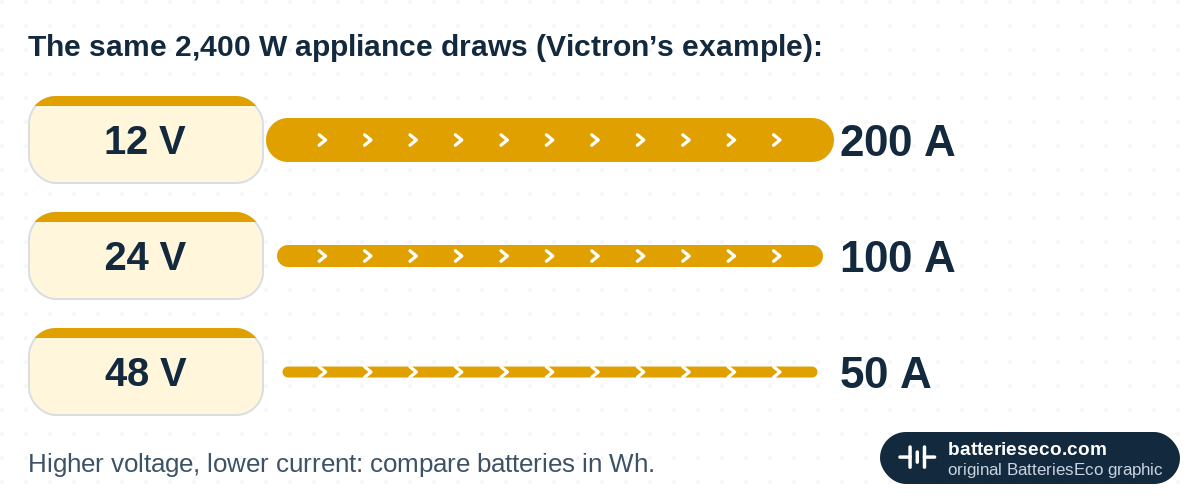
A solar battery is anything from a portable power station to a home battery like Tesla’s Powerwall 3, which Tesla’s North America datasheet rates at 13.5 kWh nominal 1. The name also covers the 12 V house battery of an RV, a van or a boat. Whatever the type, a higher voltage cuts the current for the same power: in Victron’s example, a 2,400 W appliance draws 200 A at 12 V but 50 A at 48 V 2.
What counts as a solar battery
As we read it, the products sold under that name do very different jobs:
- For camping, travel or a power outage: a portable power station, which houses a battery, an inverter and chargers in a single unit. The eight that Germany’s auto club ADAC tested in 2025 were rated from 768 Wh to 1,440 Wh 3 4.
- In an RV, a van or a boat: a 12.8 V house battery, such as Super B’s Epsilon 12V100Ah at 100 Ah and 1,280 Wh, according to its manual 5.
- For a house with solar panels on the roof: a home battery connected to the home’s wiring, such as Tesla’s Powerwall 3 1 or Enphase’s IQ Battery 5P at 5.0 kWh usable 6.
Our batteries section compares the chemistries inside them.
In our view, lithium iron phosphate (LFP, or LiFePO4) cells are now common at every size.
All eight power stations in ADAC’s 2025 test used them 3, and so do Super B’s Epsilon house battery 5 and Enphase’s IQ Battery 5P 6.
Over 90% of the stationary battery storage installed worldwide in 2025 was LFP, according to the International Energy Agency (IEA) 7. Our LiFePO4 guide explains why.
Choosing 12 V, 24 V or 48 V
Victron sells its Lithium NG LiFePO4 batteries at 12.8 V, 25.6 V and 51.2 V nominal, for 12 V, 24 V or 48 V systems. Its LFP-51.2/100 model is rated at 100 Ah and 5,120 Wh at 77 °F (25 °C) 8.
The volt is defined as the watt per ampere 9.
Our reading of that definition: a battery’s energy is its amp-hours times its voltage, so amp-hours alone don’t tell you how much it stores.
Our calculation: Super B’s Epsilon 12V100Ah and Victron’s LFP-51.2/100 both carry 100 Ah on the label. The first stores 1,280 Wh at 12.8 V and the second 5,120 Wh at 51.2 V, four times as much (5,120 ÷ 1,280).
Our calculation, the other way around: at Victron’s nominal voltages, the same energy takes fewer amp-hours as the voltage rises.
| Battery’s nominal voltage | Capacity for 2,560 Wh |
|---|---|
| 12.8 V | 200 Ah |
| 25.6 V | 100 Ah |
| 51.2 V | 50 Ah |
The big change is in the current. In its book Wiring Unlimited (rev. 04, August 2026), Victron takes the example of a 2,400 W appliance on two 1.5 m (about 5-foot) cables of 16 mm² 2 10:
| System voltage | Current drawn | Voltage drop in the two cables | Energy lost |
|---|---|---|---|
| 12 V | 200 A | 0.64 V | 5% |
| 24 V | 100 A | 0.32 V | 1.3% |
| 48 V | 50 A | 0.16 V | 0.3% |
In a given cable, the power lost as heat equals the resistance times the square of the current, as Victron points out 2.
Our calculation: halving the current cuts that loss to a quarter. At 12 V, Victron’s 5% comes to 120 W of the appliance’s 2,400 W (2,400 × 0.05), compared with about 7 W at 48 V (2,400 × 0.003), using Victron’s rounded percentages.
Victron’s preferred upper inverter power limits, in volt-amperes (VA), are up to 3,000 VA at 12 V, up to 5,000 VA at 24 V and 5,000 VA and up at 48 V 11. To avoid very thick cables, it says the first thing to consider is raising the system voltage 11.
What home battery datasheets and warranties promise
Home batteries are sold with a usable capacity and a warranty whose terms depend on where you live:
| Battery and document | Energy | Warranty terms |
|---|---|---|
| Tesla Powerwall 3, North America datasheet (2025) and US warranty (effective August 21, 2023) | 13.5 kWh nominal, at 77 °F (25 °C) at beginning of life 1 | 10 years; 70% of 13.5 kWh retained at 10 years, with unlimited cycles for solar self-consumption, time-based control and backup, and 37.8 MWh of throughput for other uses 12 |
| Tesla Powerwall 3, UK datasheet (2026) and European-region warranty (effective December 3, 2025) | 13.5 kWh usable, the minimum guaranteed at beginning of life, at 77 °F (25 °C) and 5 kW charge/discharge power 13 | 10 years; 80% retained at 10 years for the UK, same throughput terms 14 |
| Enphase IQ Battery 5P, North America datasheet (May 2025) | 5.0 kWh usable, LFP cells 6 | Up to 15 years or 6,000 cycles, whichever comes first, with more than 60% capacity retained; “restrictions apply” 6 |
Our calculation: the US warranty’s 70% at 10 years comes to 9.45 kWh (13.5 × 0.7), and the UK’s 80% to 10.8 kWh (13.5 × 0.8). The 37.8 MWh limit for other uses equals 2,800 full discharges of 13.5 kWh (37,800 kWh ÷ 13.5 kWh), or about 7.7 years at one full discharge a day (2,800 ÷ 365).
Some conditions are easy to miss. Tesla’s warranties say it may not honor the full 10 years if the Powerwall isn’t connected to the internet for an extended period or isn’t registered 12 14. They add that Tesla will always honor at least four years from the first installation 12 14.
In our view, if the battery will sit somewhere with an unreliable internet connection, that clause is the one to read before you buy.
Tesla’s datasheets don’t state the cell chemistry 1 13. The North America Powerwall 3 datasheet lists UL 1741, UL 9540, UL 9540A and UL 1973 among its certifications 1, and the UK one lists G98 and G99, the grid-connection standards for Great Britain 13.
Our reading: those are type-test papers, not proof that a given home needs only a G98 notification.
How big a solar battery do you need?
Start with what you want it to run and for how long, in watt-hours. Our watts, amps, Ah and Wh converter turns amp-hours into watt-hours, and our power station runtime calculator gives a runtime for the appliances you list.
Our calculation, for a new, fully charged battery with no solar coming in and ignoring conversion losses: one Powerwall 3’s 13.5 kWh nominal would keep Victron’s 2,400 W example appliance running for about 5.6 hours of a power outage (13,500 Wh ÷ 2,400 W).
Don’t count on the full rated capacity of a power station or a lead-acid battery. In its 2025 test, ADAC found the usable capacity of the eight power stations on average 10% to 15% below the maker’s figure, or a little more 4. In a 2024 report on RV batteries, it advises using only 30% to 75% of a lead-acid battery’s capacity, depending on the type 15.
Our lithium vs AGM and lead-acid guide covers that older alternative.
As we read it, whether a home battery pays off depends on your electricity rates, your solar output and any incentives where you live.
Who should install it
A portable power station plugs in like an appliance. A battery connected to a home’s wiring, or a 12 V, 24 V or 48 V system in an RV or a boat, involves cable sizes, fuses and local electrical codes.
Our reading: leave that connection to a qualified installer, working from the battery maker’s manual.
In our view, when you plan a battery system from scratch, choose the voltage from the inverter power you need, as Victron’s limits above do: the cable sizes follow from it.
Sources
- Powerwall 3 Datasheet (North America, en-us, 2025)
- Wiring Unlimited (rev 04 - 08/2026), sections 2.3 Conductivity and resistance, 2.5 Connection resistance and 2.7 Current, cable resistance and voltage drop
- Mobile Powerstations 2025: per-model test result pages (Bluetti AC180P, Ecoflow Delta 3 Plus, Allpowers R1500, Anker Solix C800 Plus, DJI Power 1000, Fossibot F1200, Jackery Explorer 1000 v2, Ective BlackBox 10)
- Mobile Powerstations im ADAC Test: Nur die Hälfte schneidet gut ab
- Epsilon 12V100Ah / 12V150Ah User Manual (Version V1.9.1, January 2026), with Epsilon 12V150Ah datasheet v3 (EN)
- IQ Battery 5P data sheet, North America (DSH-00010-11.0-EN-2025-05-06)
- Global EV Outlook 2026 - Electric vehicle batteries
- Batteries Lithium NG 12,8, 25,6 et 51,2 V (fiche technique)
- Le Système international d’unités (SI), 9e édition 2019, version V4.01 (juin 2026), §5.4 (écriture des symboles), tableaux 4, 7 et 8
- Wiring Unlimited (rev 04 - 08/2026), sections 2 (voltage drop) and 3.2-3.4 (battery banks)
- Wiring Unlimited (rev 04 - 08/2026), section 4.1 Cable selection
- Tesla Powerwall Limited Warranty (USA), Rev. 1.0, effective August 21, 2023
- Powerwall 3 Datasheet (en-uk, Powerwall-3-Datasheet-EN.pdf, 2026)
- Tesla Powerwall Warranty (European Warranty Region), Rev. 1.16, effective December 03, 2025
- Nachrüstung von Stromspeicher- und Ladelösungen für Campingfahrzeuge (33109 BOE)