LiFePO4 (lithium iron phosphate) batteries: pros, cons, lifespan and voltage chart
LiFePO4, or LFP, is a lithium-ion battery with a lithium iron phosphate cathode and no cobalt or nickel. In a Sandia lab study, LFP cells reached (or were projected to reach) 2,500 to 9,000 equivalent full cycles before falling to 80% of their capacity. It costs less per kWh than NMC but stores less energy per kilogram, shouldn’t be charged below freezing and can still catch fire.
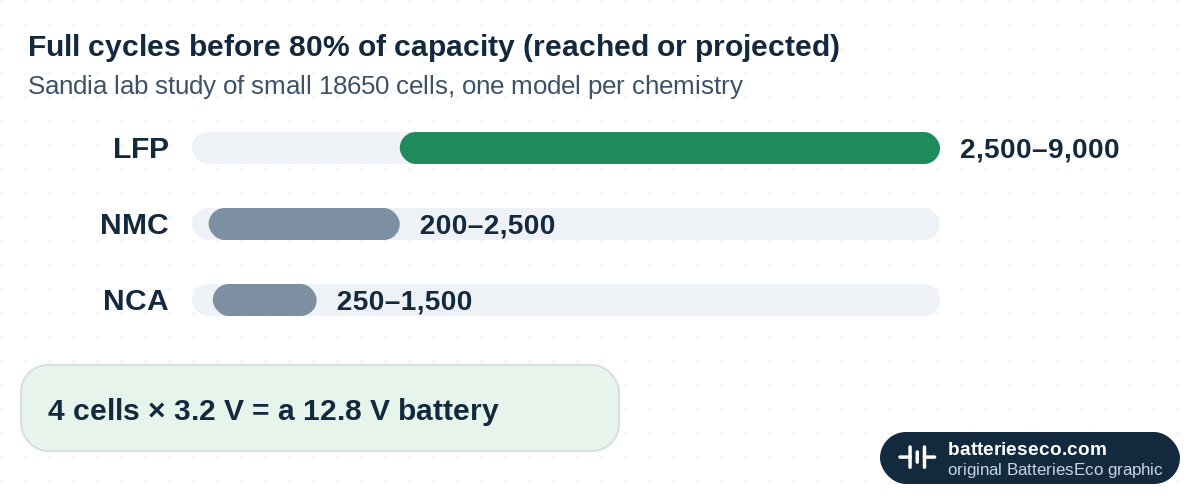
In lab tests at Sandia National Laboratories, LiFePO4 (LFP) cells lasted, or were projected to last, far more charge cycles than the NCA and NMC cells tested alongside them 1. For LFP, that meant 2,500 to 9,000 equivalent full cycles before the cells fell to 80% of their capacity 1. They store less energy per kilogram than NMC, shouldn’t be charged below freezing and still carry a fire risk 2 3 4.
Is LFP a lithium-ion battery?
Yes, LFP is one kind of lithium-ion battery. LiFePO4 and LFP are two names for the same chemistry, lithium iron phosphate.
Its cathode (positive electrode) is lithium iron phosphate with an olivine crystal structure 5. It contains no nickel or cobalt 6.
A single LiFePO4 cell has a nominal voltage of 3.2 V 7. According to Victron’s datasheet, a “12-volt” LiFePO4 battery has four cells in series (12.8 V nominal) and a “24-volt” one has eight (25.6 V) 7.
For a 48 V bank, Victron suggests two 24 V batteries in series 7. Some LFP cells are rated 3.3 V instead, like the one Stanford researchers tested 8.
Our calculation: two 25.6 V batteries in series make 51.2 V nominal, the same as 16 cells × 3.2 V.
Where LFP is used
In 2025, LFP made up over 90% of the world’s stationary battery storage installations 9. It also accounted for over 55% of the battery capacity in new electric vehicles, a share that includes lithium manganese iron phosphate (LMFP) 9. All eight portable power stations that the German auto club ADAC tested in 2025 used LFP cells 10.
What LFP does better
- Many more charge cycles. Sandia ran a multi-year study of commercial 18650 cells, one model per chemistry. The NCA cells managed 250 to 1,500 equivalent full cycles before falling to 80% of their capacity, and the NMC cells 200 to 2,500. The LFP cells reached, or were projected to reach, 2,500 to 9,000 1. The state-of-charge range they were cycled through had little effect on them, but heat did: they wore out faster at 95 °F (35 °C) than at 59 °F (15 °C) 11.
- A more stable chemistry. LFP is more stable and less flammable than nickel-rich chemistries, and it lasts more cycles 6. More stable doesn’t mean it can’t burn (see safety below).
- Lower cost. In 2025, the average LFP pack cost more than 40% less per kWh than the average NMC pack, according to the IEA. Part of that gap reflects stationary storage, where high energy density matters less 9. Dollar figures from a separate survey, BloombergNEF’s, are in what LFP costs below.
- Good efficiency. In Sandia’s tests, LFP cells returned more of the energy put into them than NCA and NMC cells under every condition tested 12. Victron rates its LiFePO4 Smart batteries at 92% round-trip efficiency, compared with 80% for an average lead-acid battery 13.
- Full charges when you need them. In electric vehicles, an LFP battery can be charged to 100% when needed without significant degradation, while NMC is typically limited to 80% 14.
Where it falls short
- Weaker in the cold. LFP typically performs worse in cold climates 14. Victron rates its 12.8 V 100 Ah Smart battery at 80 Ah at 32 °F (0 °C) and 50 Ah at −4 °F (−20 °C), at a discharge current of up to 1C 15. Charging has tighter limits (see how cold is too cold to charge).
- A charge level that’s hard to read. An LFP cell’s voltage stays almost flat through most of the discharge 5. That flat curve makes the state of charge hard to estimate from voltage alone 8. Estimating it is one of the key jobs of the battery management system (BMS) 8. The voltage chart below shows how flat it is.
- It needs a BMS. Stanford battery researchers write that these batteries need a BMS, because real-time monitoring is crucial to their safety and performance 8. Super B builds one into its Epsilon batteries 16, while Victron’s Lithium Smart batteries may be used only with an external BMS that Victron approves 17. Our guide to battery management systems shows what one does.
- Less energy per kilogram. An LFP car pack stores about a fifth less energy per kilogram and about a third less per liter than an NMC pack 2.
In our view, that weight penalty matters less for a battery that sits in a garage than for one in a vehicle.
How cold is too cold to charge?
In a lab study of commercial 2.3 Ah LiFePO4 cells charged at 1C, cycle life at about 0 °F (−18 °C) was under 10% of the room-temperature figure. The authors conclude that charging below freezing should be avoided 3.
Each manufacturer sets its own minimum charging temperature. Victron’s datasheet, which rates its battery down to −4 °F (−20 °C) for discharge, allows charging only at 41 °F (5 °C) and above 15.
| Battery (source) | Minimum charging temperature |
|---|---|
| Victron 12.8 V 100 Ah Smart (datasheet) | 41 °F (5 °C) 15 |
| Epoch (2022 manual) | 32 °F (0 °C) 18 |
| Battle Born BB5012 cells (manual) | 32 °F (0 °C) 19 |
| Super B Epsilon, default setting (manual) | 32 °F (0 °C) in every cell 16 |
Units: Epoch’s and Battle Born’s manuals give both °F and °C.
Battle Born’s BMS blocks charging below 25 °F (−3.9 °C) 19. Some batteries heat themselves: Super B’s Epsilon uses the charger’s power to warm its cells first, according to its manual 16.
LiFePO4 voltage chart
A voltage reading reflects the state of charge only when the battery is at rest, with nothing charging it or drawing power from it. The figures below, taken after the battery has rested for 30 minutes, come from the manuals of three Renogy LiFePO4 batteries.
Renogy calls them reference values only, because voltage varies slightly from one battery to another 20 21 22. It gives no temperature for them.
| State of charge | 12.8 V battery (Core Mini 12V 100Ah) | 25.6 V battery (Core LT 25.6V 100Ah) | “48 V” battery (Core LT 48V 50Ah) |
|---|---|---|---|
| 100% | 13.6 V | 27.2 V | 51.0 V |
| 99% | 13.4 V | 26.8 V | 50.3 V |
| 90% | 13.2 V | 26.4 V | 49.5 V |
| 70% | 13.1 V | 26.2 V | 49.1 V |
| 40% | 13.0 V | 26.0 V | 48.8 V |
| 30% | 12.9 V | 25.8 V | 48.4 V |
| 20% | 12.8 V | 25.6 V | 48.0 V |
| 14% | 12.7 V | 25.4 V | 47.6 V |
| 9% | 12.6 V | 25.2 V | 47.2 V |
| 0% | 10.0 V | 20.0 V | 42.0 V |
Sources: Renogy’s manuals for the RBT12100LFP-H 20, RBT24100LFPSH 21 and RBT4850LFPSH 22.
Renogy rates its “48 V” battery at 48 V nominal, not 51.2 V 22. Victron’s Lithium Smart manual has no such table at all. Victron’s Lithium Smart batteries have no built-in state-of-charge monitoring, and Victron tells you to add a battery monitor such as its BMV or SmartShunt 23.
Our calculation: between 90% and 20%, the 12.8 V battery’s resting voltage moves by only 0.4 V (from 13.2 V to 12.8 V), and neighboring rows in that range sit just 0.1 V apart.
As we read it, a small measurement error can put you a full row off, and another maker’s battery may read a little higher or lower. The “48 V” column doesn’t fit a 16-cell 51.2 V battery, and we haven’t found a maker’s table for one. A monitor sidesteps the problem: it counts the current going in and out instead of guessing from the voltage.
Victron does give a voltage test, for a battery recovering from a very deep discharge. After its recovery charge and a few hours at rest, it should read 13.2 V or more, comfortably above 12.8 V. If it’s below 12.8 V after a further 24 hours at rest, Victron considers it damaged beyond recovery 23.
How long do LiFePO4 batteries last?
Manufacturers rate cycle life under different conditions, so check the fine print behind each number.
| Battery or cell | Rated cycles | Conditions stated |
|---|---|---|
| Victron Lithium Battery Smart (12.8 V) | 2,500 / 3,000 / 5,000 | At 80%, 70% and 50% depth of discharge, until capacity falls to 80% of nominal; no current or temperature given in this table 13 |
| EVE LF280K cell (280 Ah, 2021 specification) | 6,000 or more | At 0.5C and 77 °F (25 °C), to 80% of initial capacity, with the cell clamped at 300 kgf 24 |
| Pylontech US5000 (4.8 kWh) | More than 6,000 | At 77 °F (25 °C); depth of discharge, current and end-of-life capacity not stated for this figure; operating life of 15+ years at 77 °F 25 |
In our view, depth of discharge, temperature and the capacity counted as “end of life” all change the answer. So Victron’s 2,500 cycles at 80% depth of discharge can’t be compared with Pylontech’s 6,000-plus at 77 °F, which come with no other conditions stated.
Our calculation: at one cycle a day, Victron’s 2,500 cycles at 80% depth of discharge come to about 6.8 years (2,500 ÷ 365). Pylontech’s 6,000-plus cycles at 77 °F come to about 16.4 years or longer (6,000 ÷ 365).
Batteries also age on the shelf. A 2016 Technical University of Munich study stored one model of LFP 18650 cell for nine months at different states of charge.
By the end, the cells were still losing about 0.2 percentage points of capacity a month at 77 °F (25 °C) and 0.5 points at 122 °F (50 °C) 26. Losses were noticeably higher above 70% charge 26.
In the field, a German study tracked 21 home batteries for up to eight years, between 2015 and 2022. The mid-size LFP systems averaged around 200 equivalent full cycles a year and lost an average of 2 percentage points of usable capacity a year 27.
Storage advice varies by manufacturer. Super B calls 40% to 60% charge optimal 28.
It advises 50% when nothing is connected and no CAN, LIN or Bluetooth link is active, but 95% if there’s no battery disconnect switch 28. Liontron’s advice is to charge to about 80% with all devices disconnected 29.
What LFP costs per kWh
The only prices we can find reliable sources for are industry averages for packs, not retail prices. BloombergNEF’s 2025 survey found an average lithium-ion pack price of $108 per kWh across all uses, with LFP packs at $81 and NMC packs at $128 30.
Our calculation: on BloombergNEF’s prices, LFP packs came out about 37% cheaper ($128 minus $81, divided by $128).
As we read it, a pack price leaves out a home system’s inverter, installation and the seller’s markup. To compare batteries you’re shopping for, divide each one’s price by its watt-hours. Our guide to kWh and amp-hours shows how to turn amp-hours into watt-hours.
Is LiFePO4 safe?
LFP can still catch fire. INERIS, France’s industrial-risk institute, concludes that LFP batteries can go into thermal runaway like every current lithium-ion chemistry, and are not intrinsically safe.
During thermal runaway, LFP tends to smoke for a long time without a visible flame. That smoke contains many flammable gases, which can build up into an explosive atmosphere in an enclosed space 4.
A review of published tests compared the gases that cells release in thermal runaway. LFP’s gas was, on average, more toxic and a bigger flammability hazard than NMC’s, even though NMC cells give off a larger specific volume of gas (gas volume per kWh of battery capacity) 31.
LFP vs lead-acid, NMC and sodium-ion
Victron’s own ratings show the gap between LFP and lead-acid. Its AGM deep-cycle batteries are rated for 400 cycles at 80% depth of discharge 32, and its Lithium Battery Smart for 2,500 cycles at 80% depth of discharge, to 80% of nominal capacity 13.
The IEA’s 2024 report puts lead-acid batteries at 35 to 40 Wh/kg, compared with about 90 to 300 Wh/kg at cell level for lithium-ion batteries 33. Our side-by-side comparison of lithium with AGM and other lead-acid batteries goes through them point by point.
On the figures cited on this page, LFP and NMC compare as follows.
| Chemistry | Cycles to 80% capacity, Sandia lab cells 1 | Energy per kg, newest cells 34 | Average pack price, 2025 30 | Charge level in electric vehicles 14 |
|---|---|---|---|---|
| LFP | 2,500-9,000 | Up to 205 Wh/kg | $81 per kWh | 100% when required, without significant degradation |
| NMC | 200-2,500 | 265 Wh/kg | $128 per kWh | Typically limited to 80% |
Most of the LFP cells in the Sandia study hadn’t yet fallen to 80% when it ended, so their cycle counts are partly projected 1. Our guide to lithium-ion batteries explains how LFP differs from NMC, NCA and the other types.
Sodium-ion stores less energy per kilogram than LFP: up to 175 Wh/kg for the latest sodium-ion cells, compared with up to 205 Wh/kg for the latest LFP. It holds up much better in the cold, though 34.
In our view, three lines on a LiFePO4 datasheet deserve a close look before you buy: the cycle rating and its test conditions, the minimum charging temperature and whether the BMS is built in. Our batteries section has a separate guide on each of these topics: charging, the BMS and solar storage.
Sources
- Degradation of Commercial Lithium-Ion Cells as a Function of Chemistry and Cycling Conditions
- Global EV Outlook 2025 - Electric vehicle batteries
- Low-temperature aging mechanisms of commercial graphite/LiFePO4 cells cycled with a simulated electric vehicle load profile — A post-mortem study (Journal of Energy Storage 20, 344-356; accepted version)
- Profil de risque des batteries Li-ion LFP (Ineris-213996-2761939-v1.0)
- U.S. DOE Energy Storage Handbook, Chapter 3: Lithium-Ion Batteries (Preger, Torres-Castro, McDowall)
- Batteries and Secure Energy Transitions (World Energy Outlook Special Report), sections 1.2 and 2.3.2
- Lithium Battery 12,8V & 25,6V Smart datasheet
- Advancing SOC estimation in LiFePO4 batteries: Enhanced dQ/dV curve and short-pulse methods
- Global EV Outlook 2026 - Electric vehicle batteries
- Mobile Powerstations 2025: per-model test result pages (Bluetti AC180P, Ecoflow Delta 3 Plus, Allpowers R1500, Anker Solix C800 Plus, DJI Power 1000, Fossibot F1200, Jackery Explorer 1000 v2, Ective BlackBox 10)
- Degradation of Commercial Lithium-Ion Cells as a Function of Chemistry and Cycling Conditions
- Degradation of Commercial Lithium-Ion Cells as a Function of Chemistry and Cycling Conditions
- Lithium Battery 12,8V & 25,6V Smart datasheet
- Global EV Outlook 2025 - Electric vehicle batteries
- Lithium Battery 12,8V & 25,6V Smart datasheet
- Epsilon 12V100Ah / 12V150Ah User Manual (Version V1.9.1, January 2026), sections 3.1.2, 3.1.6, 4.9, 5.2, 5.3.3, 5.5 and 5.7
- Lithium Smart Battery Manual (12,8V & 25,6V)
- Product Manual: Li-ion Battery Systems (Updated 11/30/22), Technical Data Part I
- Battle Born Batteries Model BB5012, 50Ah 12V Deep Cycle LiFePO4 Battery, Manual and Installation Guide
- Renogy 12V 100Ah Core Series Mini LiFePO4 Battery with Self-Heating (RBT12100LFP-H) User Manual, November 25, 2024 (Battery Management System, Troubleshooting, Checking Voltage)
- Renogy Core LT (Low Temperature) Series 25.6V 100Ah Deep Cycle Lithium Iron Phosphate Battery, RBT24100LFPSH, User Manual Version A0 (How to Estimate the Battery SOC?, Charging Logic, Specifications)
- Renogy Core LT (Low Temperature) Series 48V 50Ah Deep Cycle Lithium Iron Phosphate Battery, RBT4850LFPSH, User Manual Version A0, September 23, 2024 (How to Estimate the Battery SOC?, Charging Logic, Specifications)
- Lithium Smart Battery Manual, rev 21 - 01/2026 (sections 3.5 Battery monitoring, Effect of temperature on battery capacity, 6.1.5 Battery very low terminal voltage)
- Product Specification, LFP Power Battery Model LF280K (File No. LF280K-72174)
- Scheda tecnica Pylontech US5000 (distributor-hosted datasheet)
- Calendar Aging of Lithium-Ion Batteries: I. Impact of the Graphite Anode on Capacity Fade
- Multi-year field measurements of home storage systems and their use in capacity estimation (Nature Energy 9, 1438-1447, published online 16 September 2024; open access, full text re-read for this row)
- Usage & Maintenance Manual: charging and storage instructions applicable to Super B energy and starter batteries (Version V1.0, January 2026)
- Bedienungsanleitung Lithium LiFePO4 Batterien LX Smart BMS Serie 12,8V
- Lithium-Ion Battery Pack Prices Fall to $108 Per Kilowatt-Hour, Despite Rising Metal Prices: BloombergNEF (press release, 9 December 2025)
- Review of gas emissions from lithium-ion battery thermal runaway failure - Considering toxic and flammable compounds
- Gel and AGM Batteries datasheet
- Batteries and Secure Energy Transitions (World Energy Outlook Special Report), sections 1.2, 2.3.2 and 2.3.6
- Global EV Outlook 2026 - Electric vehicle batteries (section "Emerging battery chemistry and designs")