What a battery management system (BMS) does, and what to check on a lithium battery
A battery management system (BMS) keeps a lithium battery within safe limits for cell voltage, temperature and current, balances the cells and estimates the state of charge. In 12 V LiFePO4 batteries like Renogy’s, it’s built in and cuts the current itself; Victron’s Lithium Smart and Lithium NG batteries instead need an external BMS that switches off the chargers and loads. The cutoff thresholds, balancing current and standby draw vary by manufacturer.
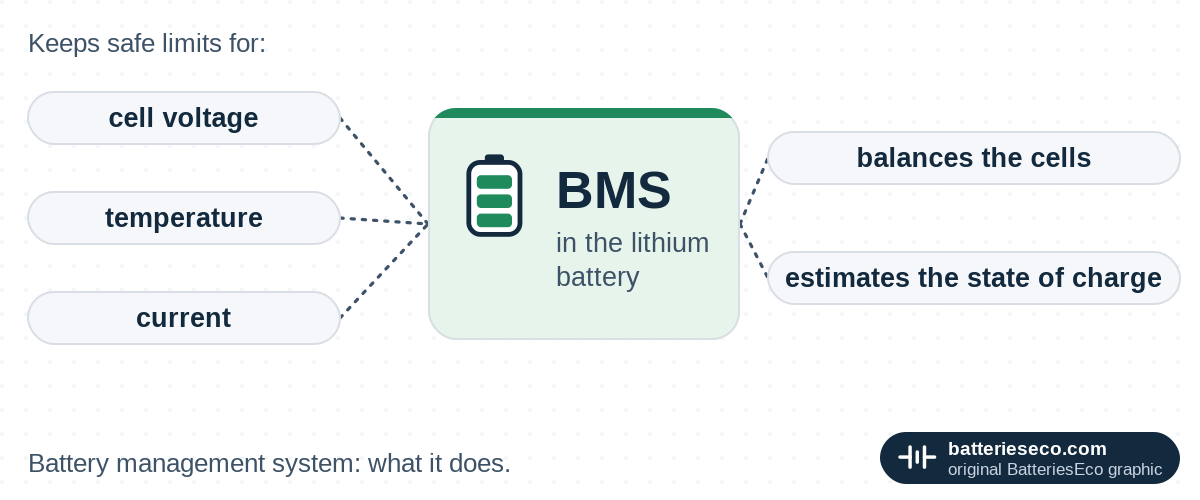
A battery management system (BMS) keeps a lithium battery inside the voltage, temperature and current limits its maker sets 1. In Renogy’s Pro Series 12.8 V 100 Ah battery, the BMS is built in, with short-circuit protection at 500 A, according to Renogy’s manual 2. Victron’s Lithium NG battery works differently: it relies on an external BMS, sold separately 3.
What does a battery management system do?
In a 2025 review of BMS standards in Germany, RWTH Aachen University calls the zone inside those limits the battery’s safe operating area. The maker defines it by limits on cell and battery voltage, temperature, and charge and discharge current. The review names five main functions: monitoring the battery, safety, energy management (including cell balancing), communication and data management, and thermal management 1.
A 2022 University of Waterloo review adds that a BMS measures each cell’s current, voltage and temperature. It also estimates the state of charge and the state of health. Neither can be measured directly, so the BMS uses algorithms such as lookup tables, amp-hour counting or model-based methods 4.
According to the RWTH review, standards such as IEC 62619 require the BMS to interrupt the current if a cell’s temperature or current goes past its safety limits. It must also cut the current before or as soon as a cell’s voltage reaches its upper limit. Standards for stationary storage require it to cut off on overcharge, deep discharge or overheating 1.
These standards aren’t free to read, so we report what the review says about them. The review was written mainly for electric vehicles and stationary storage.
Built-in BMS or external BMS
In these 12 V LiFePO4 batteries, the BMS is built in and cuts the current itself:
- Renogy claims more than 60 alarms and protections for the built-in BMS of its Pro Series 12.8 V 100 Ah battery 2.
- Victron describes a built-in BMS in its Lithium SuperPack NG battery that handles short circuits, overcurrent, low voltage and temperature 5.
Victron’s Lithium NG and Lithium Smart batteries work differently, and the Lithium SuperPack NG above is a different product. The Lithium NG manual says the battery has no BMS that cuts the current. Instead, a built-in module balances and monitors the cells and sends its alarms to an external BMS 3.
That external BMS is required and sold separately, according to the same manual. It shuts off chargers and loads, either through an on/off signal or by disconnecting them 3.
Victron’s Lithium Smart Battery manual says to use those batteries only with an external BMS approved by Victron 6. Victron offers several:
- VE.Bus BMS V2, which also controls Victron’s VE.Bus inverter-chargers 7.
- smallBMS, a simpler unit that isn’t suitable for Victron’s MultiPlus and Quattro inverter-chargers 8.
- Lynx Smart BMS, for 12 V to 48 V systems of up to 20 batteries; a 500 A or 1,000 A contactor serves as its backup safety device 9.
Our reading: with an external BMS, the protection only works if the BMS actually controls every charger and every load.
Where makers set the cutoffs
Each manufacturer sets its own limits. These are the ones given in the documents we read for these batteries and BMS units, all with LiFePO4 cells. The voltages apply to each cell, not to the battery’s terminals:
| Battery or BMS, and document | Discharge cutoff (per cell) | Charge cutoff (per cell) | Charging blocked by cold |
|---|---|---|---|
| Renogy Pro Series 12.8 V 100 Ah, manual (version A1, October 2024), “for reference” | 2.7 V above 32 °F (0 °C), 2.2 V at 32 °F or below | 3.7 V | At 32 °F (0 °C), resuming at 37 °F (3 °C) 2 |
| Renogy Core Series 12.8 V 100 Ah Mini, manual (November 2024), “for reference” | 2.3 V | 3.75 V | At 32 °F (0 °C), resuming at 41 °F (5 °C) 10 |
| Victron Lithium NG, manual (revision 11, March 2026), external BMS | 2.8 V after at least 30 seconds, per its alarm table | 3.6 V, per its alarm table | Below 41 °F (5 °C) 3 |
| REC 2Q, external BMS for 4 to 16 cells, manual (2024), adjustable factory settings | 2.80 V | 3.85 V | Below 14 °F (−10 °C) 11 |
| JK-BxA8S-20P boards, installed by whoever builds the battery, manual (version 22.1.1), adjustable factory settings | 2.6 V | 3.6 V | Below −4 °F (−20 °C) 12 |
Victron’s Lithium NG manual isn’t consistent. Its troubleshooting section mentions loads cut below 2.6 V per cell and chargers disabled when a cell reaches 3.75 V, compared with 2.8 V and 3.6 V in its alarm table 3 13 14.
The REC 2Q and JK values are factory defaults that the user can change 11 12.
As we read it, those defaults aren’t limits set for any particular cell. The JK boards’ default cold-charging limit of −4 °F (−20 °C) is far lower than the 32 °F to 41 °F (0 °C to 5 °C) charging limits of the 12 V batteries in the table.
The BMS also protects against overcurrent. For its Pro Series 12.8 V 100 Ah battery, Renogy gives a discharge cutoff at 125 A after 60 seconds, at 200 A after 30 seconds and at 250 A after 300 milliseconds, with short-circuit protection at 500 A 2.
Our calculation: at the battery’s 12.8 V nominal voltage, 125 A is about 1,600 W (125 × 12.8). A load pulling more than that from this battery for a full minute would reach the first of Renogy’s discharge cutoffs.
When the BMS cuts off
What happens next depends on the BMS.
Victron Lithium SuperPack NG (built-in BMS, manual rev. 04, October 2026). At the low-voltage cutoff, the BMS disconnects the loads, stops discharge and issues a W-B01 warning. If the condition isn’t cleared within 30 seconds, it also turns off its allowed-to-discharge (ATD) signal and raises an A-B01 alarm 5.
An overcurrent triggers a cutoff within 5 seconds, and the battery recovers within 5 minutes at most. If the cells keep self-discharging after the cutoff, a lockout (error E-B44) blocks discharge and then charging. It clears only when the cause is fixed and the battery is fully switched off and on again 5.
Victron says that after a protective cutoff the battery may re-energize the circuit without notice, and that such a cutoff therefore isn’t a safety disconnect 5.
Renogy Pro Series 12.8 V 100 Ah battery. Each overcurrent protection clears once at least 0.5 A flows the other way (a charging current, after a discharge cutoff), or by itself after 60 seconds (10 seconds for the 250 A discharge level). Charging is locked out after the “ultimate protection” trips three times 2.
Victron VE.Bus BMS V2 (external, for Lithium Smart batteries). A pre-alarm comes at least 30 seconds before loads are cut. At low voltage the inverter-charger switches to “charger only,” and the BMS turns loads and the inverter back on once the battery voltage has recovered 7 15.
The energy left after a low-voltage cutoff
Victron says only about 1 Ah per 100 Ah is left in a Lithium Smart battery after a low-cell-voltage cutoff 15. In its example, a residual current of 10 mA can damage a 200 Ah battery left discharged for more than 8 days 15.
Our calculation: about 1 Ah per 100 Ah leaves roughly 2 Ah in a 200 Ah battery. A steady 10 mA (0.01 A) uses 2 Ah in 200 hours (2 ÷ 0.01), a little over 8 days. That’s the situation of a system left unused after its battery cut off, with something still drawing a small current.
If you’re not sure whether anything still draws current, Victron advises disconnecting the battery when the system isn’t in use 15. It also recommends shutting the system down at a set state of charge instead of relying on the BMS cutoff 15.
Its Lynx Smart BMS offers a “discharge floor”: in Victron’s example, keeping 10% in reserve covers a 200 Ah battery’s self-discharge for about 9 months 16.
How a BMS balances the cells
The cells in a battery don’t have exactly the same capacity, and the gap grows with cycling, the REC 2Q manual explains. When they’re charged together on one charger, some cells can go past their maximum voltage 17.
According to the University of Waterloo review, active balancing moves energy from the fullest cells to the emptiest, while passive balancing burns off the fullest cells’ excess as heat 4. Without balancing, capacity and life fall 4.
In large systems, passive balancing with resistors is the most common method, according to the Department of Energy’s energy storage handbook 18.
In its abstract, a 2021 study published in IEEE Access reports up to 3.1% more discharge capacity and a 7.7% longer service life with active balancing than with passive balancing, over almost a year and a half of aging 19. The study compared just two packs, one per BMS type, and the abstract doesn’t specify the cells.
What each document says about its own product:
| Battery or BMS, and document | Balancing type | When and at what current |
|---|---|---|
| Renogy Pro Series 12.8 V 100 Ah, manual (October 2024) | Passive (one resistor per cell group) | Only while charging, once the highest group reaches a set starting voltage and the gap to the lowest passes a set difference; no figures given 20 |
| Renogy Core Series 12.8 V 100 Ah Mini, manual (November 2024) | Passive (resistors) | From 3.5 V per cell, in pulses 10 |
| Victron Lithium NG, manual (March 2026) | Built into the battery | Only during absorption, 1.8 A per battery (1 A for the 50 Ah model) 13 |
| REC 2Q, manual (2024) | Passive, 4.0 Ω resistors | With a charge current above 0.2 A and a cell above the balancing start threshold (3.45 V by default) 11 17 |
| JK-BxA8S-20P boards, manual (version 22.1.1) | Active (energy transfer) | Up to 1 A or 2 A, once two cells differ by more than 0.01 V by default 12 |
These balancing currents are the manufacturers’ own figures. No source we read gives a typical balancing current: neither the University of Waterloo review 4 nor a 2022 IEEE conference review of balancing methods 21, both read in full.
For its Lithium NG, Victron explains that slow balancing can make an unbalanced battery take a long time to reach 100% 13.
When the BMS talks to a charger or an inverter
A BMS can tell a charger or an inverter what the battery can take. Victron’s Lynx Smart BMS communicates over Bluetooth with the VictronConnect app, over VE.Can with a Victron GX device and over NMEA 2000. With a GX device, it automatically sets the charge current and voltages of compatible Victron inverter-chargers and solar charge controllers 9.
With Pylontech’s 48 V home batteries, the BMS talks over CAN. Victron’s compatibility page for them says each module has its own BMS and that the CAN link to the GX device carries a keep-alive signal, the charge and discharge limits, error codes and the state of charge. It adds that a Victron solar charge controller that loses its link to the GX device stops charging with error #67, “no BMS” 22.
The REC 2Q BMS offers eight hybrid-inverter CAN protocols, including Victron’s, SMA’s and Growatt’s 17.
In our view, that list tells you which devices it can talk to, not that those makers support it. The inverter maker’s compatibility list is what counts.
According to the RWTH review, standards also require the BMS of a system connected to a charger to interrupt the current if communication is lost 23.
The BMS’s own power draw
Each BMS whose manual we read draws some current of its own, according to its manufacturer:
| BMS and document | Draw given |
|---|---|
| Victron VE.Bus BMS V2, manual (June 2025) | 10 mA on, 2 mA at low cell voltage, 1.50 mA when switched off through its remote on/off terminal 15 |
| Victron smallBMS, manual (January 2023) | 2.2 mA on, 1.2 mA at low cell voltage or off 8 |
| Victron Lynx Smart BMS, manual (September 2026) | 0.3 mA off, about 0.6 W on standby, about 2.6 W (500 A model) or 4.2 W (1,000 A) on 16 |
| REC 2Q, manual (2024) | 180 to 190 mW on at 48 V, 1.5 mW disabled 11 |
| JK-BxA8S-20P boards, manual (version 22.1.1) | Up to 1,300 mW on; an optional sleep mode switches the board off after 26 hours below 1 A 12 |
Our calculation, for a 30-day month in storage (720 hours) with the BMS powered by a 100 Ah battery: the VE.Bus BMS V2’s 10 mA comes to 7.2 Ah (0.01 A × 720 h), about 7% of the battery. Switched off through its remote terminal, its 1.50 mA comes to about 1.1 Ah (0.0015 A × 720 h).
BMS failures, and what UL 1973 covers
The RWTH review reports that Hyundai recalled about 82,000 electric cars in 2021 after fires that LG Energy Solution blamed on faulty BMS software. It also cites a 2024 EPRI report that finds the control unit, BMS included, partly responsible for more than 43% of failures in large-scale storage 23. Those are vehicles and grid systems, not 12 V batteries.
In the US and Canada, the UL 1973 standard (edition 3, published February 25, 2022) covers the safety of batteries for stationary storage and for auxiliary power in vehicles, RVs included. According to its catalog page, it evaluates how the battery withstands simulated abuse conditions, not its performance or capacity 24.
In our view, a UL 1973 listing on an RV or home battery’s datasheet says nothing about how much energy the battery holds.
Reading a lithium battery’s datasheet
Our reading: on a lithium battery’s datasheet or manual, these are the points to check.
- Whether the BMS is built in and cuts the current itself, or whether you need an external BMS that controls the chargers and loads.
- The continuous and peak currents the BMS lets through, and for how long, compared with what you’ll connect.
- Low-temperature charge protection and any built-in heating: see charging in the cold.
- The cutoff thresholds, and what the manual says about restarting the battery after a cutoff.
- Balancing (passive or active, at what current) and how the battery shows its cell voltages.
- Communication (Bluetooth, CAN) if the battery has to talk to an inverter or a charger, and the inverter maker’s compatibility list.
- The BMS’s own draw, and how to switch the battery off for storage.
Our LiFePO4 guide, one of several in our batteries section, explains why these batteries need a BMS at all.
Sources
- Standards and Regulations for Battery Management Systems in Germany: Review and Improvement Potentials (Global Challenges 9(9) e00129, 2025)
- Smart Lithium Iron Phosphate Battery, RENOGY Pro Series 12.8V 100Ah RBT12100LFP-BT – User manual (version A1, October 10, 2024)
- Lithium NG 12,8V battery manual, 100Ah | 150Ah | 200Ah | 300Ah (Rev 11 - 03/2026, EN)
- Concept Review of a Cloud-Based Smart Battery Management System for Lithium-Ion Batteries: Feasibility, Logistics, and Functionality
- Lithium SuperPack NG manual (Rev 04 - 10/2026), chapters 6 Operation and 7 Troubleshooting
- Lithium Smart Battery Manual (12,8V & 25,6V)
- VE.Bus BMS V2 – Product manual (rev 07 - 06/2025, EN)
- smallBMS with pre-alarm – manual (rev 02 - 01/2023, EN)
- Lynx Smart BMS – manual (rev 18 - 09/2026, EN)
- Renogy 12V 100Ah Core Series Mini LiFePO4 Battery with Self-Heating (RBT12100LFP-H) User Manual, November 25, 2024 (Battery Management System, Troubleshooting, Checking Voltage)
- REC 2Q BMS – user manual (Battery Management System, REC d.o.o., © 2024; file UserManual_REC_2Q.pdf uploaded 06/2026, HW version 1.36/1.37, SW version 1.6)
- Product specification / maintenance manual, Lithium battery active balancing protection board JK-BxA8S-20P, version 22.1.1 (first release 2026.05.14), Chengdu Jikong Technology Co., Ltd
- Lithium NG 12,8V battery manuel (Rev 11 - 03/2026), chapitres 5 Fonctionnement et 6 Dépannage et assistance
- Lithium NG 12,8V battery manuel (Rev 11 - 03/2026), chapitres 5 Fonctionnement et 6 Dépannage et assistance
- VE.Bus BMS V2 – Product manual (rev 07 - 06/2025, EN)
- Lynx Smart BMS – manual (rev 18 - 09/2026, EN)
- REC 2Q BMS – user manual (Battery Management System, REC d.o.o., © 2024; file UserManual_REC_2Q.pdf uploaded 06/2026, HW version 1.36/1.37, SW version 1.6)
- U.S. DOE Energy Storage Handbook, Chapter 3: Lithium-Ion Batteries, section 2.1.3 Modular Design
- Reducing Cell to Cell Variation of Lithium-Ion Battery Packs During Operation
- Smart Lithium Iron Phosphate Battery, RENOGY Pro Series 12.8V 100Ah RBT12100LFP-BT – User manual (version A1, October 10, 2024)
- Efficient Battery Cell Balancing Methods for Low-Voltage Applications: A Review (2022 IEEE International Conference on Power, Energy and Applications, ICPEA)
- Victron & Pylontech UP2500, US2000(C/D), US3000, US3000C, US5000, US5000B, UF5000, Pelio-L, UP5000, Phantom-S, Force-L1 & L2 (battery compatibility page, Victron documentation wiki)
- Standards and Regulations for Battery Management Systems in Germany: Review and Improvement Potentials (Global Challenges 9(9) e00129, 2025)
- UL 1973 – ANSI/CAN/UL Batteries for Use in Stationary and Motive Auxiliary Power Applications, Edition 3 (catalogue page, UL Standards & Engagement shop)