How to charge a LiFePO4 battery: voltages, chargers, alternators and cold weather
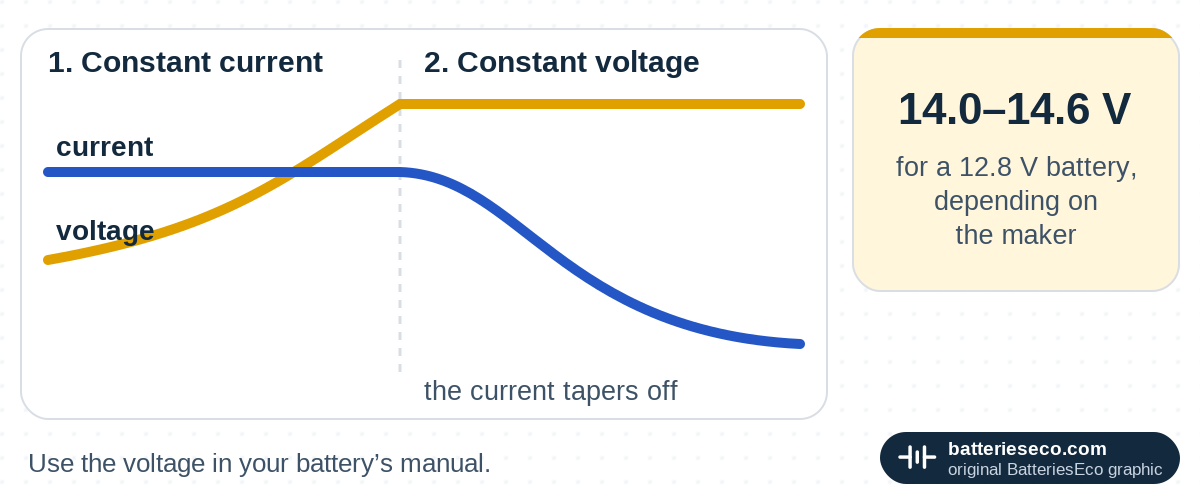
A LiFePO4 battery charges in two stages: constant current up to a set voltage, then constant voltage while the current tapers off. The right voltage is the one in your battery’s manual, around 14.0 V to 14.6 V for a 12.8 V battery depending on the maker.
Use a charger with a lithium mode or an adjustable voltage, with no desulfation or temperature compensation. Don’t charge it below freezing, or below the higher minimum some makers set, unless the battery has built-in heating.
The voltage for charging a LiFePO4 battery depends on the manufacturer: Victron recommends 14.2 V of absorption for 2 hours, then 13.5 V float, for its 12.8 V Lithium Battery Smart 1. The current it recommends is 0.5C, half the battery’s capacity in amp-hours, so 50 A for a 100 Ah battery 1. Charging that battery is allowed only between 41 °F and 122 °F (5 °C and 50 °C), according to its manual 2.
How charging a LiFePO4 battery differs from lead-acid
Renogy’s and Super B’s manuals describe two stages: constant current up to a set voltage, then constant voltage while the current tapers off 3 4. Chargers call that constant-voltage stage absorption; float is a lower voltage held afterward.
For its Core Series 12.8 V 100 Ah Mini self-heating battery, Renogy describes 50 A of constant current up to 14.6 V, then 14.6 V of constant voltage until the current drops below 5 A 3. The whole charge typically takes 2.5 hours 3.
For a lithium battery, the manufacturers below advise turning off or changing several charging steps that lead-acid batteries need, or their chargers do it:
- Temperature compensation, which shifts the charge voltage with temperature. Victron says to disable it (0 mV/°C) for its Lithium Battery Smart 1, and Battle Born gives the same setting for its BB5012 5. Mastervolt recommends a temperature sensor for its gel and AGM batteries but not for lithium-ion 6.
- Desulfation and reconditioning, lead-acid stages that pulse or raise the voltage to reverse sulfation. The lithium mode of Victron’s Blue Smart IP65 chargers turns reconditioning off 7.
That same lithium mode turns float off; a storage mode holds the battery at 13.5 V instead 7.
Yet Victron’s battery manual gives 13.5 V float for its Lithium Battery Smart 1, and Super B and Battle Born give float ranges of their own, listed in the table below 8 5. Renogy says leaving its battery on float keeps balancing the cells without harming it 3. Float voltages don’t match from one manufacturer to the next.
LiFePO4 charging voltage by manufacturer
| Battery (12.8 V) | Absorption voltage (bulk on some chargers) | Float | Source |
|---|---|---|---|
| Victron Lithium Battery Smart | 14.2 V for 2 hours | 13.5 V | Manufacturer’s manual (rev 21, 2026) 1 |
| Super B (its LFP batteries) | 14.0 V to 14.6 V; typically 14.2 V or 14.4 V, depending on the battery’s software version (14.4 V in the Epsilon manual) | 13.6 V to 13.9 V, typically 13.8 V | Manufacturer’s manuals (2026) 8 4 |
| Battle Born BB5012 (50 Ah) | 14.2 V to 14.6 V | 13.4 V to 13.8 V | Manufacturer’s manual (2021) 5 |
| Fogstar Drift | 14.2 V (acceptable 14.2 V to 14.4 V) | 13.6 V (acceptable 13.3 V to 13.6 V) | Manufacturer’s manual (2025) 9 |
| Renogy Core Series 100 Ah Mini | 14.6 V in its charging description; 14 V (±0.2 V) as the charger setting | Not given | Manufacturer’s manual (2024) 3 |
Our reading: Renogy’s manual sets chargers to 14 V (±0.2 V) but describes charging up to 14.6 V, so ask Renogy if you’re unsure which to use.
To give the cells time to balance, Victron recommends at least 2 hours of absorption a month for a lightly used Lithium Battery Smart 1. In a heavily cycled off-grid system, it recommends 4 to 8 hours a month 1.
Super B advises a full charge every 7 to 20 days of use, or every 10 to 20 cycles, according to its manual 8.
Fogstar says its battery’s BMS can take 4 to 5 charge cycles to learn the battery 9. It says to charge it to the full 14.2 V for the first few cycles 9.
For a 24 V or 48 V bank built from Smart batteries in series, Victron gives absorption voltages of 28.4 V and 56.8 V, respectively 1. Not every battery can be wired in series, though.
Super B says its Epsilon must never be wired in series 4. Victron allows it for its Lithium Battery Smart 10, and Renogy allows up to four Core Series 100 Ah Mini batteries in series 3.
How long does a LiFePO4 battery take to charge?
Victron gives a rule for its Blue Smart IP65 chargers: divide the amp-hours you need to put back by the charger’s current, and you get the length of the first stage in hours 11.
In Victron’s example, an empty 100 Ah lithium battery takes about 9.5 hours on a 10 A charger, plus half an hour of absorption, for 10 hours in all 11.
As we read it, anything drawing power while the battery charges makes it take longer.
At the 0.5C it recommends for its Lithium Battery Smart, Victron says an empty battery recharges in 2 hours, followed by 2 more hours of absorption 1.
Our calculation, from those two Victron examples for an empty 100 Ah battery: 4 hours at 50 A (2 hours plus 2 hours of absorption), compared with 10 hours on a 10 A charger.
The manuals and product pages we read give these charge currents:
| Battery | Recommended charge current | Maximum | Source |
|---|---|---|---|
| Victron Lithium Battery Smart 100 Ah | 50 A or less | 200 A | Manufacturer’s datasheet (undated) 10 |
| Renogy Core Series 100 Ah Mini | 50 A | 100 A | Manufacturer’s manual (2024) 3 |
| Mastervolt MLI Ultra 12/1250 (100 Ah) | 50 A or less | 100 A | Manufacturer’s product page (undated) 12 |
| Super B Epsilon 100 Ah | 33 A (C/3) for the longest life | 90 A | Manufacturer’s manual (2026) 4 |
| Epoch B12100B (100 Ah) | Not given | 50 A (continuous charge rating) | Manufacturer’s manual (2022) 13 |
Some charger manufacturers also set a minimum battery size. Victron gives a minimum lithium battery capacity of 8 to 50 Ah for its Blue Smart IP65 chargers of 4 A to 25 A, so that the charge current stays at or below 0.5C 7.
CTEK says its LITHIUM XS, a 5 A charger, charges LiFePO4 batteries of 5 to 60 Ah and can maintain batteries up to 120 Ah 14.
LiFePO4 battery chargers with a lithium mode
Among the chargers whose manuals or product pages we read, the following offer a LiFePO4 setting.
- Victron Blue Smart IP65 (230 V models, 12 V, 4 to 25 A): Li-ion mode at 14.2 V absorption, float off, 13.5 V storage, reconditioning off. In this mode, temperature compensation is off and the charging program drops from 7 stages to 4 7.
- CTEK LITHIUM XS (EU 220-240 V version): made for 12 V LiFePO4 batteries only, 5 A, with 8 charging steps, including a test of whether the battery holds its charge 14.
As we read it, those are European versions: for a model sold for 120 V outlets, check its own manual.
A battery whose BMS has shut it off for low voltage can look dead to a charger. Victron says the Blue Smart IP65 resets this protection automatically and starts charging 7; CTEK says its LITHIUM XS resets it automatically 14.
Can you use a lead-acid charger?
Super B advises against it, saying lead-acid chargers can damage its batteries 8. Liontron’s LX series manual allows one, provided the right charge voltage is set and no desulfation program runs 15.
In our view, a lead-acid charger with no voltage setting, or with a desulfation mode you can’t turn off, shouldn’t charge a LiFePO4 battery.
Charging from the alternator while you drive
In an RV, a van or a boat, the engine’s alternator can charge the house battery on the road. With a lithium house battery, makers recommend a DC-DC charger (also called a battery-to-battery charger or booster) between the starting battery and the house battery.
- For Germany’s auto club ADAC, such a charger is practically a must when the starting battery is lead-acid 16. Super B requires a DC-DC booster to charge its Epsilon from an alternator 4, and Liontron’s manual says a LiFePO4 battery should never be wired straight to a lead-acid battery 15.
- Victron explains why. A lithium battery’s low impedance pulls a high current from the alternator, and controlled charging keeps the alternator from overloading. In vehicles built to the European Euro 5 and Euro 6 emission standards, it adds, “smart” alternators often supply a charging voltage that’s too low even with the engine running 17.
- Renogy’s manual for its 12 V 20 A and 40 A DC-DC chargers (2024) says they handle smart and traditional alternators alike. To find out which one a vehicle has, it says to measure the starting battery’s voltage with the engine running: about 14.4 V points to a traditional alternator, about 12.5 V to 13.5 V to a smart one 18.
As we read it, a starting battery that shows 12.5 V to 13.5 V with the engine running is below the 14.2 V of absorption Victron recommends for its Lithium Battery Smart. A Lithium Battery Smart charged straight from such an alternator might not reach its absorption voltage.
Installing a DC-DC charger means sizing cables and fuses and connecting to the vehicle’s electrical system.
Our reading: follow the charger’s manual, or have a qualified installer do it.
Charging a lithium battery in cold weather
When you charge a lithium-ion cell that’s too cold, lithium can deposit as metal on the graphite electrode instead of moving into it. This is called lithium plating.
In a 2018 study, researchers from Aalto University and partners cycled commercial 2.3 Ah LiFePO4 cells with an electric-vehicle profile. They charged at 1C until the cells fell to 80% of their starting capacity, then took one cell per temperature apart 19.
At about 0 °F (−18 °C), cycle life fell below 10% of the room-temperature figure, while at 32 °F (0 °C) the cells still reached about 90% of it. The researchers found heavy lithium plating in the cell cycled at about 0 °F (−18 °C), and much less in the one cycled at 32 °F (0 °C) 19. They concluded that charging below freezing should be avoided 19.
The manufacturers’ own cold-weather limits:
| Battery (12.8 V) | Charging allowed | Discharging allowed | Source |
|---|---|---|---|
| Victron Lithium Battery Smart | 41 °F to 122 °F (5 °C to 50 °C) | −4 °F to 122 °F (−20 °C to 50 °C) | Manufacturer’s manual (rev 21, 2026) 2 |
| Battle Born BB5012 | BMS blocks charging below 25 °F (−3.9 °C); cells rated for charging at 32 °F (0 °C) and above | Down to −4 °F (−20 °C) | Manufacturer’s manual (2021) 5 |
| Epoch B12100B | 32 °F to 131 °F (0 °C to 55 °C) | −4 °F to 131 °F (−20 °C to 55 °C) | Manufacturer’s manual (2022) 13 |
| Super B Epsilon, heating off | 32 °F to 113 °F (0 °C to 45 °C) | −4 °F to 140 °F (−20 °C to 60 °C) | Manufacturer’s manual (2026) 20 |
| Renogy Core Series 100 Ah Mini, normal charging | 32 °F to 131 °F (0 °C to 55 °C) | −4 °F to 140 °F (−20 °C to 60 °C) | Manufacturer’s manual (2024) 21 |
Victron explains its limit: it says a lithium cell is permanently damaged if charged below 41 °F (5 °C), and that setting its BMS’s minimum charge temperature lower voids the warranty 2. ADAC says a LiFePO4 battery can’t be charged below about 37 °F (3 °C) without heating 16.
As we read it, Battle Born’s BMS cutoff (25 °F) sits below the temperature its cells are rated to charge at (32 °F). And a battery that has cooled to just above freezing after a cold night in an unheated van is outside Victron’s charging range but inside the ranges the other four makers list in the table.
The charger doesn’t always know the battery’s temperature. Victron warns not to charge a lithium-ion battery below 32 °F (0 °C) with its Blue Smart IP65 chargers 7.
Our reading: that manual describes no automatic cold cutoff.
With the Lithium Battery Smart, the external BMS should ideally stop the charger, cutting it off below the minimum charge temperature 2.
Self-heating batteries
Some batteries heat their own cells. In the three whose manuals we read, the heater runs by default on the charger’s current:
- Super B Epsilon. By default, if a cell is below 32 °F (0 °C) when charging starts, the BMS opens (disconnects) the charge path and uses the charger’s power to heat the cells first. Charging from −22 °F (−30 °C) needs an outside source of at least 80 W for the 100 Ah model and 120 W for the 150 Ah 20.
- Renogy Core Series 100 Ah Mini self-heating. A 110 W heater starts below 41 °F (5 °C) and stops above 50 °F (10 °C). It needs a steady charge current above 10 A per battery, and charging is then possible from −22 °F to 131 °F (−30 °C to 55 °C) 21.
- Fogstar Drift. Around 32 °F (0 °C), a low-temperature warning switches on the 36 W heating pads, powered only by the incoming charge current (at least 4 A). The battery lets the charge through once it reaches 41 °F (5 °C) 9.
Renogy asks for more than 10 A and Fogstar for at least 4 A 21 9.
In our view, a small charger, or a solar panel giving little current on a winter morning, may not be enough to start the heater.
Heating doesn’t solve everything. The German RV magazine promobil tested nine batteries of 150 Ah or more (one sample of each, supplied by its maker; article updated October 5, 2026).
All of them had BMS-controlled cell heating. After at least 12 hours at 10 °F (−12 °C), one battery let charge current through only after nearly 40 minutes 22. Another’s BMS switched the charge on and off for about four minutes before going over to heating, and a third locked up until it was reset 22.
What charge to store a LiFePO4 battery at
Storage advice from the manuals we read:
- Super B calls 40% to 60% charge optimal. It advises 50% when nothing is connected and no CAN, LIN or Bluetooth link is active, but 95% if there’s no battery disconnect switch 8. For its Epsilon, it gives a storage range of −4 °F to 113 °F (−20 °C to 45 °C) for less than a month and 64 °F to 82 °F (18 °C to 28 °C) for longer 20.
- Fogstar says to charge to 40% to 50%, store ideally between 41 °F and 59 °F (5 °C and 15 °C), check the voltage every 3 to 6 months and recharge if it drops below 12 V 9.
- Battle Born recommends storing its BB5012 at 100% charge with the negative cable disconnected, and says its batteries lose about 2% to 3% of capacity a month on average 5.
Our calculation, at Battle Born’s average of 2% to 3% a month: a Battle Born battery stored for 3 months loses about 6% to 9% of its capacity, and one stored for 6 months about 12% to 18%.
What to check on a charger
In our view, these are the checks:
- The charger has a LiFePO4 mode or an adjustable voltage that lets you set the voltages in your own battery’s manual, with no desulfation or equalization.
- Its current suits the battery: no higher than the datasheet’s maximum, and not so low that charging takes too long for your use.
- It can wake a battery whose BMS has shut off.
- Something stops charging in the cold: a temperature sensor, a link with the BMS or a self-heating battery.
The chemistry itself is in our LiFePO4 guide, whose voltage chart shows why a voltmeter tells you little about a resting LiFePO4 battery’s charge. The rest of our batteries section covers the other chemistries.
Sources
- Lithium Smart Battery Manual, rev 21 - 01/2026 (EN)
- Lithium Smart Battery Manual, rev 21 - 01/2026 (EN)
- RENOGY Core Series 12.8V 100Ah Mini Lithium Iron Phosphate Battery w/Self-heating Function (RBT12100LFP-H) User Manual, version A0, November 25, 2024 (EN/DE)
- Epsilon 12V100Ah / 12V150Ah User Manual (Version V1.9.1, January 2026), with Epsilon 12V150Ah datasheet v3 (EN)
- Battle Born Batteries Model BB5012, 50Ah 12V Deep Cycle LiFePO4 Battery, Manual and Installation Guide
- Charging batteries (technical background page)
- Blue Smart IP65 Charger (230 V) — manuel en ligne (FR): Caractéristiques, Fonctionnement, Spécifications techniques
- Usage & Maintenance Manual: charging and storage instructions applicable to Super B energy and starter batteries (Version V1.0, January 2026)
- Fogstar Drift LiFePO4 Battery User Manual, 2025 V2.2 (file NEW2024_FogstarDriftManual_V3_MARCH25)
- 12,8 & 25,6 Volt Lithium-Iron-Phosphate Batteries Smart — datasheet (EN)
- Blue Smart IP65 Charger (230 V) — manuel en ligne (FR): Fonctionnement, Estimation du temps de charge
- MLI Ultra 12/1250, MLI Ultra 12/2500 and MLI Ultra 12/5500 — product pages with specifications
- Product Manual: Li-ion Battery Systems (Updated 11/30/22), Technical Data Part I
- LITHIUM XS EU — product page with technical data
- Bedienungsanleitung Lithium LiFePO4 Batterien LX Smart BMS Serie 12,8V
- Nachrüstung von Stromspeicher- und Ladelösungen für Campingfahrzeuge (33109 BOE)
- Orion XS 12/12-50A DC-DC battery charger – manual (2 General; 3.3 Cable and fuse recommendations; 6 Technical data)
- DC-DC Battery Charger 12V 20A/40A RBC20D1U/RBC40D1U User Manual, Version A2, December 13, 2024 (file UM_RBC40D1U-G2.pdf)
- Low-temperature aging mechanisms of commercial graphite/LiFePO4 cells cycled with a simulated electric vehicle load profile — A post-mortem study (Journal of Energy Storage 20, 344-356; accepted version)
- Epsilon 12V100Ah / 12V150Ah User Manual (Version V1.9.1, January 2026), sections 3.1.2, 3.1.6, 4.9, 5.2, 5.3.3, 5.5 and 5.7
- RENOGY Core Series 12.8V 100Ah Mini Lithium Iron Phosphate Battery w/Self-heating Function (RBT12100LFP-H) User Manual, version A0, November 25, 2024 (EN/DE)
- Lithium-Batterien für Wohnmobile mit 150 Ah im Test: 9 LiFePO4-Akkus treten an