Convert watts to amps, amp-hours to watt-hours, and Wh to kWh
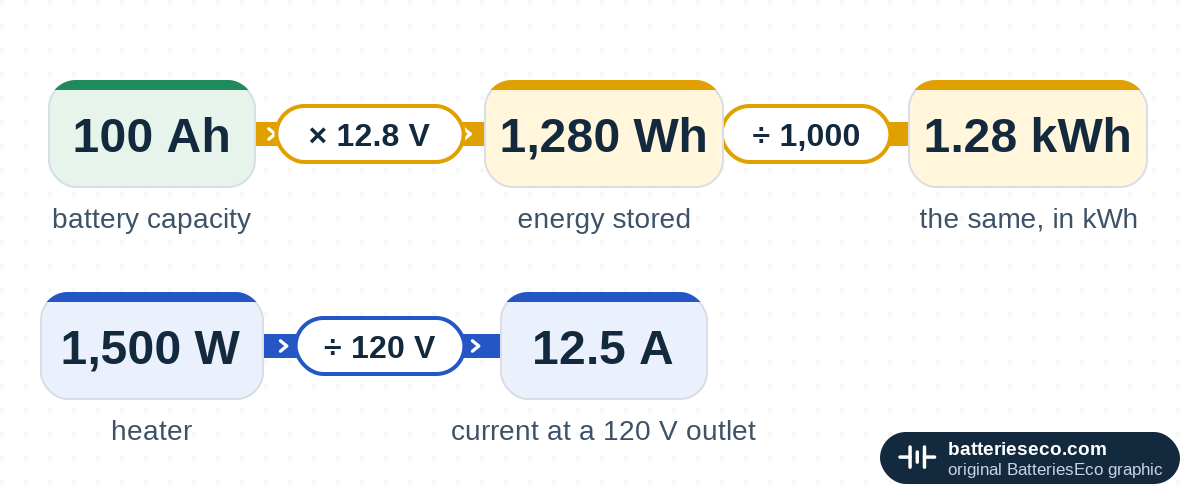
To turn amp-hours into watt-hours, multiply by the battery’s nominal voltage; divide milliamp-hours by 1,000 first. A 100 Ah battery at 12.8 V stores 1,280 Wh (100 × 12.8), or 1.28 kWh.
To turn watts into amps, divide by the voltage: a 1,500 W heater draws 12.5 A from a 120 V outlet, though for motors on AC power the current can be higher than watts divided by volts.
Updated
- In kilowatt-hours
- 1.28 kWh
- In amp-hours at this voltage
- 100 Ah
- Power
- – W
- Current at this voltage
- – A
Watts = volts × amps, and watt-hours = volts × amp-hours. On an AC outlet this is exact only for a purely resistive load, such as a heater or a kettle; for motors and other inductive loads the current can be higher than watts ÷ volts (power factor below 1).
| Preset | Voltage |
|---|---|
| 12 V lead-acid (AGM, gel, flooded) | 12 V |
| 12.8 V (“12 V” LiFePO4) | 12.8 V |
| 24 V lead-acid | 24 V |
| 25.6 V (“24 V” LiFePO4) | 25.6 V |
| 48 V lead-acid | 48 V |
| 51.2 V (“48 V” LiFePO4) | 51.2 V |
| 120 V AC, household outlet (United States) | 120 V |
| 230 V AC, household outlet (United Kingdom) | 230 V |
| 240 V AC, large appliances (United States) | 240 V |
To convert watts to amps, or amp-hours to watt-hours, you always need the voltage: without it, an amp-hour rating says nothing about energy.
Our calculation: two batteries rated 100 Ah can hold very different amounts. A 12 V lead-acid one holds 1,200 Wh; a 25.6 V lithium iron phosphate (LiFePO4) one holds 2,560 Wh.
To compare batteries and power stations, use their energy, in watt-hours (Wh) or kilowatt-hours (kWh). Our kWh guide explains these units, and our electricity basics section covers volts and amps.
Formulas for watts, amps and watt-hours
- Power (W) = voltage (V) × current (A)
- Current (A) = power (W) ÷ voltage (V)
- Energy (Wh) = capacity (Ah) × voltage (V)
- Capacity (Ah) = energy (Wh) ÷ voltage (V)
- Energy (Wh) = capacity (mAh) ÷ 1,000 × voltage (V)
- 1 kWh = 1,000 Wh
The International Bureau of Weights and Measures defines the volt as one watt per ampere, and the prefix milli- as one-thousandth 1. Eurostat defines the kilowatt-hour as 1,000 watt-hours 2.
Our reading: the formulas above follow from these SI definitions.
US hazardous materials rules use the same formula for a lithium-ion battery’s rating: amp-hours times nominal voltage 3. The calculator applies these formulas and rounds only the numbers it displays.
How to convert watts to amps at 120 V, 240 V and 230 V
In the US, homes get 120/240 V single-phase service 4. The Department of Energy says the US uses 110-120 V at 60 Hz 4. In the UK, regulations set the household supply at 230 V and 50 Hz 5.
Our calculation: the same wattage draws a different current at each of these voltages.
| Power | At 120 V (US outlet) | At 240 V (US large appliances) | At 230 V (UK) |
|---|---|---|---|
| 1,500 W heater | 12.5 A | 6.25 A | 6.5 A |
| 1,000 W load | 8.3 A | 4.2 A | 4.3 A |
| 60 W load | 0.5 A | 0.25 A | 0.26 A |
These currents assume a load that turns all the current into useful power, such as a space heater or a toaster. Motors, transformers and other inductive loads don’t 6.
The Department of Energy defines power factor as the ratio of real (working) power to apparent (total) power. In its example, a power factor of 0.70 means only 70% of the current supplied does useful work. It lists electric motors among the loads that lower power factor 7.
In our reading of these two sources, household (single-phase) AC works like this: real power = volts × amps × power factor, and volts × amps alone is the apparent power, as in the three-phase formulas without their √3 factor 7 6. So a load with a power factor below 1 draws more current than watts ÷ volts; if a label gives amps, use that figure.
Our calculation: a motor load taking 1,000 W of real power from a 120 V outlet, at the DOE example’s power factor of 0.70, would draw about 11.9 A (1,000 ÷ (120 × 0.70)), not the 8.3 A that watts ÷ volts gives.
Which voltage to use for a battery
Use the battery’s nominal voltage, not its charging voltage. Victron gives 3.2 V nominal for one lithium iron phosphate cell: its 12.8 V batteries have four cells in series, and its 25.6 V batteries have eight 8.
Super B also rates its Epsilon 12V100Ah at 12.8 V nominal and 1,280 Wh, and recommends a higher voltage, 14.4 V, to charge it 9. For a “12-volt” lead-acid battery, use 12 V: Universal Power Group’s UB1270 AGM datasheet, for example, prints 12 V as its nominal voltage 10.
mAh to Wh for power banks and phones
According to Anker, the mAh printed on a power bank is the capacity of its cells, and most lithium-ion power banks use cells with a nominal voltage of 3.7 V. So a 20,000 mAh power bank stores 74 Wh 11. The calculator gives the same answer: 20,000 mAh at 3.7 V is 74 Wh.
In another help article, Anker explains its capacity ratings using 3.6 V cells 12.
Our calculation: the same 20,000 mAh comes to 72 Wh at 3.6 V. Multiplied by the 5 V USB voltage instead, it would come to 100 Wh, more than the 74 Wh Anker gives.
Anker explains that converting the cells’ 3.7 V to 5 V USB output loses energy (the conversion is about 80% to 85% efficient). It advises comparing power banks in watt-hours, not milliamp-hours alone 11.
A phone battery works the same way when its maker gives the voltage. Fairphone rates the Fairphone 4’s spare battery at 3,905 mAh, 15.03 Wh and 3.85 V nominal 13.
Our calculation: with Anker’s 80% to 85% conversion, its 74 Wh example leaves about 59 to 63 Wh at the 5 V output (74 × 0.80 = 59.2; 74 × 0.85 = 62.9). That’s about four times the 15.03 Wh of the Fairphone 4’s battery.
Watt-hour limits when you fly
Airline limits are set in watt-hours, so this is where the conversion matters most.
- US flights. The Federal Aviation Administration (FAA) says spare lithium-ion batteries and power banks go in carry-on baggage only, with the terminals protected from short circuits. Lithium-ion batteries are limited to 100 Wh each, and with the airline’s approval you may also carry up to two larger batteries rated 101 to 160 Wh 14.
- UK flights. The UK Civil Aviation Authority (CAA) also allows spare batteries in carry-on baggage only, up to 100 Wh without approval, and over 100 Wh and up to 160 Wh with the airline’s approval 15. Since March 27, 2026, its rules also limit passengers to two power banks and ban recharging them on board, following a change to the international (ICAO) rules 16 17.
IATA, the airlines’ trade association, is stricter than the FAA and the CAA on power banks 18. Its 2026 passenger guidance already lists power banks over 100 Wh as forbidden 18, and the edition of its Dangerous Goods Regulations that takes effect January 1, 2027 drops the approval route for them 19 20.
Our reading: the FAA and CAA pages, which set the rules for US and UK flights, still allow a power bank of 101 to 160 Wh with the airline’s approval, but an airline that follows IATA’s guidance may refuse it.
Our calculation: at 3.7 V, 100 Wh is 27,027 mAh. A 20,000 mAh power bank like Anker’s 74 Wh example stays under that 100 Wh line.
Check your airline’s own rules before you fly: the FAA and the CAA both say airlines may be stricter 14 15.
Common batteries in watt-hours
| Battery | Capacity | Nominal voltage | Energy (our calculation) |
|---|---|---|---|
| “12-volt” LiFePO4, e.g. Super B Epsilon 12V100Ah 9 | 100 Ah | 12.8 V | 1,280 Wh (1.28 kWh) |
| “24-volt” LiFePO4, e.g. Victron Lithium Battery Smart 8 | 100 Ah | 25.6 V | 2,560 Wh |
| “12-volt” lead-acid | 100 Ah | 12 V | 1,200 Wh |
| Universal Power Group UB1270 AGM 10 | 7 Ah (20-hour rate) | 12 V | 84 Wh |
| 20,000 mAh power bank, per Anker 11 | 20,000 mAh | 3.7 V | 74 Wh |
| Fairphone 4 battery 13 | 3,905 mAh | 3.85 V | 15.03 Wh |
How much of the rated energy you get
The result is the battery’s rated energy. You may get less out of it.
ADAC, Germany’s auto club, measured the gap in a 2025 test of eight portable power stations rated 768 to 1,440 Wh: on average, usable capacity came out a good 10% to 15% below the manufacturer’s figure 21. For a lead-acid battery, ADAC advises using only 30% to 75% of the capacity, depending on the type and the discharge current 22.
Cold weather cuts capacity too. Victron’s datasheet gives its 100 Ah LiFePO4 Smart battery 80 Ah at 32 °F (0 °C), for a discharge at up to 1C (a current equal to the rated amp-hours, 100 A here) 23.
Our calculation: at 32 °F (0 °C), those 80 Ah at 12.8 V come to 1,024 Wh (80 × 12.8), a fifth below the 1,280 Wh of the full 100 Ah.
To estimate how long a battery will run your appliances, our power station runtime calculator counts only part of the rated capacity: 85% for a portable power station. For other conversions and estimates, see the calculators section.
Sources
- Le Système international d’unités (SI), 9e édition 2019, version V4.01 (juin 2026), §5.4 (écriture des symboles), tableaux 4, 7 et 8
- Glossary: Kilowatt-hour (kWh) — Statistics Explained
- 49 CFR § 171.8 Definitions and abbreviations
- Electric Power eTool, Illustrated Glossary: Distribution Systems (OSHA); Electricity 101 (DOE Office of Electricity)
- The Electricity Safety, Quality and Continuity Regulations 2002, regulation 27; The Electricity Safety, Quality and Continuity Regulations (Northern Ireland) 2012, regulation 28
- Power Factor (training slide deck, file VInPLT-Power-Factor-2023.pdf)
- Reducing Power Factor Cost (Fact Sheet, Motor Challenge, a Program of the U.S. Department of Energy, DOE/GO-10096-286)
- Lithium Battery 12,8V & 25,6V Smart datasheet
- Epsilon 12V100Ah / 12V150Ah User Manual (Version V1.9.1, January 2026), with Epsilon 12V150Ah datasheet v3 (EN)
- UB1270 Sealed Lead-Acid Battery (AGM) datasheet, UPG No. 40800
- Why is the Rated Capacity of Power Banks Lower Than Expected? (Anker support article)
- Detailed Explanation of Power Bank Silk Screen Details (Anker support article)
- Fairphone 4 Batterie - Pièces de rechange
- PackSafe - Lithium Batteries
- What items can I travel with and which are restricted (Air passengers > About your trip > Baggage)
- Changes to rules on the carriage of lithium cells/batteries and power banks (Commercial industry > Airlines > Dangerous goods)
- De nouvelles restrictions concernant les batteries externes contribueront à renforcer la sécurité de l’aviation civile internationale (communiqué de presse) / New power bank restrictions will safeguard international aviation (press release)
- Passengers Travelling with Lithium Batteries - Guidance Document, Revised for the 2026 Regulations (IATA, 31/03/2026)
- Dangerous Goods Regulations, Edition 68 (1 January 2027): Table 2.3.A (Dangerous Goods Requiring Operator Approval) and Table 2.3.B (Dangerous Goods Operator Approval Not Required), English extracts
- Changes Regarding Power Banks: Guidance Document for Operators, implementing the changes announced on 27 March 2026 (IATA, 31/03/2026)
- Mobile Powerstations im ADAC Test: Nur die Hälfte schneidet gut ab
- Nachrüstung von Stromspeicher- und Ladelösungen für Campingfahrzeuge (33109 BOE)
- Lithium Battery 12,8V & 25,6V Smart datasheet