RV and camper batteries: lithium or AGM, how many amp-hours, and how to charge them
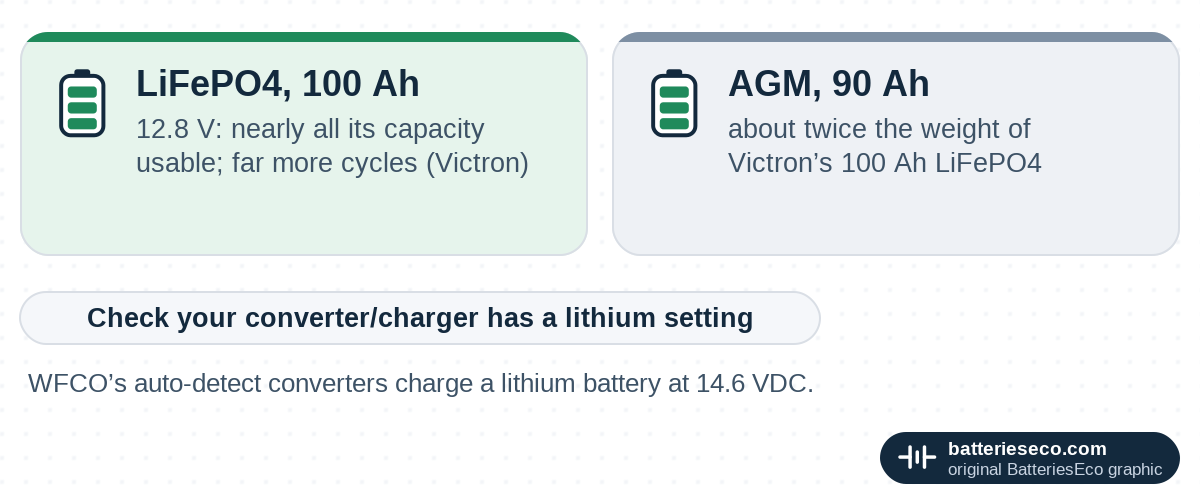
A 12.8 V LiFePO4 house battery lets you use nearly all its capacity. Victron rates its LiFePO4 batteries for far more cycles than its AGM batteries, and its 100 Ah LiFePO4 weighs about half as much as its 90 Ah AGM.
Check that your converter/charger has a lithium profile, that a DC-DC charger sits between the alternator and the battery and that the battery’s BMS allows the current your inverter draws; don’t charge it below freezing unless it’s a self-heating model.
An RV battery on the house side runs your lights, water pump, fridge controls and inverter when you’re not plugged in. Germany’s auto club ADAC says a LiFePO4 battery can be discharged almost 100% 1. A lead-acid one, it says, should only be discharged by 30% to 75% of its capacity, depending on the type and the discharge current 1.
Lithium or AGM in an RV
ADAC also says lead-acid batteries are often damaged by a full discharge 1. Most lithium house batteries in vehicles, it adds, are in practice LiFePO4 with a built-in battery management system (BMS) 1.
In a May 2024 article, the German RV magazine promobil drained an AGM and a LiFePO4 battery on an RV load profile. The 110 Ah LiFePO4 delivered 110 Ah over 2 days and 6 hours, and the 120 Ah AGM 72 Ah over 1 day and 7 hours. The magazine tested only one battery of each type 2.
Our calculation: 2 days and 6 hours is 54 hours, and 1 day and 7 hours is 31 hours. On the same RV’s loads, the lithium battery kept things running 23 hours longer, close to one more day between charges.
On the scale, Victron’s 90 Ah AGM deep-cycle battery (12 V) comes in at 27 kg, about 60 lb 3, while its 100 Ah LiFePO4 Smart (12.8 V) weighs 14 kg, about 31 lb 4.
On cycle life, Victron rates its AGM deep-cycle batteries at 400 cycles at 80% discharge 5 and its LiFePO4 Smart batteries at 2,500 cycles at 80% depth of discharge, to 80% of nominal capacity 6. Our lithium vs AGM guide sets the two chemistries side by side.
Amp-hours: what you need and what you get
Begin with your daily use in watt-hours and the number of days you want between charges. Our runtime calculator estimates how long a battery runs your appliances. After that, look at what the battery really holds.
In another promobil test, last updated in October 2026, nine LiFePO4 RV batteries of 150 Ah or more were each discharged at 0.5C, a current of half the rated amp-hours 7. Three of the results:
| Battery | Rated | Measured |
|---|---|---|
| Tempra | 150 Ah | 155.3 Ah |
| Supervolt SX240Pro | 240 Ah | 243.2 Ah |
| NL LB180 | 180 Ah | stopped at 170.8 Ah |
The magazine tested one sample per model 7.
A battery’s settings also cut its usable capacity. By default, Super B’s Epsilon shuts down at 20% charge, according to its manual 8. At that level, the manual says, the battery has about 70 days before a deep discharge 8.
What the BMS will deliver
The BMS protects the cells and shuts off if the current gets too high or the voltage too low. ADAC notes that it shuts off without warning when overloaded, and says a LiFePO4 battery for a 1,500 W inverter should be at least 150 Ah 1.
As we read it, when you’re off shore power, a BMS that trips takes everything on the house battery down at once: the lights, the water pump and the inverter.
Continuous current limits differ by model. Super B rates its Epsilon 100 Ah at 190 A continuous with 300 A pulses for 10 seconds 9.
Our reading: before you buy, compare the BMS limit with what your inverter pulls at full load. Our inverter guide shows how to estimate that current.
Does your converter charge lithium?
In an RV, the converter/charger charges the house battery when you’re plugged in at a campground (the pedestal side is in our RV, van and boat guides). Check what yours does with lithium:
- WFCO’s auto-detect WF-9800-AD converters select the charging profile automatically 10. A lithium battery gets a two-stage charge at 14.6 V for one to four hours, then 13.6 V; lead-acid and AGM get 14.4 V, then 13.6 to 13.2 V in storage mode 10.
- Progressive Dynamics says its PD9200 is a lead-acid charger, not directly compatible with a LiFePO4 battery, though a button on its pendant lets you manually apply 14.4 V for 4 hours 11.
- Battle Born’s 2021 manual for its BB5012 specifies 14.2 V to 14.6 V bulk/absorption (the main charging voltage) and 13.4 V to 13.8 V float (the lower voltage that holds a full battery), with temperature compensation off 12.
A low converter voltage makes charging slow. In Progressive Dynamics’ test, a 125 Ah battery fully discharged to 10.5 V took 70 hours to reach full charge on a 60 A converter set to 13.6 V 11.
Our calculation: 70 hours is 2.9 days (70 ÷ 24, rounded) plugged in at the campground before that battery is full. Our LiFePO4 charging guide goes through voltages and chargers in detail.
Charging from the engine as you drive
With a lithium house battery, ADAC says a DC-DC charger between the alternator and the battery is practically a must when the starting battery is lead-acid 1. Victron explains that a lithium battery’s low internal resistance draws high current from the alternator 13.
Renogy says its 12 V 20 A and 40 A DC-DC chargers work with both smart and traditional alternators 14. With a smart alternator, its manual adds, the charger’s ignition-signal (IGN) wire is required 14.
In our view, have the DC-DC charger installed by someone who knows vehicle electrical systems.
Cold nights and heated batteries
LiFePO4 batteries shouldn’t be charged below freezing unless they heat themselves. Victron allows its Lithium Battery Smart to charge only at 41 °F (5 °C) and above 15, and Battle Born’s BMS blocks charging below 25 °F (−3.9 °C) on its BB5012 12.
Some heated batteries use the charger’s power to warm their cells before they accept a charge 8. When a cell is below 32 °F (0 °C), Super B’s Epsilon blocks the charge and lets the charger power its heaters 8.
In promobil’s test, one heated battery took nearly 40 minutes before it let charge current through, after at least 12 hours at 10 °F (−12 °C) 7. Our cold-charging section has the details.
Keeping it healthy while the RV is parked
An RV draws small currents even when parked: monitors, detectors and controllers. Victron’s SmartShunt battery monitor draws under 1 mA, and its SmartSolar MPPT 75/10 to 100/15 controllers draw 10 mA at 12 V with the load output off 16.
Victron says a residual current of just 10 mA can damage a 200 Ah Lithium Smart battery left discharged for more than 8 days after a low-voltage shutdown. It recommends using a battery disconnect switch, pulling the fuse or disconnecting the battery when the RV isn’t in use 17 18.
As we read it, that 10 mA doesn’t take a forgotten light: one of the SmartSolar controllers above draws that much by itself at 12 V, with its load output off.
A lead-acid battery needs regular charging in storage. Trojan says to store its batteries fully charged and recharge AGM or gel when they fall to 75% charge 19, and Progressive Dynamics says a lead-acid battery self-discharges about 4% a week at 80 °F 11.
For storage, follow your own battery maker’s advice. On lithium, Battle Born recommends 100% charge with the negative cable disconnected for its BB5012 12, while Super B calls 40% to 60% optimal 20.
Sources
- Nachrüstung von Stromspeicher- und Ladelösungen für Campingfahrzeuge (33109 BOE)
- AGM- vs. Lithiumakku: Welche Wohnmobil-Bordbatterie ist besser?
- Gel and AGM Batteries datasheet
- 12,8 & 25,6 Volt Lithium-Iron-Phosphate Batteries Smart — datasheet (EN)
- Gel and AGM Batteries datasheet
- Lithium Battery 12,8V & 25,6V Smart datasheet
- Lithium-Batterien für Wohnmobile mit 150 Ah im Test: 9 LiFePO4-Akkus treten an
- Epsilon 12V100Ah / 12V150Ah User Manual (Version V1.9.1, January 2026), sections 3.1.2, 3.1.6, 4.9, 5.2, 5.3.3, 5.5 and 5.7
- Epsilon 12V100Ah / 12V150Ah User Manual (Version V1.9.1, January 2026), with Epsilon 12V150Ah datasheet v3 (EN)
- Product Manual WF-9800-AD Deck Mount Converter Charger (Rev: 7/24); WFCO Frequently Asked Questions page
- Frequently Asked Questions (Progressive Dynamics, Inc.)
- Battle Born Batteries Model BB5012, 50Ah 12V Deep Cycle LiFePO4 Battery, Manual and Installation Guide
- Orion XS 12/12-50A DC-DC battery charger – manual (2 General; 3.3 Cable and fuse recommendations; 6 Technical data)
- DC-DC Battery Charger 12V 20A/40A RBC20D1U/RBC40D1U User Manual, Version A2, December 13, 2024 (file UM_RBC40D1U-G2.pdf)
- Lithium Battery 12,8V & 25,6V Smart datasheet
- SmartShunt 300 A / 500 A / 1000 A / 2000 A datasheet; SmartSolar Charge Controllers with load output MPPT 75/10, 75/15, 100/15, 100/20-48 V datasheet
- Lithium Smart Battery Manual (12,8V & 25,6V), rev 21 - 01/2026, sections 4.7 and 5.3
- Lithium Smart Battery Manual (12,8V & 25,6V)
- User’s Guide: Trojan deep-cycle flooded, AES, AGM and gel batteries (2023005), sections 3.8, 5, 6 and 7
- Usage & Maintenance Manual: charging and storage instructions applicable to Super B energy and starter batteries (Version V1.0, January 2026)