MPPT vs PWM solar charge controllers: how they differ, what MPPT really gains and how to size one
A PWM controller pulls the panel down to the battery’s voltage; an MPPT controller runs the panel at its maximum power point and steps the voltage down. With a 12 V panel on a 12 V battery, studies found the gap depends mostly on cell temperature.
In a University of Jaén study in Spain, MPPT gained a little over 20% more power with cells below 77 °F (25 °C) and a battery below 13.6 V, and almost nothing above 149 °F (65 °C) with a battery above 14 V.
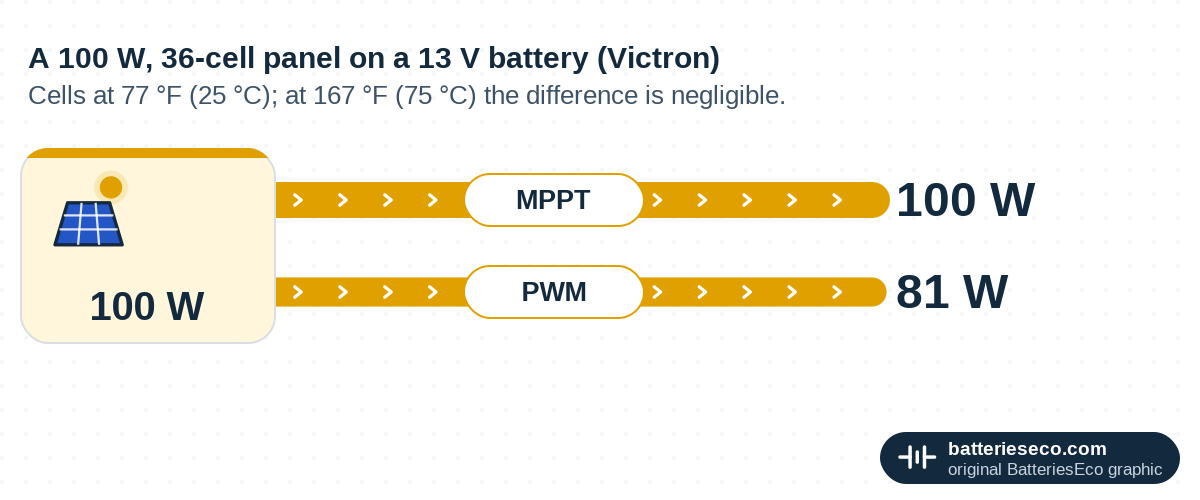
How much an MPPT solar charge controller gains over a PWM one changes with the temperature of the panel’s cells 1. Victron’s calculation puts numbers on it: with cells at 77 °F (25 °C), a 100 W, 36-cell panel charging a 13 V battery gives 100 W through an MPPT controller but 81 W through a PWM one 1. At a cell temperature of 167 °F (75 °C), the difference is negligible 1.
To size a controller, check its maximum charge current and its maximum input voltage; the panels’ open-circuit voltage must stay under that voltage even on the coldest morning.
Why panels need a controller
Victron says solar panels must not be connected directly to a battery and that a solar charger is needed between them 2. Our solar panels section covers the panels themselves.
A 1998 report on charge controllers from the International Energy Agency’s PV program describes the basic job. As the battery approaches full charge, a shunt controller short-circuits the panels and a series controller disconnects them 3.
The international standard IEC 62509 sets performance requirements for PV charge controllers. Its catalog page says it covers lead-acid batteries 4.
Our reading: that scope leaves lithium batteries out; the lithium section below covers what makers do.
What’s the difference between MPPT and PWM?
A PWM (pulse-width modulation) controller sends current to the battery in high-frequency pulses of varying length, so the battery gets a constant-voltage charge 3. Morningstar explains that a PWM controller connects the panels directly to the battery, which pulls their voltage down to the battery’s 5.
In Morningstar’s figures, a “12 V” panel commonly has a maximum-power voltage of about 17 V at standard test conditions, while a 12 V battery sits between 10 and 15 V. The bigger that gap, it says, the more energy a PWM controller wastes 5.
An MPPT (maximum power point tracking) controller runs the panels at their maximum power point and steps the voltage down. In Morningstar’s example, a 100 W panel at 17 V sends 5.88 A into the controller, which puts 8.33 A into a 12 V battery, assuming 100% efficiency 5.
Is MPPT better than PWM?
Victron’s datasheet for its SmartSolar 75/10 to 100/20 claims up to 30% more harvest than PWM, especially under cloudy skies 6. EPEVER says 20% to 30% for its Tracer-AN G3 7. Morningstar writes that even a basic MPPT controller is generally accepted to deliver 10% to 15% more charge 5.
None of these makers gives test conditions for its figure. Two independent studies, both with 12 V modules on a 12 V battery, found that the gain depends mostly on temperature.
At the University of Jaén in Spain (published 2013), researchers measured more than 5,000 current-voltage curves on two 12 V modules over several months 8. From them, they calculated that MPPT gained a little over 20% more power with modules below 77 °F (25 °C) and a battery below 13.6 V 8. Above 149 °F (65 °C), with a battery above 14 V, the gain was negligible 8.
With some realistic controller efficiencies and an average battery voltage above 13.6 V, the daily energy gain from MPPT could be negligible, or even negative, in most months studied 8. Only in the winter months might it not turn negative 8.
At Kenyatta University in Nairobi, Kenya (published 2024), the field tests ran for three months on 50 W, 36-cell modules 9. Two off-the-shelf MPPT controllers gave about 24% to 29% more energy than a PWM controller while the cells stayed below 122 °F (50 °C) 9. At the highest cell temperatures, their advantage dropped to almost nothing 9.
The IEA’s 1998 report put MPPT’s gain at about 5% to 10% more charging current, and advised buyers to check that the controller’s own power draw didn’t eat it up 3. Those were 1990s controllers and panels.
Morningstar concludes that MPPT pays off most in cold climates and that heat can cancel its advantage 5. PWM, it says, can be the better choice for small, low-current systems and for arrays much larger than the loads 5.
Our reading: a 36-cell panel on a 12 V battery used mostly in summer is where PWM loses least. A higher-voltage panel, or winter use, points to MPPT.
Matching panels to a PWM controller
With PWM, Morningstar calls for 36-cell or 72-cell modules whose maximum-power voltage is above 15 V for a 12 V battery, 30 V for 24 V and 60 V for 48 V 5. It adds that the panels’ short-circuit current must not exceed the controller’s current rating 5.
Take Renogy’s Wanderer 10 A PWM controller. According to its safety warnings, it takes at most 50 V of input, and its error-code table limits the panels’ short-circuit current to 10 A 10. Renogy pairs it with 130 W of panels on a 12 V battery 10.
How to size a charge controller for current
An MPPT controller caps the current it sends to the battery. Victron’s example is its SmartSolar 75/15: even with a 360 W panel, that’s 15 A × 12 V = 180 W into a 12 V battery, but 360 W into a 24 V battery 11.
Our calculation: with the 12 V battery in that example, 180 W of the panel’s 360 W rating gets through, so half of the rating is lost (360 W − 180 W = 180 W).
Morningstar calculates the useful array power the same way, rated current × battery voltage 5. Going over it doesn’t harm its controller, Morningstar says: the extra is simply lost 5.
As we read it, one check before you buy is a multiplication: the controller’s rated current times your battery voltage, compared with your panels’ watts.
Makers handle extra panel power in their own ways. Victron limits input power on its SmartSolar 75/10 to 100/20 6, EPEVER’s Tracer-AN G3 keeps charging at its rated current 7, and Phocos allows more panel power than its CIS-N-MPPT controllers use 12.
The panels’ short-circuit current is still a hard limit: Victron says an array with a short-circuit current above the controller’s rating can damage the controller 6. The Victron models above charge at 10 A to 20 A, for 145 W to 290 W of panels on a 12 V battery 6.
For what 100 W of panels makes by season in US and UK cities, use the table in our RV and van solar guide.
Cold mornings and the maximum input voltage
Every controller has a maximum input voltage: 75 V or 100 V for the Victron SmartSolar models above 6, and 100 V for Renogy’s Rover Li 13. A panel’s open-circuit voltage rises in the cold 11. Victron says a voltage above the maximum can damage the controller and isn’t covered by its warranty 11.
Victron and Morningstar account for the cold in different ways:
- For its SmartSolar 75/10 to 100/20, Victron recommends an extra 10% safety margin in cold climates, as a rule of thumb 11.
- Morningstar starts from the module’s voltage coefficient: a 21 V module at −0.05 V per °C reaches 22.75 V at a low of 14 °F (−10 °C) 5.
Victron rates its BlueSolar 130 W panel at 24.8 V open-circuit, with a coefficient of −0.35% per °C 14.
Our calculation: applying that coefficient from 77 °F (25 °C) down to 14 °F (−10 °C) gives these open-circuit voltages for panels in series. Three of them stay under a 75 V controller’s limit at 77 °F, but not on a 14 °F morning.
| Panels in series | Open-circuit voltage at 77 °F (25 °C) | At 14 °F (−10 °C) |
|---|---|---|
| 1 | 24.8 V | 27.8 V |
| 2 | 49.6 V | 55.7 V |
| 3 | 74.4 V | 83.5 V |
Victron’s own wiring guide uses the example of three 12 V panels of about 22 V each in series on a 75 V controller 2.
As we read it, the cold decides whether that works, along with your panels’ open-circuit voltage. With the BlueSolar panels above, where mornings reach 14 °F, two in series (55.7 V) fit a 75 V controller, while three (83.5 V) would need one of the 100 V models.
Charging also needs the panel voltage above the battery’s. On Victron’s SmartSolar 75/10 to 100/20, that’s 5 V above it to start, then at least 1 V above it while charging 6.
Series or parallel strings
In series, voltages add up; in parallel, currents add up. Either way, the array’s total power is the sum of the panels’ power 2. In series, the panel with the lowest current limits the string; in parallel, the one with the lowest voltage does 14.
For a 24 V battery with PWM, Morningstar’s rule is a maximum-power voltage above 30 V, with modules giving about 17 to 18 V per 12 V of battery 5.
Our calculation: that means one 72-cell module or two 36-cell modules in series (2 × 17 to 18 V = 34 to 36 V).
With MPPT, the series string’s open-circuit voltage must stay under the controller’s maximum input, even in the cold (see above). EPEVER allows up to four 36-cell modules in series on its 100 V Tracer-AN G3 with a 12 V battery, and calls two the best choice 7.
Connectors have limits of their own. Victron’s wiring guide rates MC4 connectors at 20 A 2, while the manual for its SmartSolar 75/10 to 100/20 says more than 30 A per connector pair can burn or melt them 11.
Charging a lithium battery in the cold
Not every controller protects a lithium battery from charging in the cold. On Victron’s SmartSolar 75/10 to 100/20, the LiFePO4 setting stops charging below 41 °F (5 °C) by default 11.
As we read it, that’s why a SmartSolar on that setting may not charge on a cold morning, even in full sun, until the battery warms past 41 °F.
EPEVER’s Tracer-AN G3 stops below 32 °F (0 °C) by default, with its optional temperature sensor 7. Renogy’s Rover Li manual gives no low-temperature cutoff 13. With a lithium battery, the same manual has you set the system voltage (12 V or 24 V) yourself 13.
Our LiFePO4 charging guide explains why the cold matters.
Efficiency and the controller’s own draw
Victron’s datasheet gives 98% peak efficiency and 19 mA self-consumption while charging at 12 V for its SmartSolar 75/10 and 75/15 6. EPEVER’s manual gives a maximum of 98% and no more than 8 mA of static losses for its Tracer-AN G3 7. Renogy’s manual lists up to 100 mA for its Rover Li at 12 V 13.
These aren’t measured the same way, so they don’t compare directly.
Why the panels won’t charge the battery
Victron’s manual for its SmartSolar 75/10 to 100/20 lists common causes 11:
- Panel voltage too low. Charging starts when the panel voltage is 5 V above the battery’s; night, clouds, shade, dirty panels, the low winter sun or a wiring fault can prevent it.
- Voltage too high. Above the maximum, the controller stops charging and shows error 33.
- Lithium battery too cold. Charging may be paused below the set temperature.
- Heat. Output is reduced above 104 °F (40 °C).
The connection order comes from your controller’s manual too. Victron’s SmartSolar 75/10 to 100/20 11, EPEVER’s Tracer-AN G3 7 and Renogy’s Rover Li 13 all have you connect the battery before the panels. Take fuse and cable sizes from that same manual.
Sources
- Which solar charge controller: PWM or MPPT? (technical information)
- Wiring Unlimited (rev 04 - 08/2026), chapters 4.12 Solar and MC connectors
- Recommended Practices for Charge Controllers (Report IEA PVPS T3-05:1998)
- IEC 62509:2010 Battery charge controllers for photovoltaic systems - Performance and functioning (catalogue page)
- Traditional PWM vs Morningstar’s TrakStar MPPT Technology (white paper)
- Contrôleurs de charge SmartSolar avec sortie de charge MPPT 75/10, 75/15, 100/15, 100/20-48 V (fiche technique FR)
- MPPT Solar Charge Controller User Manual Tracer1206AN G3/Tracer1210AN G3, Tracer2206AN G3/Tracer2210AN G3, Tracer3210AN G3/Tracer4210AN G3 (version V2.2)
- Power Gain and Daily Improvement Factor in Stand-Alone Photovoltaic Systems With Maximum Power Point Tracking Charge Regulators. Case of Study: South of Spain (J. Sol. Energy Eng. 135(4): 041011)
- Performance of MPPT Charge Controller Under Moderate- to High-Temperature Field Condition
- Renogy Wanderer PWM Solar Charge Controller 10A 12V/24V RNG-CTRL-WND10-G1 manual, Version A4
- SmartSolar MPPT 75/10 up to 100/20 manual (HTML): 6. Operation and 8. Troubleshooting and Support
- CIS-N-MPPT Series (15-30 A) Industrial MPPT Charge Controllers w/ Lighting Control, datasheet (version 2019-12-03)
- MPPT Solar Charge Controller Rover Li Series 12V/24V 20A/30A/40A (RNG-CTRL-RVR20/30/40) User Manual, Version B3
- SmartSolar MPPT 75/10 up to 100/20 manual (technical specifications, installation); BlueSolar Monocrystalline Panels datasheet, current models; blog: Connecting different sized Victron Energy PV modules: series or parallel?