Is a home battery worth it in the UK? What it costs, what it saves on a smart tariff or with solar, and the 0% VAT deadline
The Energy Saving Trust puts a 5 kWh home battery at around £4,600, and its battery page gives a life of about 10-12 years. Installing a battery in a home is zero-rated for VAT until 31 March 2027.
In the Trust’s July 2026 modelling, with 2024 tariffs in Great Britain and a 9 kWh battery costing £6,200, a battery alone in a gas-heated home without solar had a median saving of about £320 a year on the best tariff. Payback took around 20 years, longer than a battery lasts. Batteries usually switch off in a power cut unless they have a backup or island mode.
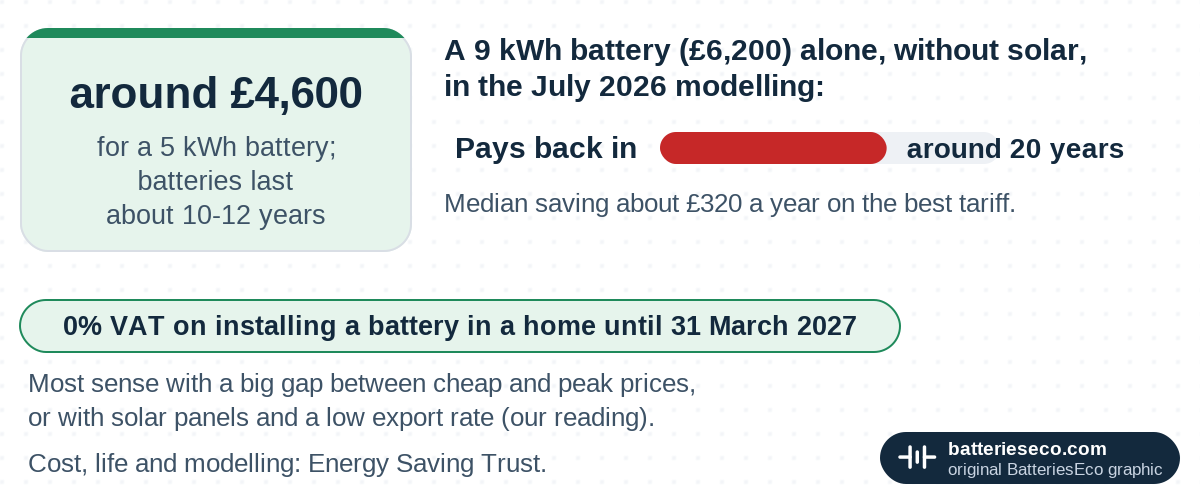
Is a home battery worth it in the UK? In the Energy Saving Trust’s July 2026 modelling, using 2024 tariffs in Great Britain, a 9 kWh battery costing £6,200 in a gas-heated home without solar had a median saving of about £320 a year on the best tariff 1. It took around 20 years to pay back 1.
The report notes that this is longer than a typical battery life of 10 years 1.
The Trust puts a 5 kWh system at around £4,600 2, and installing one in a home is zero-rated for VAT until 31 March 2027 3. We can’t tell you what you’ll save on your own bill: your tariff, your electricity use and whether you have solar panels all change the answer.
Storing power for later
A home battery stores electricity so you can use it later. With solar panels, it holds the surplus for the evening or early morning 4. It can also be charged from the grid at off-peak times on a smart tariff 4.
The government says using stored energy often saves more money than selling extra electricity back to the grid, but that the benefits depend on your circumstances and the costs can be high 4.
A battery stops discharging at a set level, perhaps 20% of its capacity, so you can’t use all of it 2.
Our calculation: if a 5 kWh battery stops at 20%, about 4 kWh of it is left to use (5 kWh minus 20%). The model home in the Trust’s report below uses 2,700 kWh a year for appliances, about 7.4 kWh a day (2,700 ÷ 365). Those 4 kWh are a little over half a day of its use.
Prices from UK advice bodies
Public advice bodies give different figures, including Home Energy Scotland, the Scottish Government-funded advice service 5:
| Source | Cost | Battery size given |
|---|---|---|
| Energy Saving Trust, battery page | around £4,600 2 | 5 kWh |
| Energy Saving Trust, battery page | £1,500 to £10,000 2 | depends on type and size |
| Energy Saving Trust, solar panel page | around £5,000 to £8,000 6 | none |
| Home Energy Scotland | £8,000 5 | none, and no date |
A typical home battery system might be 10 kWh, according to the Energy Saving Trust 2. Its battery page says installing a battery at the same time as solar panels should save money, and suggests getting at least three quotes from MCS-certified installers 2.
What it can save
The Energy Saving Trust’s ‘Flexible futures’ report (July 2026) modelled more than 1.7 million scenarios using tariffs available in Great Britain on 1 April 2024 1. Its figures are a guide only: they’re medians for a home using 2,700 kWh a year for appliances and occupied part of the day 1. It assumed a 9 kWh battery costing £6,200 installed, controlled by simple fixed rules rather than smart software 1.
The report is based on the market in Great Britain and says its results may not apply in Northern Ireland, where time-of-use tariffs aren’t yet widely available 1. Its median results for gas-heated homes 1:
| Set-up | Saving a year | Payback |
|---|---|---|
| Battery alone, no solar, best tariff (dynamic) | about £320 | around 20 years |
| Battery added to existing solar, home already on a good Smart Export Guarantee (SEG) rate of 15.6p per kWh | about £210 | longer than the battery’s life |
| Battery added to existing solar, home on a low export rate of 4p per kWh | over £400, in some cases close to £500 | about 13-15 years at best |
| Solar and battery installed together, home previously on a standard tariff | £730-£810 | 16-18 years |
A battery alone had a median saving of £250 on Economy 7 and none on a standard tariff 1. On the best tariff, the battery alone took around 20 years to pay back, compared with a typical battery life of 10 years 1.
Our calculation: in that modelled case, £320 a year for 20 years comes to £6,400, roughly the £6,200 the battery cost.
With a low export rate, payback was still longer than the battery’s expected life 1. Part of that saving came from switching tariff, not from the battery alone 1. For solar and a battery installed together, the report assumed a £6,700 solar system and a £6,200 battery, with payback within the panels’ life but beyond the battery’s 1.
On a flat tariff, where the price is the same all day, a battery can’t shift when you use electricity 1. It can even raise running costs, because some energy is lost in charging 1.
Over a system’s life, the report found that systems with a battery often saved less overall than the same system without one 1. That’s because the extra savings didn’t always cover the battery’s cost 1.
The Trust’s battery page adds that a battery saves more money running a heat pump than just exporting extra solar energy 2.
How long a battery lasts
The report gives the battery’s life as 10 years in one place and 12 in another 1. The Energy Saving Trust’s battery page says about 10-12 years, and Home Energy Scotland says 10-15 years 2 5.
What to look at on your own tariff
Our reading: a home battery makes most sense when your tariff has a big gap between cheap and peak prices, or with solar panels and a low export rate. Look up those prices and that export rate before you ask for quotes.
How time-of-use tariffs work is in our guide to Economy 7 and time-of-use tariffs, and our price cap guide gives the standard rates to compare against.
What the SEG pays when you have a battery
Once the battery is full, spare solar power can be sold through a Smart Export Guarantee tariff 2. For SEG payments, the installation needs suitable certification, an export meter and an export MPAN (meter point administration number) 7.
The SEG pays for electricity from solar panels and other eligible generators, not for power a battery has taken from the grid 7. If your export meter also records grid-charged battery power, the supplier doesn’t have to pay SEG on it 7. It may pay on all or none of your export, ask for extra meters, or estimate the grid-charged share and deduct it 7.
The SEG covers Great Britain only 8. Our Smart Export Guarantee guide compares what suppliers pay. In Northern Ireland, there’s no Smart Export Guarantee 8: our Northern Ireland guide explains how export works there.
The VAT deadline and government loans
Installing a battery in a home is zero-rated for VAT until 31 March 2027, in Great Britain and in Northern Ireland, whether it stores solar power or electricity from the grid 3. The law ties the zero rate to supplies made before 1 April 2027 3.
Our reading: if your installation is close to 31 March 2027, ask the installer which rate the invoice will show.
From 1 April 2027, under the law as it stands, the reduced rate of 5% applies 9 10. The VAT Act’s reduced-rate schedule lists these installations from that date, and Budget 2026 confirmed it 9 11.
Our calculation: treating the Trust’s £4,600 as the price before VAT, the 5% rate would add £230 to an installation supplied on or after 1 April 2027.
Buy a battery over the counter and fit it yourself, and the zero rate doesn’t apply: HMRC says a retailer’s sale of energy-saving materials is always standard-rated 10.
The government announced its Warm Homes Loan Scheme on 27 October 2026 12. It offers loans of up to £15,000 for a battery at no or low interest, across the UK including Northern Ireland 12. The work has to be done by an MCS-certified installer, and each lender runs its own affordability and credit checks 12.
Will a battery keep the lights on in a power cut?
Usually not. SSEN, a network operator, says batteries usually switch off in a power cut unless they have a backup or ‘island mode’, which can power parts of your home 13.
Electricity safety law lets a small generating source (up to 16 A per phase) run in parallel with the grid on simpler terms only if it’s set up to disconnect itself when the network supply is cut off, and the network operator is told before, or at the time of, commissioning 14 15. Larger ones must agree their requirements with the network operator 14 15. A backup source your home is switched over to, as an alternative to the grid, must never run in parallel with it 14 15.
MCS’s battery installation standard sets safety rules for systems that have an island mode 16.
Our reading: without a backup mode, a fully charged battery sits unused through an evening power cut. If backup matters to you, ask the installer before you buy whether the system has it and which circuits it keeps running.
Our power cuts guide explains what to do when the power goes off.
Checks before you sign a quote
- Ask where the battery will go: PAS 63100, a fire safety specification, sets out where a battery can go 17. See our PAS 63100 guide.
- Ask about the warranty for the battery and its installation, as the Energy Saving Trust advises 2.
- Check who will tell your network operator: you or the installer must do so for a system that connects to the grid 4. MCS says a battery added to solar panels is likely to take the total above 16 A per phase, and then the network operator must approve the connection first 18: see our guide to MCS, G98 and G99.
Sources
- Flexible futures: Integrating smart tariffs with low-carbon home technologies. Phase 1 report: Understanding the financial case
- Battery storage
- Value Added Tax Act 1994, Schedule 8 (Zero-rating), Group 23: Installation of energy-saving materials (revised text); with the GOV.UK content record of VAT Notice 708/6
- Install a battery (Clean Energy campaign)
- Battery storage
- Solar panels: costs, savings and benefits explained
- Smart Export Guarantee: Guidance for generators
- Smart Export Guarantee (SEG)
- Value Added Tax Act 1994, section 29A (Reduced rate) and Schedule 7A (Charge at reduced rate), Part 2, Group 2: Installation of energy-saving materials (revised text)
- Energy-saving materials and heating equipment (VAT Notice 708/6)
- Budget 2026
- Warm Homes Loan Scheme: Factsheet
- Planned power cuts
- The Electricity Safety, Quality and Continuity Regulations 2002, regulations 21 (Switched alternative sources of energy) and 22 (Parallel operation), revised
- The Electricity Safety, Quality and Continuity Regulations (Northern Ireland) 2012, regulations 22 (Switched alternative sources of energy) and 23 (Parallel operation), as made
- MIS 3012: 2025 Battery: Installation Standard, Issue 1.0
- PAS 63100:2024 Electrical installations – Protection against fire of battery energy storage systems for use in dwellings – Specification
- Notifying DNOs