Economy 7, Economy 10 and smart time-of-use tariffs: how they work and how to charge a battery on cheap electricity
In Great Britain, Economy 7 usually gives 7 hours of cheaper electricity in one overnight block, and Economy 10 gives 10 hours, sometimes split through the day. Smart time-of-use tariffs need a smart meter and can change price every half hour.
A home battery can be charged in the cheap hours and used at peak times. It loses some energy on the way, so the cheap rate has to be low enough to cover that loss.
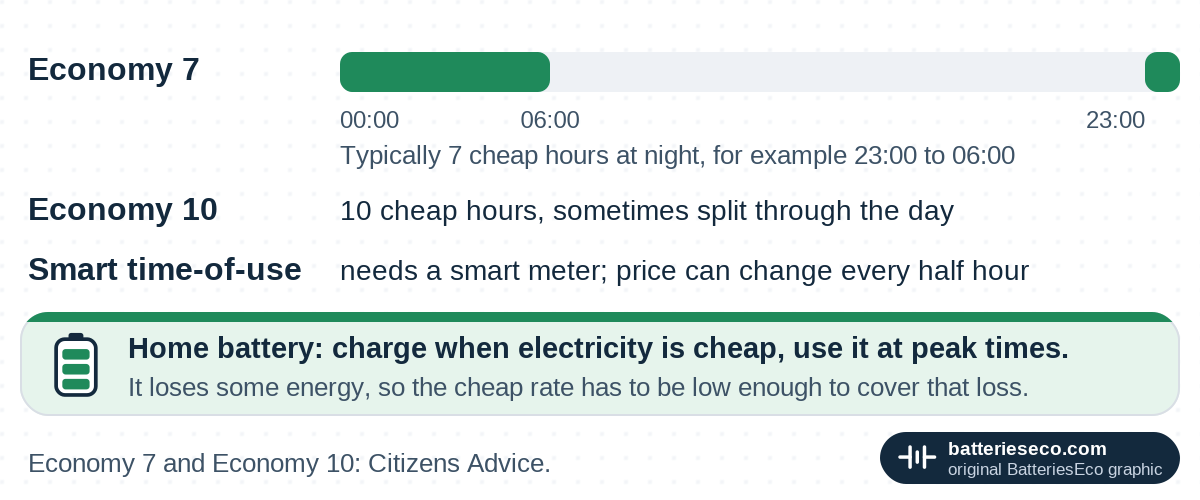
Economy 7 is a time-of-use tariff that usually gives 7 hours of cheaper electricity in every 24, in one overnight block such as 23:00 to 06:00 1. Economy 10 and smart tariffs set their cheap hours differently, and a home battery can be charged during those cheap hours. A battery loses some energy on the way in and out, though, so the cheap rate has to be low enough to cover that loss.
Everything here is for Great Britain. Northern Ireland has its own electricity market and tariffs: our Northern Ireland guide explains what’s different there.
How a time-of-use tariff works
A time-of-use (or multi-rate) tariff charges different prices at different times of day. Often there’s a peak (day) rate and an off-peak (night) rate, and sometimes more rates 1.
You usually need a smart meter, though some of these tariffs work with a “two rate” or “dual rate” meter. Static tariffs have fixed peak and off-peak prices; dynamic ones follow wholesale prices, and some of their rates can even be negative, Citizens Advice explains 1.
Economy 7 hours, Economy 10 hours
Economy 10 gives 10 cheap hours, which may be split through the day. Like Economy 7, it usually needs a two-rate meter or a smart meter 1.
On the 23:00 to 06:00 example, anything you run from 06:00 onwards, the morning kettle included, is back on the day rate.
The Energy Saving Trust notes that some variations of Economy 7 offer 8.5 or 10 hours, and that people on these tariffs typically use the cheap hours to charge storage heaters 2.
What the price cap means on Economy 7
Under the price cap, the peak and off-peak rates of a multi-rate tariff, taken together, can’t be more than the cap 3. For 1 October to 31 December 2026, Ofgem’s average for multi-rate meters paid by Direct Debit is a standing charge of 54.62 pence a day and a unit rate of 24.90 pence per kWh 4. Its regional tables give one unit rate per region, not separate day and night rates 4.
Ofgem’s figures assume an Economy 7 household uses 58% of its electricity at peak (day) times and 42% off-peak 5. They put a medium multi-rate household at 3,400 kWh a year 5.
Our calculation: for that medium household, 58% of 3,400 kWh is about 1,970 kWh a year at the day rate, and 42% is about 1,430 kWh in the cheap hours.
If your meter switches by radio signal
Older meters that switched between peak and off-peak rates using a radio signal are being replaced. Ofgem says support for these radio teleswitch (RTS) meters has now ended 6. If you still have one, it may no longer work as expected; Ofgem’s advice is to contact your supplier to arrange a free smart meter 6.
In advice written for England, Citizens Advice says your supplier has to offer you a tariff similar to your current one when you get a new meter 7. The supplier should also recommend a smart meter tariff that works in a similar way to what you have now, for example Economy 7 7. If the times can’t stay exactly the same, for example with slightly different peak and off-peak hours, the supplier should explain what will change, Citizens Advice adds 7.
Our reading: if you’re offered a new smart meter tariff, compare its cheap hours with the ones you have now.
Smart tariffs and half-hourly prices
According to the Energy Saving Trust, smart time-of-use tariffs need a smart meter that sends readings to your supplier every half hour, so the price can change just as often 2. If you don’t have one, it adds, your supplier can install it for free 2. In its August 2026 price cap announcement, Ofgem said many suppliers offer smart meter customers cheaper electricity outside peak times 8.
Two tariffs from one supplier, Octopus Energy, show how much the hours differ. Prices and terms change, so check the current offer:
- Intelligent Octopus Go: up to 6 hours of off-peak electricity for the whole home between 23:30 and 05:30 every night, for customers with a compatible electric car or charger 9.
- Octopus Flux: a tariff for homes with both solar panels and a battery, with a cheap rate from 02:00 to 05:00 and a peak rate from 16:00 to 19:00, all year round 10.
Does charging a battery on a cheap rate pay?
With a home battery, the Energy Saving Trust points out, you can store electricity when it’s cheap and use it later, even at peak times 2. Home Energy Scotland says a battery can be charged with cheap electricity on certain tariffs, at night or in the middle of the day 11. In its advice, a time-of-use tariff helps you get the most out of the battery 11.
The government’s campaign page on home batteries adds that a battery can charge from the grid off-peak on a smart tariff 12.
A battery doesn’t give back everything you put in. In its 2025 modelling, the US National Laboratory of the Rockies (formerly NREL, the National Renewable Energy Laboratory) assumes a typical home battery returns 85% of the energy put in 13. That share is called its round-trip efficiency.
Our calculation: at 85%, each kWh you take from the battery costs the off-peak price divided by 0.85, or about 1.18 times that price. The cheap rate must be below 85% of the rate you’d otherwise pay for you to save anything, and that’s before you count the cost of the battery.
Some tariffs come with conditions. Octopus Flux requires solar panels as well as a battery 10, and Intelligent Octopus Go is built around an electric car 9.
Before you switch to Economy 7
Our reading: check your bills for how much of your use falls in the cheap hours, and set it against the 42% in Ofgem’s figures. Even at 42%, most of the electricity is bought at the day rate. Then look at the two rates your supplier charges: with a battery that returns 85% of what you put in, the cheap one has to be below 85% of the rate it replaces.
Our home solar storage overview explains how a battery charges from solar or the grid. The rates of a standard tariff are in our energy price cap guide.
Sources
- Choosing your energy tariff
- Should I switch to a time of use tariff?
- Energy price cap unit rates and standing charges
- Energy price cap unit rates and standing charges (regional tables: "Electricity standing charges and unit rates paid by Direct Debit, single rate" and "..., multi-rate")
- Review of typical domestic consumption values: decision
- Get help with your smart meter
- If you have a radio teleswitch or dynamically teleswitched energy meter
- Energy price cap will rise by 4% from October 2026
- Intelligent Octopus Go
- Octopus Flux
- Battery storage
- Install a battery (Clean Energy campaign)
- Annual Technology Baseline 2025 - Residential Battery Storage