Solar panels, batteries and bills in Northern Ireland: what’s different
Northern Ireland has its own electricity market, and Ofgem’s price cap doesn’t apply: the Utility Regulator reviews the regulated Power NI tariff instead. There’s no Smart Export Guarantee either, so you need an export contract with a supplier. Power NI pays 11.88p per kWh from 1 October 2026 to 30 September 2027.
Solar and batteries connect under G98/NI or G99/NI with NIE Networks, and plug-in solar isn’t currently permitted. Installing solar panels or a battery in a home is zero-rated for VAT until 31 March 2027. There’s no general grant for homeowners, though some low-income homes get retrofits through the Northern Ireland Sustainable Energy Programme (NISEP).
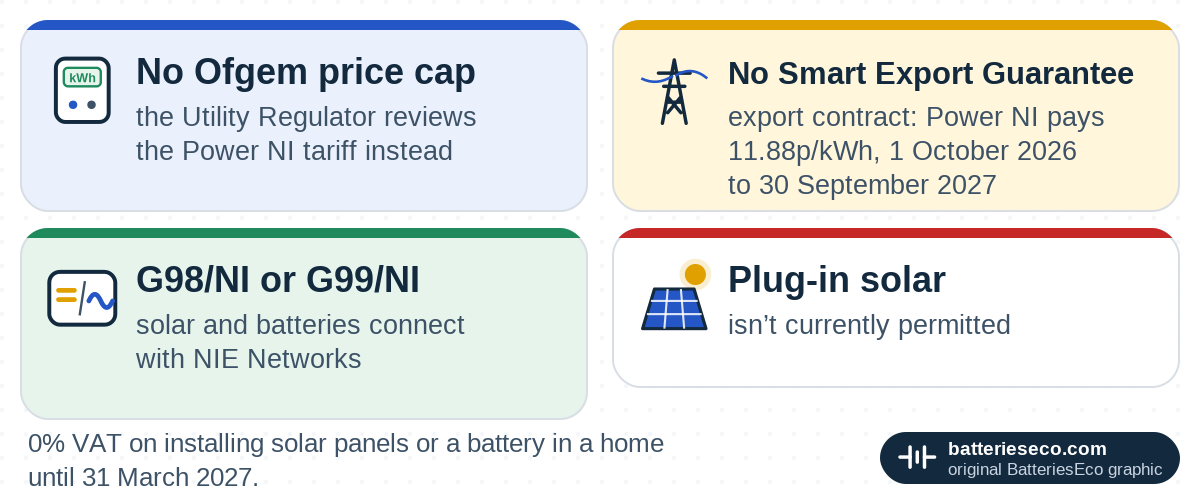
Solar panels and batteries in Northern Ireland come under some different rules from Great Britain, starting with export. There’s no Smart Export Guarantee, which is limited to installations in Great Britain 1. Exported electricity is bought by suppliers instead, and Power NI pays 11.88p per kWh from 1 October 2026 to 30 September 2027 2 3.
No Ofgem price cap in Northern Ireland
Ofgem’s price cap doesn’t apply in Northern Ireland, which has its own electricity market 4. The Utility Regulator oversees it, and the largest supplier must show the regulator, the Consumer Council and the Department for the Economy that its prices are fair 4. That supplier’s tariff then acts as the price for other suppliers to beat 4.
After its review, the Utility Regulator approved a 6.2% rise in Power NI’s domestic electricity tariff from 1 July 2026, or £64 a year 5. It put the average annual bill at £1,093 for 3,200 kWh 5.
Our calculation: £64 a year is about £5.33 a month, and £1,093 divided by 3,200 kWh comes to about 34p per kWh on average.
Household electricity in Northern Ireland is still charged VAT at 5%: the zero rate from 1 October 2026 covers Great Britain only 6 7. At Budget 2026, the government said extended VAT relief on household electricity is expected to apply in Northern Ireland from April 2027 8. The announcement isn’t law yet 8.
How exports are paid without the SEG
To be paid for the electricity you export, you need a purchase contract (an export tariff) with an electricity supplier 2. For generators up to 50 kW, Power NI says the Utility Regulator approves its export price each year 3. NIE Networks, which connects your system to the network, says it doesn’t buy your electricity: suppliers do 2.
Use your solar power or export it?
Our reading: each kWh of solar power you use yourself saves the unit rate on your bill, a rate the regulator doesn’t give on its own for Power NI.
Our calculation: if your unit rate is near the 34p average, it’s about 2.9 times the 11.88p export price (34 ÷ 11.88), so using your own power is likely to be worth more than exporting it. Check the unit rate on your own bill, and ask other suppliers whether they offer an export price too.
Which connection route applies, G98/NI or G99/NI
NIE Networks is Northern Ireland’s network operator, and your installer usually makes the application 2. Which route applies depends on your total installation capacity, not only on what you export 9:
- G98/NI covers micro-scale generation up to 16 A per phase (about 3.68 kW on a single-phase supply) 10. The installer fits and commissions the system, then has 30 days to send NIE Networks the Stage 1 form 10. NIE Networks arranges an import/export meter if needed, and the Stage 1 application is free 2 10.
- G99/NI Fast Track is for systems such as solar panels with battery storage of up to 60 A per phase in total (13.8 kW), with no single inverter above 32 A (7.36 kW) and export limited to 16 A per phase 9. NIE Networks must approve it before installation starts, and there’s an application fee 9.
- G99/NI applies above the Fast Track limits, also with approval before installation 9.
Our reading: that total counts solar and battery together. So if you plan a battery alongside solar panels, ask your installer which route applies before any work is booked.
Issue 2 of G98/NI and G99/NI has the Utility Regulator’s approval, with 1 May 2026 as the date it recommended for their use 11. Our guide to MCS, G98 and G99 explains the rules in more detail.
Safety law, commissioning and backup
Northern Ireland’s own electricity safety regulations, the ESQCR (NI) 2012, apply to any source of energy that can run in parallel with NIE Networks’ network 12.
As we read it, that includes a solar inverter or a battery.
A small source of up to 16 A per phase can run in parallel on simpler terms only if it disconnects itself when the network supply is lost and NIE Networks is told before, or at the time of, commissioning 12. Larger ones need requirements agreed with NIE Networks 12.
The two timings differ: NIE Networks’ own G98/NI process allows the installer 30 days after commissioning to send the Stage 1 form 10. The regulations, though, ask for NIE Networks to be told of the plan before, or at the time of, commissioning 12.
Our reading: ask your installer to let NIE Networks know by the day of commissioning.
Backup power that your home is switched over to, as an alternative to the network, must be unable to run in parallel with it 12.
Our reading, then: to keep some circuits running in a power cut, a battery needs a backup or island mode that first separates those circuits from the network. What that means for a home battery is in our home battery guide.
Plug-in solar isn’t permitted for now
The Minister for the Economy gave Northern Ireland’s position in September 2026: plug-in solar devices aren’t currently permitted under its electricity safety framework, and no date was given for a change 13. The 2026 change that allows them in Great Britain doesn’t extend to Northern Ireland 14.
As we read it, a plug-in kit isn’t permitted in Northern Ireland for now. Our plug-in solar guide has the detail.
VAT on installing solar and batteries
In Northern Ireland, installing solar panels in a home has been zero-rated for VAT since 1 May 2023, and installing a home battery since 1 February 2024 15 16. Both stay at 0% until 31 March 2027, the same end date as in Great Britain 15. The law ties the zero rate to supplies made before 1 April 2027, and HMRC says the rate goes back to 5% from that date 15 16.
Panels or a battery you buy from a shop to fit yourself don’t get the zero rate: HMRC says a retailer’s sale of energy-saving materials is always charged at the standard rate of VAT 16.
Planning permission
In Northern Ireland, the Planning (General Permitted Development) Order (Northern Ireland) 2015 lets you install solar panels on the roof of a house, or on a building within its grounds, without applying for planning permission, within limits 17. Panels mustn’t:
- protrude more than 20 cm beyond a roof slope that faces onto and is visible from a road
- rise above the highest part of a ridged roof, or more than 1.5 m above a flat roof
- extend beyond the edge of the roof
Different limits apply to wall-mounted panels and to a single free-standing array (at most 14 m² and 2 m high) 17. In a conservation area or World Heritage Site, panels can’t go on a roof slope facing onto and visible from a road 17.
In the grounds of a listed building, none of these rights applies without listed building consent 17. Panels must be mainly for energy used on the property and removed once they’re no longer used 17.
These rights are for houses only: the order’s definition of a dwellinghouse excludes flats and buildings containing flats, so for panels on a flat or a block of flats, ask your council’s planning office 17. Part 2 of the order, which covers home microgeneration, has no class for battery storage 17.
Our reading: if you plan to put a battery outside, check with the council’s planning office as well.
Is there a grant for solar in Northern Ireland?
Not as a general grant. Two narrower or newer routes exist all the same: NISEP retrofits for some low-income homes, and the UK-wide Warm Homes loans.
Official sources don’t all say the same thing here. nidirect, the Northern Ireland government website, says there’s no financial support for homeowners who want to generate their own electricity 18. That page was last updated in September 2025 18.
NISEP retrofits
Asked about support for low-income families, the Department said in February 2026 that the Northern Ireland Sustainable Energy Programme (NISEP) funds whole-house retrofits that can include solar panels and battery storage 19. It added that it is working on a scheme to replace NISEP 19.
NISEP is run by the Utility Regulator through organisations that bid for schemes, not as a grant you apply for yourself. The call for schemes for its 2027/2029 programme opened in October 2026, with bidders due to hear in March 2027 whether they’ve succeeded 20.
No source we read says how a household asks for a NISEP retrofit.
A month later, in March 2026, the Department said it offers no support of its own for households installing renewable energy systems 19.
Warm Homes loans
The UK government announced its Warm Homes Loan Scheme on 27 October 2026, after the nidirect page was last updated 21. It said the no- and low-interest loans are available across the UK, Northern Ireland included 21. They go up to £15,000 for solar panels and up to £15,000 for a battery 21.
These are loans, not grants. Each lender runs its own affordability, credit and eligibility checks, and an MCS-certified installer must do the work 21.
Reporting a power cut, and compensation
To report a power cut in Northern Ireland, call NIE Networks on 03457 643643, 24 hours a day 22.
NIE Networks’ guaranteed standards, as currently published, give a household £50 when its electricity isn’t restored within 24 hours of a power cut, and £25 more for every further 12 hours 23. Claims must be made within one month, and the standards may not apply in situations outside NIE Networks’ control, such as severe weather 23.
Our calculation: under those standards, a cut that lasts 36 hours brings £50 for the first 24 hours plus £25 for the next 12: £75 in all, if the standards apply and you claim in time.
In July 2026, the Utility Regulator decided on stricter standards 24. Where fewer than 5,000 customers are affected, a home would get £95 if supply isn’t back within 18 hours, then £45 for every further 12 hours, with three months to claim 24. The change needs new regulations from the Department for the Economy and wasn’t in force on 4 November 2026 24.
Our reading: if you need to claim before those regulations are made, check the deadline in NIE Networks’ published standards first. Our power cuts guide covers the rest of the UK.
Sources
- Smart Export Guarantee (SEG)
- G98/NI Installations
- PowerNI Renewables ROCs and Export Tariff rates; How much will I be paid for selling my excess electricity?
- Reminder to Northern Ireland consumers about the Ofgem price cap
- Utility Regulator confirms increases to regulated electricity and gas tariffs
- The Value Added Tax (Supplies of Domestic Electricity) Order 2026 (SI 2026/987)
- Fuel and power (VAT Notice 701/19)
- Budget 2026
- G99/NI Fast Track Installations
- G98/NI installations FAQs
- Approval of Distribution Code Documentation – Engineering Recommendation EREC G98/NI and EREC G99/NI Issue 2 (letter to NIE Networks, 18 March 2026)
- The Electricity Safety, Quality and Continuity Regulations (Northern Ireland) 2012, regulations 22 (Switched alternative sources of energy) and 23 (Parallel operation), as made
- NI Assembly written questions and answers on plug-in solar (AQW 50870, 51138, 51610, 52362, 42994, 55641/22-27)
- The Plugs and Sockets etc. (Safety) Regulations 1994 and Electricity Safety, Quality and Continuity Regulations 2002 (Amendment) Regulations 2026 (SI 2026/848), as made
- Value Added Tax Act 1994, Schedule 8 (Zero-rating), Group 23: Installation of energy-saving materials (revised text); with the GOV.UK content record of VAT Notice 708/6
- Energy-saving materials and heating equipment (VAT Notice 708/6)
- The Planning (General Permitted Development) Order (Northern Ireland) 2015, Schedule, Part 2: Installation of domestic microgeneration equipment (revised); contents page
- Support to generate your own electricity
- NI Assembly written answers AQW 38725/22-27 and AQW 40775/22-27 (Minister for the Economy)
- Northern Ireland Sustainable Energy Programme - Framework Document 2027/2029 and Call for Schemes published
- Warm Homes Loan Scheme: Factsheet
- Power cut, faults and outage information (Planned Emergency Power Cuts)
- Customer Standards (Our guarantees for customers)
- Review of the Electricity Guaranteed Standards of Service and Overall Standards of Performance: Decision Paper (non-metering)