Plug-in (balcony) solar in the UK: what the 2026 law allows, the limits, telling your DNO and the position in Northern Ireland
Since 27 August 2026, you can plug a solar panel kit into a standard socket in England, Wales and Scotland, provided the device meets the government’s product specification. Conditions include no more than 800 W of AC output, a BS 1363 plug and, under the current grid connection rules, one device per household.
You must tell your distribution network operator (DNO), and you should check that the kit is marked Compliant on the Energy Networks Association’s register. Plug-in batteries aren’t permitted, and a plug-in kit isn’t meant to be used with a battery storage system. In Northern Ireland, plug-in solar isn’t currently permitted.
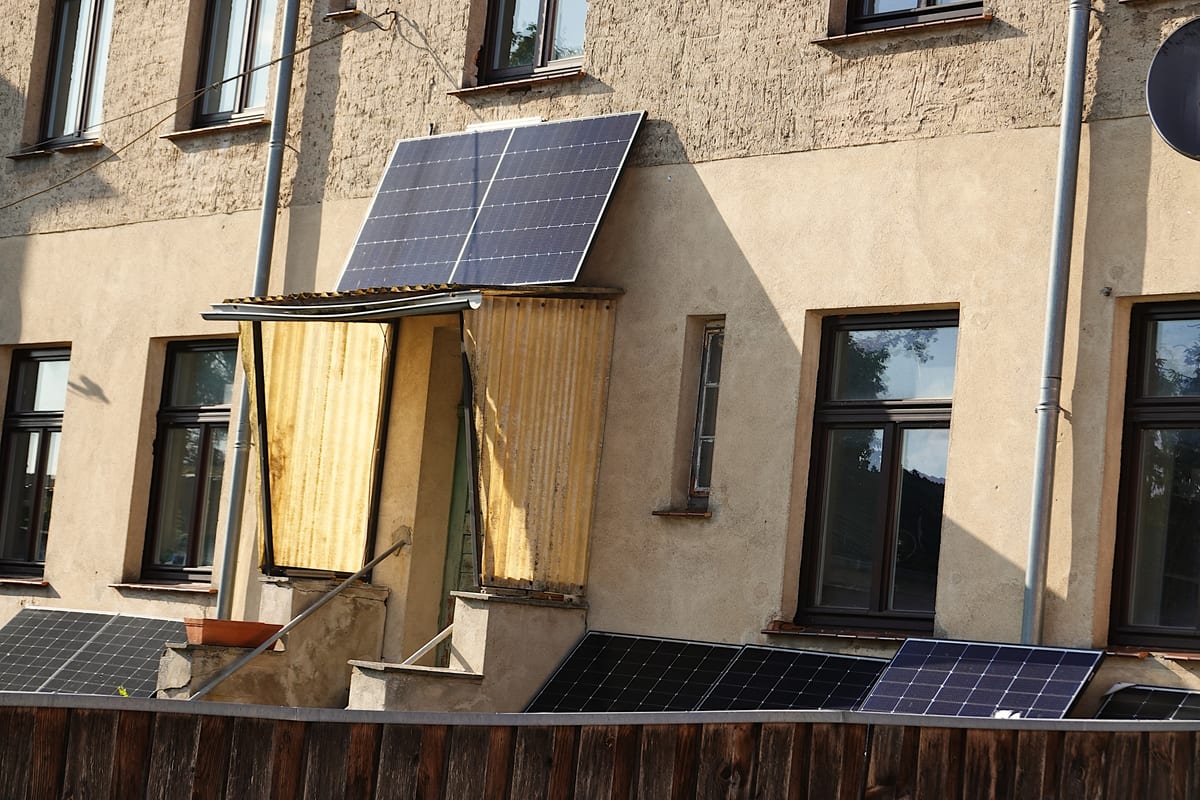
Plug-in solar panels have been allowed in England, Scotland and Wales since 27 August 2026, for kits of no more than 800 watts AC output that meet the government’s product specification 1. You may plug in and set up a compliant kit yourself 2. The change doesn’t cover Northern Ireland, where plug-in solar isn’t currently permitted 1 3.
What the 2026 law changed
Until 27 August 2026, supplying or using a plug-in solar device wasn’t permitted, the government’s explanatory memorandum says 4. The electricity safety regulations required compliance with BS 7671 (the wiring regulations) 4. And BS 1363 plugs, the standard UK household plug, weren’t allowed to connect generators to sockets 4.
The new regulations (SI 2026/848), in force from 27 August 2026, changed that. They define a plug-in microgenerator as a device that generates electricity from sunlight, with a maximum rated AC output not exceeding 800 watts 1. It connects through a standard plug and socket, runs in parallel with the network and isn’t designed to import electricity for storage 1.
Such a device must not be installed or operated unless it complies with the Department for Energy Security and Net Zero’s (DESNZ) Plug-in Solar Device Interim Product Specification, version 2 1.
The explanatory memorandum says the instrument extends to Northern Ireland as well and applies there 4. The regulations themselves allow such plugs to be approved, a change that also extends to Northern Ireland 1. But their change to the electricity safety regulations, the connection change, extends to England, Wales and Scotland only, so it doesn’t cover Northern Ireland 1.
Our reading: where the memorandum and the regulations differ, the regulations take precedence.
Limits on the kit itself
The interim product specification sets these limits for a plug-in device 5:
- Output to the mains: the device must not supply more than 800 VA or 3.5 A.
- Solar modules: together they must not exceed 2,000 W of DC power. Above 960 W of modules, the manufacturer must advise you to consider having your existing wiring assessed by a professional before you install the kit.
- Plug: the device connects only through the manufacturer’s own BS 1363 plug, a non-rewirable moulded plug with a fuse of no more than 5 A.
- Outdoors: plugs and sockets must be rated at least IP55.
The specification allows socket circuits only: not lighting circuits, and not spurs feeding fixed equipment such as a cooker or boiler 5. Extension leads aren’t allowed either, nor are multi-way, travel or RCD adaptors 5. The specification also rules out installation on timber cladding or a timber balcony, among other places 5.
One kit per household
On its own, the specification would allow one device per ring circuit in a home 5. But the grid connection rules, G98, limit that to one device per household until they’re amended 5.
The government’s consultation response and Ofgem’s decision approving the change to G98 both confirm that limit 6 2. Ofgem’s decision also lets you install the device yourself, and requires you to tell your DNO when you install or remove it, using simplified G98 forms 2.
Having rooftop solar need not rule a kit out. Ofgem’s decision allows a plug-in device alongside fixed generation such as rooftop solar, provided the total stays within G98’s 16 A per phase limit; above that, G99 applies 2.
The register, and telling your DNO
Plug-in devices are listed on the Energy Networks Association’s (ENA) Type Test Register, but being listed doesn’t prove compliance 7 5. Entries are marked Compliant or Non-compliant, so check that the kit you want is marked Compliant 7. The manufacturer must obtain confirmation that the device has been assessed and identified as compliant before putting it on sale 5.
The Energy Saving Trust says you’re legally required to register a plug-in device on the UK Plug-in Solar Registration website before using it 8. Ofgem’s decision refers to simplified G98 forms, and to a consumer notification route the ENA is building on its Connect Direct platform 2.
Our reading: none of the official sources we read says whether registering on that website counts as advising your DNO. Check what the registration site and your DNO say.
The Electricity Safety, Quality and Continuity Regulations 2002 apply in Great Britain and were amended in August 2026 9. Their regulation 22 lets a source of energy of up to 16 A per phase connect without agreeing specific requirements with the distributor, your DNO, provided it meets certain conditions 9. One condition is that whoever installs it makes sure the distributor is told, before or at the time of commissioning, that it is to run in parallel with the network 9.
Ofgem’s decision and the specification require the notification but set no deadline 2 5. We haven’t read the amended G98 itself.
As we read it, telling your DNO before you plug the kit in, or when you do, satisfies regulation 22, whatever the amended G98 says. Because Ofgem’s decision asks for a notice when a device is removed as well as when it is installed, moving house with a kit means two notices 2. One goes to your current DNO when you take it out, and one to the DNO at your new address when you plug it in there.
Plug-in batteries aren’t allowed
The approval covers plug-in solar only and doesn’t extend to plug-in batteries, the government’s response says 6. Ofgem’s decision on the grid rules says plug-in storage devices remain prohibited from being sold, supplied or used 2.
The specification also requires the instructions to carry a warning 5. A plug-in solar device, it says, isn’t intended to be connected to, operated with or used in conjunction with a battery storage system 5.
Our reading: the specification doesn’t say how that applies to a home that already has a wired home battery. Ask the manufacturer before you buy.
The Energy Saving Trust adds that plug-in panels with built-in battery storage aren’t covered by the current rules 8. It also says the panels are designed to switch off in a power cut 8.
In our view, that makes a plug-in kit no use as backup: with its panels switched off, it won’t keep even a lamp lit until the supply is back.
Permissions and insurance to check first
Before you buy or install a kit, the government advises checking whether you need any of these 10:
- permission from a landlord, building owner or freeholder
- planning permission
- listed building consent
The explanatory memorandum says the new rules cover kits installed in line with the manufacturer’s instructions, including its instructions on electrical, building and fire safety 4. The specification also says you’re responsible for checking, before you install, whether the kit affects your home or building insurance 5.
When your wiring needs an electrician
The specification says any testing or changes to your home’s wiring must be done by a professional electrician 5. If your consumer unit (fuse box) uses older fuses without RCBO protection, a professional electrician must check it and upgrade it where needed. A consumer unit where circuit breakers sit behind a shared RCD may also be acceptable, subject to further government testing 5.
If that work means replacing your consumer unit, in England it’s notifiable building work, as is a new circuit 11. Wales has a separate version of that rule 11. Scotland has its own building regulations: electrical work to or in a house usually needs no building warrant, but it must still meet the building standards 12 13.
Our reading: the Scottish exemption stops short of flats and maisonettes, and of houses with a storey more than 4.5 metres up. For those, ask the building standards service at your council whether a warrant is needed for a new circuit. In Northern Ireland, check with building control at your council what applies to the work.
The position in Northern Ireland
The Minister for the Economy said in written answers in September 2026 that plug-in solar devices aren’t currently permitted under Northern Ireland’s electricity safety framework 3. Amendments would be progressed as soon as possible, the minister added, without giving a date 3.
A question tabled on 2 November 2026 asking for an update had not been answered when we checked on 4 November 2026 3. The Energy Saving Trust says the same: plug-in panels aren’t currently legal to use in Northern Ireland 8.
Savings estimates for a plug-in kit
In August 2026, the government said households could save up to £110 a year 10. The Energy Saving Trust expects an 800 W device to generate around 700 kWh a year, saving £100 a year if you’re at home all day or £70 if you’re out during the day 8.
The Trust assumes electricity at 24.7p per kWh and a south-facing kit in Manchester, and says a device costs from around £450 8.
Our calculation from those figures: a £450 kit saving £100 a year would take 4.5 years to cover its price (£450 ÷ £100), and about 6.4 years at £70 a year (£450 ÷ £70 = 6.43). A dearer kit would take longer.
To see how your own home compares, check your unit rate, the price of the kit you’re considering and which way its panels would face.
You normally can’t get Smart Export Guarantee payments for a plug-in kit 8. Ofgem’s SEG guidance for generators asks for solar installations up to 50 kW, and their installer, to be certified under MCS or an equivalent scheme 14. Without that, a supplier doesn’t have to pay, though it may 14.
The Energy Saving Trust says most suppliers ask for an MCS certificate, though some may offer their own tariff without one 8. When we checked on 4 November 2026, British Gas didn’t yet offer SEG for plug-in solar 15.
Sources
- The Plugs and Sockets etc. (Safety) Regulations 1994 and Electricity Safety, Quality and Continuity Regulations 2002 (Amendment) Regulations 2026 (SI 2026/848), as made
- Ofgem decision to Approve DCRP/MP/26/02: Proposed Amendment to facilitate Plug-in Microgeneration
- NI Assembly written questions and answers on plug-in solar (AQW 50870, 51138, 51610, 52362, 42994, 55641/22-27)
- Explanatory Memorandum to the Plugs and Sockets etc. (Safety) Regulations 1994 and Electricity Safety, Quality and Continuity Regulations 2002 (Amendment) Regulations 2026 (2026 No. 848)
- Plug-in Solar Device Interim Product Specification, Version 2.0, July 2026
- Plug-in solar: Regulatory amendment and interim product specification (consultation outcome page) and Plug-in solar: government response, July 2026
- ENA Connect Direct: Search the ENA Type Test Register (type Plug-in Solar)
- Plug-in solar panels
- The Electricity Safety, Quality and Continuity Regulations 2002, regulations 21 (Switched alternative sources of energy) and 22 (Parallel operation), revised
- Households can save as plug-in solar panels come to market
- The Building Regulations 2010, regulation 12 (Giving of a building notice or an application for building control approval), latest available
- The Building (Scotland) Regulations 2004 (SSI 2004/406), Schedule 3
- Building Standards Technical Handbook - Domestic (April 2026 edition)
- Smart Export Guarantee: Guidance for generators
- Smart Export Guarantee (SEG) Tariff