MCS certification, G98 and G99: when to tell your DNO about solar panels or a battery, and when to ask first
In Great Britain, solar panels and batteries that connect to the grid are covered by two engineering rules. G98 applies to type-tested equipment up to 16 A per phase (about 3.68 kW on a single-phase supply); above that, G99 applies and you must get permission before connecting.
Under G98, the installer notifies your network operator within 28 days of commissioning, as SSEN and MCS put it, though one MCS paragraph says ‘of installation’. The regulations themselves ask for the network operator to be advised before or at the time of commissioning.
MCS’s guidance is that adding a battery to solar panels is likely to take the total above 16 A per phase, which means G99. MCS certification isn’t a legal requirement, but Smart Export Guarantee suppliers normally ask for an MCS certificate or one from an equivalent scheme. Northern Ireland has its own versions, G98/NI and G99/NI.
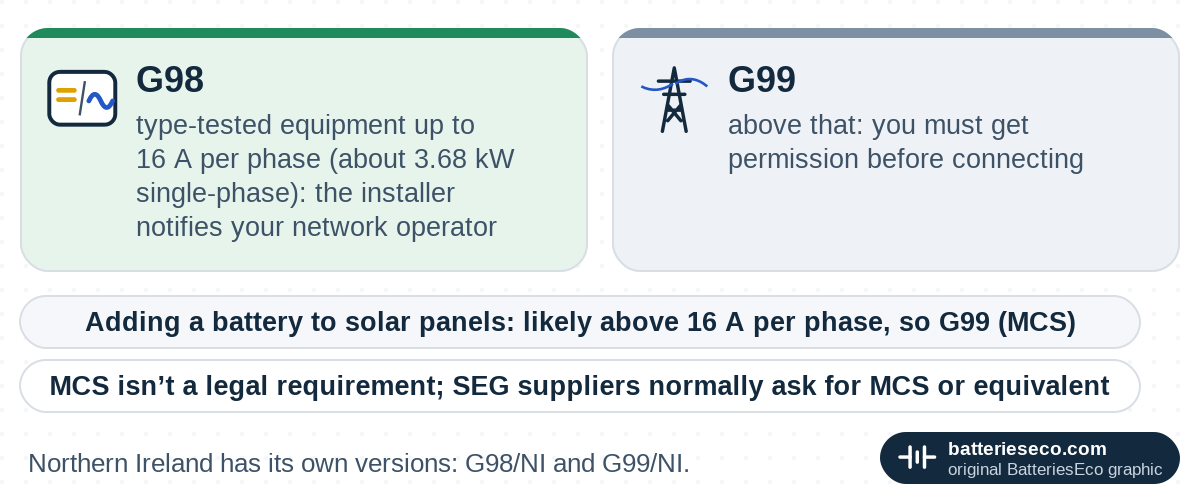
When you connect solar panels or a battery to the grid, two separate things come into play: the G98 and G99 connection rules, and MCS certification. In Great Britain, G98 covers type-tested microgenerators up to and including 16 A per phase, and G99 covers other generating equipment 1. Under G98 your installer notifies your distribution network operator (DNO); under G99 you need its permission before the system goes in 2.
Grid rules and a certification scheme
G98 and G99 are engineering rules for connecting generation to the electricity network 1. In Great Britain they’re part of the Distribution Code, which all network operators use. Issue 62 of the Code, in force from 27 August 2026, lists G98 Issue 2 Amendment 1 and G99 Issue 2 1.
MCS is a certification scheme for installers and products. MCS says its certificate records that an installation was designed and installed to industry-recognised standards 3. It also says certification isn’t a legal requirement 3.
G98: who tells the DNO, and when
G98 applies to installations up to 16 A per phase, which means up to 3.68 kW on a single-phase supply and 11.04 kW on a three-phase supply. Above that, a G99 application is needed 4. Electricity North West, the network operator for its area, takes an installation’s rating to be its inverter’s continuous rating 4.
Our reading, for a house in Great Britain on a single-phase supply: a 3.6 kW type-tested inverter, with no battery or other generation at the property, stays under G98. A 4 kW one goes over 3.68 kW and needs your DNO’s permission before connection under G99. In SSEN’s areas, the cases listed further down can still mean applying first.
Under G98, as Scottish and Southern Electricity Networks (SSEN), Electricity North West and MCS describe it, the installer sends the DNO a commissioning form, G98 Form B, after the work. The pages in the table below put that at 28 days, but the regulations set an earlier point, as the next section shows. G98 expects installation by a competent installer, though Ofgem, the energy regulator, has approved a change that lets you install a plug-in solar kit yourself 5.
The law on timing
Electricity North West says anyone planning to connect generators or storage to its network must either notify it or apply to connect 4. It calls this an obligation under the Electricity Safety, Quality and Continuity Regulations 2002 4.
Regulation 22 of those regulations sets conditions for a source of energy of up to 16 A per phase to connect without agreeing specific requirements with the distributor 6. The regulations call your DNO the distributor. Among the conditions, the person installing it ensures that the distributor is advised, before or at the time of commissioning, of the intention to use it in parallel with the network 6.
Which day the 28 days run from
The pages that give the 28 days don’t all count them from the same day.
| Page | What it says |
|---|---|
| MCS, for installers | the DNO must be notified within 28 days of commissioning, on G98 Form B 2 |
| MCS, paragraph on batteries | ‘within 28 days of installation’ 2 |
| SSEN | G98 Form B within 28 days of commissioning 7 |
| Electricity North West, older FAQ | no later than 28 days after commissioning in one answer, ‘within 28 days of installation’ in another 8 |
The regulations themselves ask for your DNO to be advised before or at the time of commissioning 6, while the DNO and MCS pages put G98 Form B at up to 28 days after commissioning. We haven’t been able to read G98 to see how it reconciles the two.
Our reading: have your installer advise the DNO no later than the day of commissioning, and send G98 Form B within 28 days of commissioning. That satisfies the regulations and every page we read, provided the system is commissioned soon after it is installed.
Our calculation, as an illustration: if the panels go in a week before they’re commissioned, 28 days counted from installation run out a week before 28 days counted from commissioning.
When you must apply first
Above the G98 limits, G99 applies and you need permission to connect before the system goes in 2. In its own areas, SSEN also asks for an application before connection in these cases 7:
- more than one generator at a property
- total generation at the site above the G98 limits
- another installation by the same installer within the last 28 days, in the same postcode once its last two characters are ignored (for example PH1 2xx)
Our reading: ask your installer which route your system takes.
Batteries count too
MCS says DNOs class a battery as demand when it imports and as generation when it exports 2. It adds that G98 and G99 set the technical requirements for connecting storage 2.
Electricity North West applies G98 to generation and storage alike, up to 16 A per phase 4. SSEN describes G98 and G99 as covering generators or storage assets 7.
MCS goes further: when a battery goes in alongside solar panels, the total connected generation is likely to be above 16 A per phase 2. G99 then applies, and the application must go in before installation 2. G99 has a fast-track application form (A1-2) for cases where the capacity is over 3.68 kW, the inverter is type-tested to G98 and the storage won’t operate when the grid fails 2.
As we read it, a battery that keeps part of your home running in a power cut doesn’t meet that last condition.
SSEN’s list above doesn’t say how a battery counts 7. The sources we’ve read don’t say exactly how a battery’s inverter adds to the 16 A total.
In our view, adding a battery to solar can mean applying first, so ask your installer before the work starts. Where a battery can go in the home is covered in our PAS 63100 guide.
Plug-in solar
A plug-in solar kit is a special case, in Great Britain only. Regulations for England, Wales and Scotland have allowed one since 27 August 2026, if its AC output is no more than 800 W and it meets the government’s interim product specification. Northern Ireland isn’t included in that change 9.
Ofgem’s decision approving the matching change to G98 lets you install one yourself instead of using a competent installer, and has you notify your DNO on a simplified form 5. For now, the limit is one device per household 5. The kit and any other generation at the property must together stay within G98’s 16 A per phase; above that, G99 applies 5.
Plug-in batteries remain prohibited 5 10. Our plug-in solar guide explains the rules, including the position in Northern Ireland.
MCS and the Smart Export Guarantee
The SEG is open only to installations in Great Britain 11. In a 2023 statement, MCS said the regulated SEG tariffs that larger suppliers must offer require an MCS-certified installation 12.
Ofgem takes a broader line in its guidance 13. It asks for an MCS certificate or one from a scheme the SEG recognises as equivalent, and lets a supplier pay without one if it chooses 13. British Gas, for example, accepts an MCS certificate, a Flexi-Orb certificate or an accreditation certificate 14.
Our reading: if export payments matter to you, check before the work starts that the installation will come with an MCS certificate or an equivalent one.
MCS installers must give you the certificate, and MCS says this should be within 14 days of commissioning, or 30 days under its redeveloped scheme 3. MCS’s battery storage page says 10 working days of completion 15.
Our Smart Export Guarantee guide compares export tariffs in Great Britain. Northern Ireland has no SEG: export there is paid under a contract with an electricity supplier 11 16.
Building rules are their own step
Telling your DNO and meeting the Building Regulations are different duties. In England, electrical work that adds a new circuit is notifiable, and a registered competent person can self-certify it 17 18. Wales has its own version of the rule 17.
Under Scotland’s own building regulations, electrical work in or to a house usually goes ahead without a building warrant, but it must still comply with the building standards 19 20.
As we read it, flats, maisonettes and houses where a storey sits more than 4.5 metres up fall outside that exemption. If your home is one of them, ask your council’s building standards service whether a new circuit needs a warrant. In Northern Ireland, ask your council’s building control what applies.
G98/NI and G99/NI in Northern Ireland
Northern Ireland uses its own versions. Its Utility Regulator approved G98/NI Issue 2 and G99/NI Issue 2 and recommended using them from 1 May 2026 21. The ‘Fit and Inform’ route of G98/NI covers systems up to 16 A per phase 22.
G99/NI Fast Track covers generation with battery storage up to 60 A per phase in total, with no single inverter above 32 A 23. NIE Networks, Northern Ireland’s network operator, puts that at 13.8 kW in total and 7.36 kW per inverter, and export is limited to 16 A per phase 23. Fast Track needs approval before installation begins and, unlike G98/NI, it carries an application fee 23.
Under G98/NI, NIE Networks’ FAQ, which still refers to Issue 1, gives the installer 30 days after fitting and commissioning the system to send in the Stage 1 form, free of charge 22. Northern Ireland’s own regulations say the same as Great Britain’s 24. The person installing a source of energy of up to 16 A per phase ensures the distributor is advised before, or at the time of, commissioning 24.
Our reading: as in Great Britain, have your installer notify NIE Networks no later than commissioning. That also satisfies NIE’s 30 days.
Sources
- The Distribution Code of Licensed Distribution Network Operators of Great Britain, Issue 62 (27 August 2026)
- Notifying DNOs
- MCS Certificate Queries
- G98, Small scale connection, generation and storage (G98 Micro-Generation and Storage Connections)
- Ofgem decision to Approve DCRP/MP/26/02: Proposed Amendment to facilitate Plug-in Microgeneration
- The Electricity Safety, Quality and Continuity Regulations 2002, regulations 21 (Switched alternative sources of energy) and 22 (Parallel operation), revised
- Installation of up to 3.68kW per phase at one property
- EREC G98 & EREC G99 Frequently Asked Questions
- The Plugs and Sockets etc. (Safety) Regulations 1994 and Electricity Safety, Quality and Continuity Regulations 2002 (Amendment) Regulations 2026 (SI 2026/848), as made
- Plug-in solar panels
- Smart Export Guarantee (SEG)
- Why MCS matters & a response to SEG confusion
- Smart Export Guarantee: Guidance for generators
- Smart Export Guarantee (SEG) Tariff
- Battery Storage - MCS (consumer technologies page)
- G98/NI Installations
- The Building Regulations 2010, regulation 12 (Giving of a building notice or an application for building control approval), latest available
- Approved Document P: electrical safety, dwellings (2013 edition) and its GOV.UK publication page
- The Building (Scotland) Regulations 2004 (SSI 2004/406), Schedule 3
- Building Standards Technical Handbook - Domestic (April 2026 edition)
- Approval of Distribution Code Documentation – Engineering Recommendation EREC G98/NI and EREC G99/NI Issue 2 (letter to NIE Networks, 18 March 2026)
- G98/NI installations FAQs
- G99/NI Fast Track Installations
- The Electricity Safety, Quality and Continuity Regulations (Northern Ireland) 2012, regulations 22 (Switched alternative sources of energy) and 23 (Parallel operation), as made