Where a home battery can go in the UK: PAS 63100, lofts, bedrooms, escape routes and storage limits
PAS 63100:2024, the government-sponsored fire safety specification for home batteries, says batteries 'shall be installed outdoors’ where practicable. Among the places it rules out are lofts and roof spaces, bedrooms, escape routes such as landings and staircases, and cellars with no access to the outside.
It limits the energy stored per dwelling house to 40 kWh, or 80 kWh in a detached garage or outbuilding, outdoors, or an attached garage or outbuilding with REI 60 fire separation. It isn’t law: MCS said in 2024 that it has no standing in UK regulations such as the Building Regulations. The IET code of practice that MCS installers follow recommends it, and at least one government grant scheme requires it.
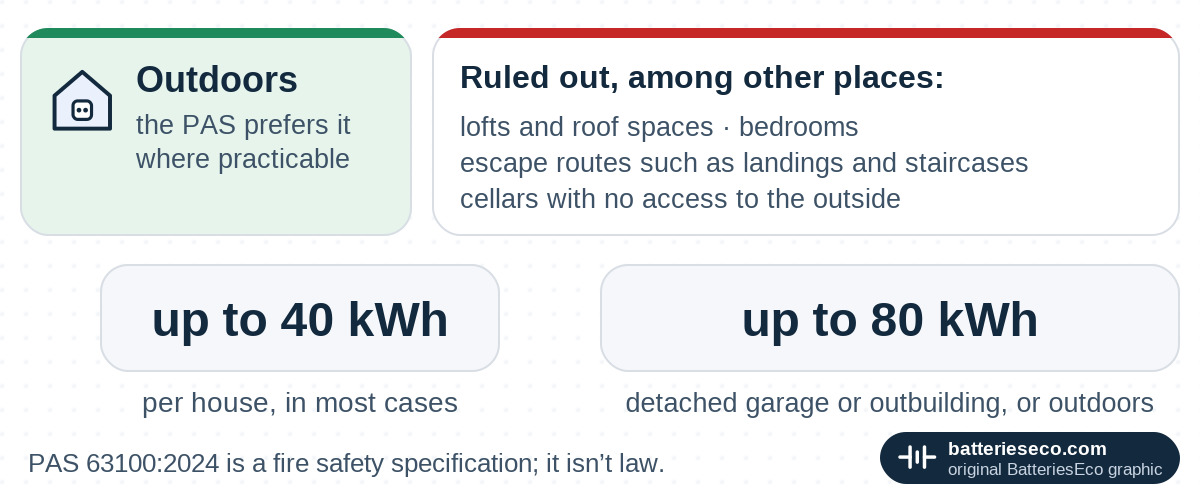
PAS 63100, a fire safety specification rather than a law, sets out where a home battery can go: batteries ‘shall be installed outdoors’ where practicable, and not in a bedroom, a loft or an escape route 1. It caps the energy stored per dwelling house at 40 kWh, rising to 80 kWh in certain places such as a detached garage or outdoors 1. PAS 63100 has no current standing in UK regulations such as the Building Regulations, MCS said in 2024 2.
What PAS 63100 is
PAS 63100:2024 is a Publicly Available Specification, the British Standards Institution’s (BSI) specification for protecting dwellings against fire from battery energy storage systems 1. It is sponsored by the Department for Energy Security and Net Zero, was first published in March 2024 and has been in effect since 31 March 2024 1.
BSI’s product page lists it as Current, published 20 March 2024 and aimed at competent designers and installers, manufacturers and certification bodies 3. On 4 November 2026, the page offered it as a free download 3.
Among other things, the PAS doesn’t cover 3:
- systems above low voltage as BS 7671 defines it
- batteries of no more than 150 Wh built into products such as alarms or appliances
- dwellings over 200 m²
- second-life batteries
- batteries in high-risk residential buildings
For homes over 200 m², the PAS says its fire safety principles can still be applied, with advice from a fire safety expert 1.
Outdoors where practicable
PAS 63100’s location rules start with outdoors: where practicable, batteries ‘shall be installed outdoors’ 1. The PAS notes that an outbuilding not meant for living in can count as outdoors if it’s detached, or separated by a main wall with REI 120 fire performance 1.
Where outdoors isn’t practicable, a battery may go indoors only in a location that meets these conditions 1:
- the list in the next section doesn’t rule it out
- it has fresh-air ventilation to outdoors
- its walls, ceilings and floors give at least REI 30 fire separation from the rooms and routes on that list
Where PAS 63100 rules a battery out
Clause 6.5.5 of PAS 63100 says batteries shall not be installed 1:
- in rooms where people sleep
- in escape routes such as landings, staircases and corridors, or in protected escape routes
- in firefighting lobbies, shafts or staircases
- in storage cupboards or spaces that open into bedrooms
- outdoors within 1 m of escape routes, doors, windows or ventilation openings
- in voids, roof spaces or lofts
- within 2 m of stored flammable materials, or fuel storage tanks or cylinders
- in cellars or basements with no access to the outside
If you were hoping to tuck the battery away in the loft or a cupboard off a bedroom, the PAS rules both out. Outside, the PAS keeps a battery on the wall of the house at least 1 m away from doors, windows, ventilation openings and escape routes.
MCS’s battery installation standard, MIS 3012 (2025 issue), adds that batteries must be placed so that a fire can’t compromise protected escape routes 4.
Smoke alarms
Where a battery is in a place that’s rarely visited, such as a store cupboard, PAS 63100 requires an interlinked smoke or multi-sensor alarm to BS 5839-6 1. Power conversion equipment in a loft or store cupboard also needs an interlinked smoke alarm 1.
Where batteries or power conversion equipment are in a rarely visited part of the home, MCS’s standard asks for fire detection to BS 5839-1 or BS 5839-6, integrated with any existing alarm system 4. The PAS also recommends that a home with a battery has a fire alarm system of at least Grade D2, Category LD2, which can mean upgrading the existing alarms 1. For the warning signs of a battery in trouble, see our lithium battery fire safety guide.
How much energy you can store
PAS 63100 limits the total stored energy of all the batteries in one dwelling house 1:
| Where the batteries are | Limit per dwelling house |
|---|---|
| Detached garage or outbuilding | 80 kWh |
| Outdoors | 80 kWh |
| Attached garage or outbuilding with REI 60 fire separation | 80 kWh |
| All other cases | 40 kWh |
Wherever they go, no single battery enclosure may hold more than 20 kWh 1.
Our calculation: two 13.5 kWh batteries hold 27 kWh in all, within the 40 kWh limit indoors, for example in a utility room that meets the conditions above. A third would take the total to 40.5 kWh, so the batteries would need to go where the limit is 80 kWh. Either way, the PAS says batteries shall be installed outdoors where practicable.
Is PAS 63100 a legal requirement?
No. MCS’s battery storage working group said in May 2024 that the PAS has no current standing in any UK regulations, such as the Building Regulations 2. The PAS itself adds that it is not to be regarded as a British Standard 1.
The Institution of Engineering and Technology’s (IET) Code of Practice for Electrical Energy Storage Systems says PAS 63100 ‘should be considered’, and ‘should be used’ when choosing a battery’s location 2. In that Code, ‘should’ marks a recommendation, which MCS says allows for flexibility 2.
MCS’s installation standard requires installers to follow that Code 4, so PAS 63100 reaches MCS installers indirectly, as a recommendation 2. We found no later MCS statement that changes this.
PAS 63100 itself says complying with it gives no immunity from legal obligations 1. It also requires batteries to be installed to BS 7671, the UK wiring standard 1. The current edition, BS 7671:2018+A4:2026, adds a new chapter on stationary batteries 5.
At least one government scheme requires PAS 63100 outright. Under Wave 3 of the Warm Homes: Social Housing Fund in England, guidance updated in June 2026 sets a rule for grant recipients 6. They’re responsible for ensuring batteries are installed to the latest versions of the quality and installation standards, including MCS’s MIS 3012, PAS 63100 and PAS 2035 6.
Circuits and building rules for a battery
In England, installing a new circuit is notifiable electrical work under Part P of the Building Regulations 7. It must be self-certified by a registered competent person, certified by a registered third party, or certified through building control 7. Wales has a Wales-only version of these rules 8.
Our reading: if fitting a home battery means installing a new circuit, that rule applies in England.
Scotland has its own building regulations. There, electrical work in or to a house usually needs no building warrant, though the work must meet the building standards all the same 9 10.
In our view, the exemption doesn’t reach flats or maisonettes, or a house with any storey more than 4.5 metres up. For those, check with your council’s building standards service whether a new circuit for the battery needs a warrant. In Northern Ireland, ask your council’s building control what applies.
A review is under way
In July 2026 the government published a contract award for a review and amendment of PAS 63100, and BSI Standards Limited is the named supplier 11. The contract was signed on 26 October 2026 and runs to 20 October 2028, with a possible extension to October 2029 11.
On 4 November 2026, BSI still listed the 2024 edition as current 3.
Our reading: PAS 63100’s rules may change when a revised version is published. The contract notice gives no publication date, so check BSI’s page for the current edition before the work starts.
Questions for your installer
Ask for the installer’s PAS 63100 statement of conformity, which the PAS says must be attached to the electrical installation certificate 1.
The government’s home battery page notes that the installer usually decides where the battery goes 12.
As we read it, the other questions to put to your installer are where the battery will go and why, and whether that spot meets PAS 63100.
How a battery works alongside solar panels is set out in our home solar storage guide.
Sources
- PAS 63100:2024 Electrical installations – Protection against fire of battery energy storage systems for use in dwellings – Specification
- Update on PAS 63100 and IET Code of Practice 3rd Edition
- PAS 63100:2024 Electrical installations. Protection against fire of battery energy storage systems for use in dwellings. Specification (BSI Knowledge product page)
- MIS 3012:2025 Battery: Installation Standard, Issue 1.0
- BS 7671 - 18th Edition Wiring Regulations; Ensure you are up to date with BS 7671
- Warm Homes: Social Housing Fund Wave 3 Scheme Guidance (with Guidance Addendum June 2026)
- Approved Document P: electrical safety, dwellings (2013 edition) and its GOV.UK publication page
- The Building Regulations 2010, regulation 12 (Giving of a building notice or an application for building control approval), latest available
- The Building (Scotland) Regulations 2004 (SSI 2004/406), Schedule 3
- Building Standards Technical Handbook - Domestic (April 2026 edition)
- Public Available Specification (PAS) 63100 Amendment and Review - Find a Tender
- Install a battery (Clean Energy campaign)