The energy price cap explained: what the unit rate and standing charge are, and what they mean for solar and batteries
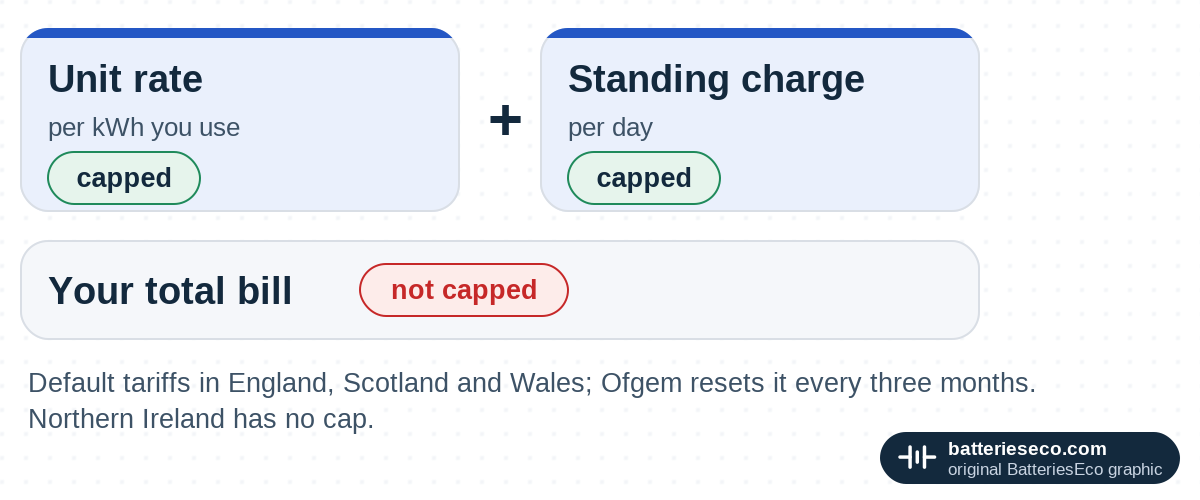
The energy price cap limits what a supplier can charge per unit of energy and per day on a default tariff in England, Scotland and Wales; it doesn’t limit your total bill. From 1 October to 31 December 2026, the cap’s average electricity unit rate for Direct Debit is 26.32 pence per kWh, with a standing charge of 54.83 pence a day and no VAT on electricity. Ofgem resets it every three months, and Northern Ireland has no cap.
This guide explains what the energy price cap is, what it means for your electricity bill, and why it matters if you have, or are thinking about, a battery or solar panels.
What the price cap is
Ofgem, the energy regulator for Great Britain, says the price cap is the most a supplier can charge for each unit of energy and for the daily standing charge. It doesn’t limit your total bill: the more you use, the more you pay.
It protects people on standard variable (default) tariffs, not people on a fixed tariff or a business contract, or those using a heat network or heating oil. Ofgem sets it every three months based on wholesale, network, policy and operating costs, among others, and the level varies with where you live, how you pay and your type of meter 1.
Ofgem says the cap protects around 22 million households on default tariffs, while around 35%, about 11 million, are on fixed tariffs and aren’t affected 2.
The current rates
From 1 October to 31 December 2026, a Direct Debit customer on a default tariff pays on average 26.32 pence per kWh for electricity, plus a standing charge of 54.83 pence a day, across England, Scotland and Wales 3. Ofgem’s typical dual-fuel figure for the same period is £1,723 a year for a Direct Debit customer, up 4%: an illustration based on typical use, not a limit on the bill 4. The rates differ by region.
For Direct Debit on a single-rate meter, the standing charge runs from 42.92 pence a day in London to 67.66 pence a day in Merseyside and Northern Wales, and the unit rate from 25.36 pence per kWh in the East Midlands to 27.86 pence per kWh in Merseyside and Northern Wales. Ofgem says standing charges differ by region because they’re calculated from how many people live there, how much energy is used there on average, how much energy the supplier has to buy and the cost of building and improving the energy network 5. They also differ by payment method 5.
Ofgem announces the next levels by 25 November 2026 (for 1 January to 31 March 2027), 23 February 2027 (April to June) and 26 May 2027 (July to September), and may publish earlier 3.
What "typical use" means
The yearly figures use Ofgem’s typical domestic consumption values. Since 1 July 2026, a medium household on a single-rate meter is assumed to use 2,500 kWh of electricity a year (1,600 kWh low, 3,800 kWh high), and one on a multi-rate meter such as Economy 7 uses 3,400 kWh 6. Your own bill depends on your own use: check how many kWh you use on your bill or in your supplier’s app (our reading).
Economy 7 and other multi-rate tariffs
On a multi-rate tariff such as Economy 7, there’s a peak and an off-peak unit rate, which together can’t be more than the cap 7. Ofgem also notes that many suppliers offer smart meter customers cheaper electricity outside peak times 2. Our time-of-use guide explains Economy 7 and smart tariffs.
VAT on electricity
Since 1 October 2026, there has been no VAT on domestic electricity in Great Britain. The legislation currently in force, SI 2026/987, sets the 0% rate until 31 March 2027 8. HMRC says it now runs to 30 June 2027, after the extension announced at Budget 2026 9 10; but as of 4 November 2026 we had found no amending order, so the official sources differ on the end date.
Gas is still charged at 5% VAT 7. In Northern Ireland, domestic electricity remains at the reduced rate of 5%, according to HMRC 9. At Budget 2026, the government said the extended VAT relief is expected to apply in Northern Ireland from April 2027, but this isn’t law yet 10.
Northern Ireland
The Ofgem price cap doesn’t apply in Northern Ireland, which has its own electricity and gas markets overseen by the Utility Regulator. Instead, the largest supplier in each area has its tariff reviewed, and that tariff acts as the price to beat, the Consumer Council for Northern Ireland explains 11. After its 2026 review, the Utility Regulator raised Power NI’s domestic electricity tariff by 6.2% from 1 July 2026, to an average of £1,093 a year for 3,200 kWh on the standard tariff 12.
What it means for a battery or solar panels
The unit rate is what a kWh from your own panels, used directly or stored in a battery, saves you when it replaces a kWh you’d otherwise buy; the standing charge is paid either way (our reading). A battery that charges on a cheap off-peak rate and runs your home at peak times saves the difference between the two rates, minus its losses (our reading). Our guide to home solar storage covers charging a battery from your panels or off-peak from the grid.
Ofgem resets the cap every three months, and we update the rates on this page when it does.
Sources
- Energy price cap and standing charges explained
- Energy price cap will rise by 4% from October 2026
- Changes to energy price cap between 1 October and 31 December 2026
- Energy price cap (default tariff) update from 1 October 2026 (Summary of changes to energy price cap 1 October to 31 December 2026)
- Energy price cap unit rates and standing charges (regional tables: "Electricity standing charges and unit rates paid by Direct Debit, single rate" and "..., multi-rate")
- Review of typical domestic consumption values: decision
- Energy price cap unit rates and standing charges
- The Value Added Tax (Supplies of Domestic Electricity) Order 2026 (SI 2026/987)
- Fuel and power (VAT Notice 701/19)
- Budget 2026
- Reminder to Northern Ireland consumers about the Ofgem price cap
- Utility Regulator confirms increases to regulated electricity and gas tariffs