Whole-home backup power: standby generator, home battery or both, plus transfer switches, permits and who can do the work
A standby generator can carry a whole house through a long outage as long as its fuel lasts. A home battery makes no fumes and needs no fuel, but its stored energy runs out unless solar recharges it. Size either for what must run at once, including the surge when an air conditioner starts.
A generator connects to your home’s wiring through a transfer switch, and neither source may feed power back into the utility’s lines during an outage. The installation usually needs a permit and, depending on your state, a licensed electrician.
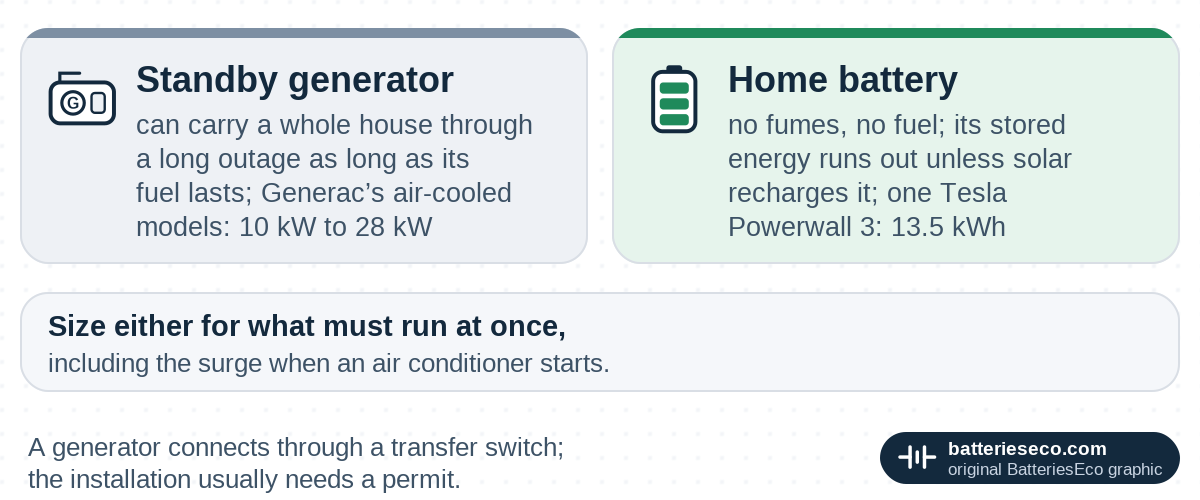
For whole-home backup power, the two options are a standby generator and a home battery. Generac lists air-cooled home standby generators from 10 kW to 28 kW 1, and Tesla rates one Powerwall 3 for North America at 13.5 kWh 2.
Generator or battery for whole-home backup?
A home battery stores energy and needs no fuel deliveries 3. Unlike diesel generators, solar with storage can keep delivering power through a long outage, even at night, the US Department of Energy notes 3.
Our reading: a home standby generator runs as long as its fuel supply lasts. Without solar to top it up, a battery is done once its stored energy is used up. Some homes combine both.
The National Laboratory of the Rockies (formerly NREL) sums up the choice in a rule of thumb: batteries are typically best for frequent, short outages 4. Under that rule, infrequent, long outages may be served more economically by a generator 4. For what a battery costs and when it pays off, see our home battery guide.
Size for what must run at once
Generac advises sizing for the appliances and systems you want to keep running, not for the square footage alone 1. Its method is to add up the running watts of everything that runs at the same time, then add the largest single starting surge 1. That surge is typically two to three times the running figure 1.
In Generac’s example, a 3-ton central air conditioner needs about 3.5 to 5 kW running but up to 15 to 18 kW to start its compressor 1. A load manager can pause lower-priority loads so a smaller unit can cope, Generac says 1.
For a battery, check both its power and its energy. Tesla and Enphase give these ratings in their datasheets:
| Battery | Energy | Continuous output | Peak or load start |
|---|---|---|---|
| Tesla Powerwall 3, North America 2 | 13.5 kWh | Configurable up to 11.5 kW | 185 LRA (load start rating) |
| Enphase IQ Battery 5P 5 | 5.0 kWh usable | 3.84 kVA at 240 V | Up to 7.68 kVA (peak) |
Up to four Powerwall 3 units plus three expansion units can be combined, according to Tesla 2. LRA (locked rotor amps) is the current a motor draws as it starts, and Tesla says the Powerwall 3 is able to start heavy loads rated up to 185 LRA 2.
A 2022 study by Berkeley Lab and NREL for the DOE modeled how a solar system sized to a home’s annual use would fare in a 3-day outage 6. The critical load it had to cover included refrigeration, nighttime lights, computer and internet, well pump loads, heating and cooling 6.
With that load and 10 kWh of storage, the system met 86% of critical load, averaged across US counties and months 6. With 30 kWh, the average was 96% 6. Our home solar storage guide explains what a battery needs to keep running without the grid.
The transfer switch
Whatever the source, it must never feed power back into the utility’s lines during an outage. OSHA’s fact sheet says never to attach a generator to a building’s wiring without a transfer switch that a qualified electrician has installed 7. Without one, it warns, a generator can energize wiring for great distances and create a risk of electrocution for utility workers 7.
According to Honda’s generator manual, a qualified electrician must make the connection for standby power 8. That connection must isolate generator power from utility power and must comply with the law and electrical codes 8.
Local building departments set the details. In Verona Township, New Jersey, a standby generator needs a permit, a load calculation, a wiring diagram and a test run 9. The township requires a permit for a portable generator’s inlet, transfer switch or listed interlock as well 9.
Our transfer switch and interlock guide covers what local codes require and who may do the work.
Licenses and permits in California, Texas and Massachusetts
These examples show how much depends on your state and city:
- California: under the regulation the Contractors State License Board adopted in 2024, a C-10 electrical contractor may install battery storage systems 10. A C-46 solar contractor may install one only as part of a solar job, and only up to 80 kWh 10.
- Texas: the Texas Department of Licensing and Regulation says electrical work must be done by a licensed electrician, except in a home you own and live in. Cities may override that exemption 11.
- Massachusetts: guidance the state issued to local officials in 2021 says a home battery installation needs permits from the building official, the fire official and the wiring inspector 12.
For battery placement and fire safety, the standard for installing stationary energy storage systems is NFPA 855 13. Ask your building department which edition applies 13. Our lithium battery fire safety guide covers the warning signs.
Our reading: before choosing between a generator and a battery, ask your city or county building department which permits each would need.
Sources
- What size generator do I need?
- Powerwall 3 Datasheet (North America, en-us, 2025)
- Solar and Resilience Basics
- Energy 101: Storage (presentation, NLR/PR-7A40-100986)
- IQ Battery 5P data sheet, North America (DSH-00010-11.0-EN-2025-05-06)
- Evaluating the Capabilities of Behind-the-Meter Solar-plus-Storage for Providing Backup Power during Long-Duration Power Interruptions (Narrative Summary)
- Using Portable Generators Safely (OSHA Fact Sheet FS-3286)
- Owner’s Manual, Generator EU2200i / EU2200i Companion
- Permit Requirements for Stand-by Generators
- Order of Adoption, 16 CCR 810, 832.10, 832.46 (Battery Energy Storage Systems)
- Electricians: Frequently Asked Questions; Electricians: Exemptions
- Superseding Guidance for Energy Storage System (ESS) Installations in One- and Two-Family Dwellings (joint memorandum)
- NFPA 855 Standard Development page