Is a home battery worth it in the US? What it costs, what size people buy and what makes it pay off
A home battery is most likely to pay off where your utility charges much more at peak hours than it credits you for solar exports, or if you put a value on backup power during outages. In the DOE’s modeled benchmark for early 2025, 8 kW of solar with a 13.5 kWh battery cost $4.59 for each watt of solar capacity, battery included, compared with $2.95 for the same solar alone, in 2024 dollars and before incentives.
The federal residential clean energy credit (25D) ended for expenditures after December 31, 2025, so state and utility programs now matter more.
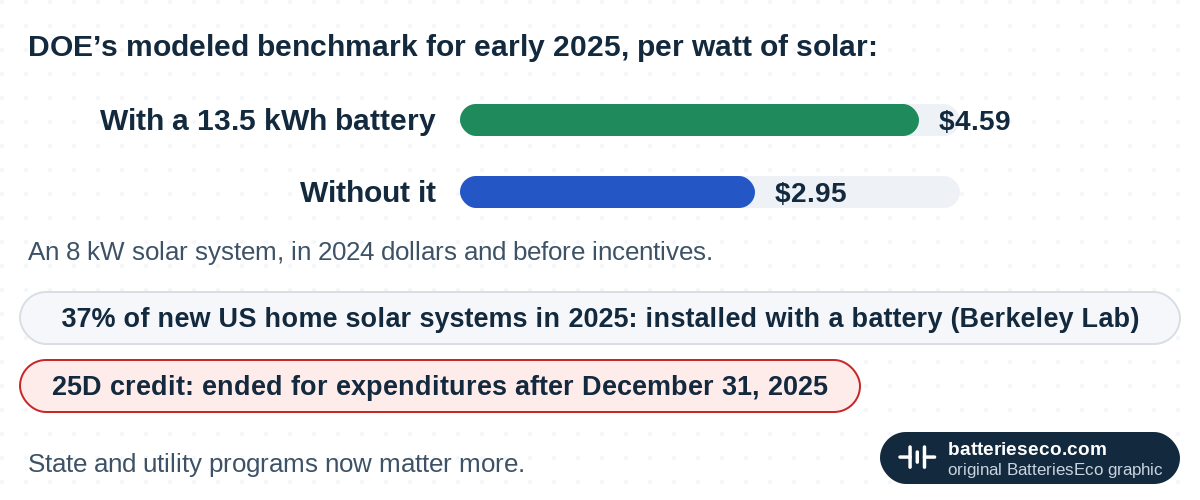
Whether a home battery is worth it in the US depends on its cost, how your utility bills you, the incentives left and what backup power is worth to you. In 2025, 37% of new home solar systems came with a battery, up from 25% in 2024, according to Berkeley Lab 1.
How much a home battery costs
The Department of Energy’s cost benchmark for the first quarter of 2025 models an 8 kW rooftop solar system with a 13.5 kWh battery at $4.59 per watt of solar 2. It models the same solar without a battery at $2.95 per watt. Both figures are in 2024 dollars and before incentives 2.
Our calculation: $4.59 minus $2.95 leaves $1.64 per watt, and $1.64 × 8,000 W comes to about $13,100 for the battery.
In our view, these are modeled national figures, and local quotes vary.
Berkeley Lab also looked at prices people actually paid. Among cash purchases of home systems installed in 2025, it found that the median price of solar with a battery was $2.10 per watt of solar higher than solar alone 1. About 80% of the price data for solar-plus-battery systems came from California, though 1.
What size people buy
In 2025, the median home battery was 13.5 kWh, the size of a single Tesla Powerwall, Berkeley Lab reports 1. Tesla rates one Powerwall 3 at 13.5 kWh 3. Enphase rates its IQ Battery 5P at 5.0 kWh of usable energy per unit 4.
The federal homeowner tax credit has ended
A home battery installed after December 31, 2025 doesn’t qualify for the residential clean energy credit (section 25D), even if you paid for it earlier 5. That’s because the law counts an expenditure as made when the installation is completed, as the IRS explains 5. Public Law 119-21, signed July 4, 2025, ended the credit for expenditures made after that date 6.
Our reading: an article that still counts the federal credit in a new battery’s price is out of date.
Our solar tax credit guide explains what’s left, including the 48E credit for system owners.
State and utility programs
Our reading: incentives now come mainly from states and utilities, and they change often. Check your state energy office and your utility for current programs.
In California, for example, the Self-Generation Incentive Program (SGIP) lists $1,100 per kWh of storage under its equity incentive for solar paired with storage at low-income homes 7. Additional eligibility criteria apply 7.
As of November 4, 2026, the program administrators’ tracker showed the general residential storage budget as closed 8. Nearly all of the equity budgets were closed or waitlisted 8.
When a home battery pays off
How your utility charges and credits you
Our reading: a battery earns most where peak prices are much higher than off-peak prices or than what you’re credited for exported solar.
California’s utility regulator, the CPUC, adopted its Net Billing Tariff in 2022 9 10. The tariff came with rates that charge much more at peak times than off-peak 9. The CPUC meant them as an incentive for batteries and for moving use out of the evening hours 9.
The tariff covers new solar customers of PG&E, Southern California Edison and San Diego Gas & Electric 9 10. Their exports are credited at values based on the utility’s avoided cost, meaning what it would otherwise pay to buy electricity from clean sources elsewhere 9. On PG&E’s E-TOU-C plan, for example, peak hours run from 4 to 9 p.m. every day 11.
In 2022, the CPUC projected that solar and solar-plus-battery customers would pay off their systems in 9 years or less on average 9. The federal residential credit was still available then, and it has since ended 6.
As we read it, that projection is now out of date. Our state-by-state electricity rates show what homes pay on average.
Losses and lifetime
A 2025 model of a representative home battery, by the National Laboratory of the Rockies (formerly NREL), assumes 85% round-trip efficiency and a 15-year lifetime 12. Round-trip efficiency is the share of the energy put into a battery that you get back out.
A rough payback check (our reading)
- Estimate the annual savings. Multiply the energy the battery shifts each day by 365, then by the gap between the price it avoids and the value of the energy it stores. Take off the 15% lost along the way, and the result is roughly what the battery saves in a year.
- Divide the battery’s cost by those annual savings. The result is a simple payback period.
- Compare that period with the battery’s lifetime.
Backup
A battery with the right equipment can keep the power on during an outage 13, a benefit no bill calculation captures. How much of an outage it can carry you through depends on what you run.
Our home solar storage guide summarizes the 2022 Berkeley Lab and NREL modeling for the DOE on what 10 kWh and 30 kWh of storage cover through a 3-day outage. To weigh a battery against a standby generator, see our whole-home backup guide.
Sources
- U.S. Distributed Solar and Storage, 2026 Data Update
- Solar Photovoltaic System Cost Benchmarks (2025Q1 benchmarks)
- Powerwall 3 Datasheet (North America, en-us, 2025)
- IQ Battery 5P data sheet, North America (DSH-00010-11.0-EN-2025-05-06)
- FAQs for modification of sections 25C, 25D, 25E, 30C, 30D, 45L, 45W, and 179D under Public Law 119-21 (FS-2025-05)
- Public Law 119-21 (139 Stat. 72), July 4, 2025: sections 70506 and 70513
- Self-Generation Incentive Program (SGIP)
- SGIP Program Metrics: Incentive Step Tracker
- CPUC Modernizes Solar Tariff To Support Reliability and Decarbonization (press release)
- Net Billing Tariff
- Time-of-Use rate plans
- Annual Technology Baseline 2025 - Residential Battery Storage
- Solar and Resilience Basics