The federal solar and battery tax credit after 2025: the end of 25D, the 48E credit for system owners and state credits
The federal residential clean energy credit (section 25D), worth 30 percent of the cost of home solar panels and batteries, doesn’t apply to expenditures made after December 31, 2025. The law counts an expenditure as made when the installation is completed, as the IRS explains. A separate business credit, 48E, still exists for qualified facilities and energy storage, and with a lease or PPA any federal credit goes to the company that owns the system.
For wind and solar facilities whose construction begins after July 4, 2026, 48E doesn’t apply to property placed in service after 2027; storage is exempt from that cutoff and is phased down instead for construction that begins in 2034 or later. Some states have their own credits.
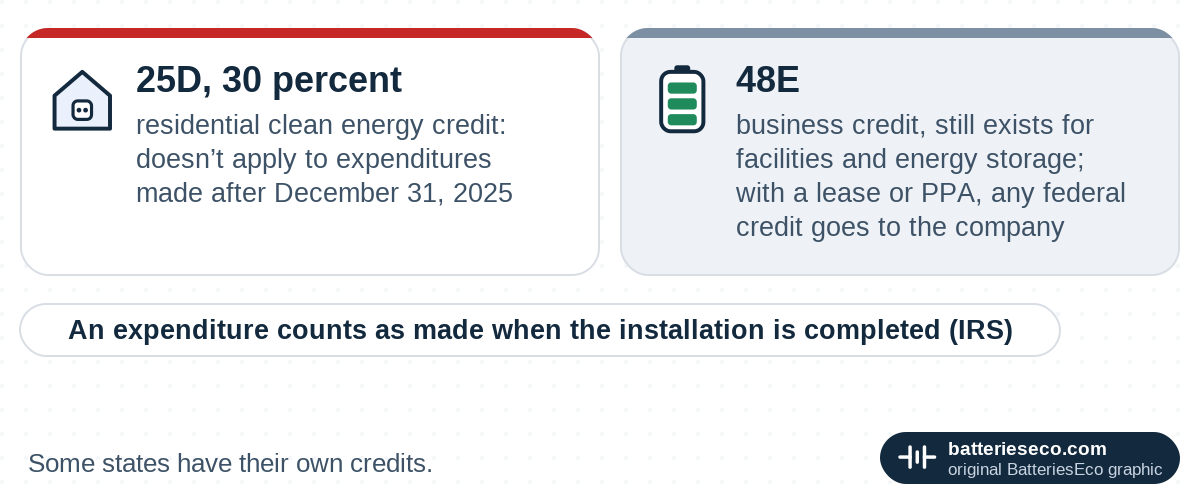
The federal solar tax credit for homeowners, section 25D, doesn’t apply to expenditures made after December 31, 2025 1. A business credit, 48E, still exists for qualified facilities and energy storage, and with a lease or PPA any federal credit goes to the company that owns the system 2 3. Some states have their own credits.
We can’t tell you what you can claim. That depends on your situation, so check with a tax professional.
What happened to the homeowner solar tax credit
The residential clean energy credit, section 25D of the tax code, was worth 30 percent of the cost of qualified clean energy property installed at a home in 2022 or later 4. Public Law 119-21, signed July 4, 2025, ended it 5. The amended tax code now says the credit “shall not apply with respect to any expenditures made after December 31, 2025” 1 5.
What counts is the date the installation is completed: the IRS explains that an expenditure is treated as made when the original installation is complete 6. So a system installed after December 31, 2025, doesn’t qualify, even if you paid for it earlier 6.
For a system that’s part of building or rebuilding a home, the expenditure counts as made when you begin using the home 6. A new home first occupied after December 31, 2025, doesn’t qualify either 6.
Batteries qualified only if they were installed at a home and had a capacity of at least 3 kilowatt-hours 1. If you couldn’t use all of your credit for a system installed in 2025 or earlier, the IRS says you can still carry the rest forward to later years 4.
The IRS’s credit page gives the December 31, 2025, end date, but further down it still says the credit can be claimed until it “begins to phase out in 2033” 4. That line is out of date. The law, which takes precedence, ended the credit after 2025 4 5.
Claiming it for a 2025 installation
If your system was installed in 2025, the credit belongs on your 2025 tax return 4. The IRS says you claim it with Form 5695 for the tax year when the property is installed, not merely purchased 4.
In our view, if you didn’t claim it on your 2025 return, ask a tax professional what you can still do.
The 48E credit for system owners
Section 48E, the clean electricity investment credit, is a business credit for qualified facilities and energy storage technology 2. For storage with a capacity of less than 1 megawatt, the rate is 30 percent, before any energy-community or domestic-content increase 2. Larger storage generally gets a 6 percent base rate unless it meets prevailing-wage and apprenticeship requirements 2 7.
As we read it, a home battery is far smaller than 1 megawatt.
With a solar lease or a power purchase agreement, the company that owns the system, not you, claims the federal tax credit, according to the FTC 3. Some state credits work differently: New York’s is open to lessees and PPA customers (see state credits) 8.
The same law that ended 25D limited 48E for wind and solar 5. For facilities whose construction begins after July 4, 2026, it doesn’t apply to wind or solar property placed in service after December 31, 2027 2. Energy storage is exempt from that cutoff 2.
Solar and storage property whose construction began after December 31, 2025, doesn’t qualify if its construction includes “material assistance from a prohibited foreign entity” 2.
IRS Notice 2025-42 spells out how a developer shows that construction began in time 9. The July 4, 2026, deadline for construction to begin has passed 9. For a leased or PPA solar system whose construction begins now, 48E is available to the owner only if the system is placed in service by December 31, 2027, and subject to the leasing question below 2 9.
The IRS’s 48E page is out of date
Last reviewed January 5, 2026, the IRS’s 48E web page still says the phase-out starts in “the later of 2032” or the year power-sector greenhouse gas emissions fall to 25 percent of 2022 levels 7. Nor does it mention the 2027 end for wind and solar 7.
Public Law 119-21 fixed that year, which the code calls the “applicable year,” at 2032, with no emissions test 5. For storage, the credit then depends on the year construction begins: the full credit for construction that begins by the end of 2033, 75 percent of it for construction that begins in 2034, 50 percent in 2035 and none after that 2 5. Where the IRS page and the statute conflict, we follow the statute, which outranks it 7 2.
What the law says about leases
Subsection (i) of 48E is titled “denial of credit for expenditures for wind and solar leasing arrangements” 2. But it cross-references solar water heating and small wind property, not solar electric property, which 25D defines in a separate paragraph 2 1.
Our reading: no IRS guidance we found explains how subsection (i) applies to leased rooftop solar panels, so we aren’t drawing a conclusion.
If a company offers you a lease or a PPA, the FTC suggests checking in the contract who gets the tax credits and other incentives 3.
In our view, the next step is to ask the company to put that in writing, along with how it’s reflected in your price.
State solar tax credits
Some states have their own credits. New York’s solar energy system equipment credit, for example, is 25 percent of qualified expenditures, up to $5,000, for equipment at your principal residence in the state 8.
Buyers can claim it, and so can lessees and power purchase agreement customers whose written agreement spans at least 10 years, according to the 2025 instructions for Form IT-255 8. New York’s Department of Taxation and Finance has an older credit page, updated in 2019, that lists leases without the 10-year condition 8.
For systems that produce electricity, the instructions also require a net metering contract with your utility, or compliance with its net metering schedule 8.
Our reading: check your state tax department’s current instructions before you count on a credit.
When a sales pitch promises the credit
Older articles and sales pitches may still promise the federal credit for a new home system. For systems installed after December 31, 2025, it no longer applies 6.
The DC Attorney General’s office warned in September 2025 about sales pitches claiming the tax credit would pay for a system 10.
To see what a home battery costs without the credit, read our guide to whether a home battery is worth it. Our solar lease and PPA guide explains who owns the system.
Sources
- 26 U.S.C. 25D: Residential clean energy credit (United States Code, Office of the Law Revision Counsel)
- 26 U.S.C. 48E: Clean electricity investment credit (United States Code, Office of the Law Revision Counsel)
- Solar Power for Your Home
- Residential Clean Energy Credit
- Public Law 119-21 (139 Stat. 72), July 4, 2025: sections 70506 and 70513
- FAQs for modification of sections 25C, 25D, 25E, 30C, 30D, 45L, 45W, and 179D under Public Law 119-21 (FS-2025-05)
- Clean Electricity Investment Credit
- Solar Energy System Equipment Credit; Instructions for Form IT-255 (2025)
- Notice 2025-42: Beginning of Construction Requirements for Purposes of the Termination of Clean Electricity Production Credits and Clean Electricity Investment Credits for Applicable Wind and Solar Facilities
- Attorney General Schwalb Warns DC Residents About Predatory Practices in the Home Solar System Industry