Solar lease, power purchase agreement (PPA) or buying: how each works, who gets the tax benefits, and what to check in the contract
You can buy a solar system, lease one or sign a power purchase agreement (PPA) to buy the power from a company’s panels on your roof. With a lease or PPA, the company owns the system, so any tax credits and incentives go to the company, not to you, according to the FTC.
Some contracts run 20 years, and payments can rise over time. If you sell your home, the FTC suggests checking whether the buyer can take over the contract and on what terms. Read those terms before you sign.
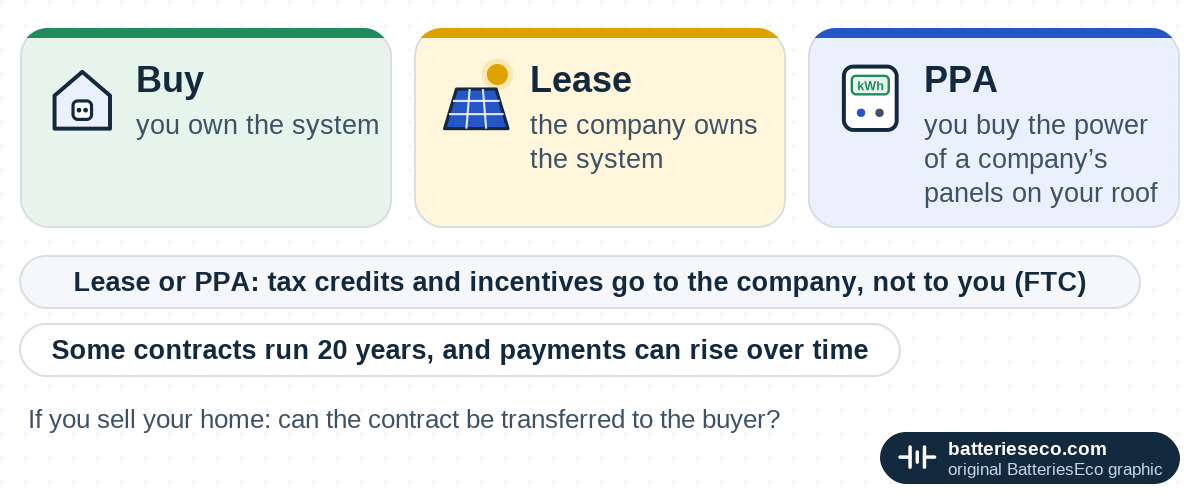
With a solar lease or a power purchase agreement (PPA), the system on your roof belongs to someone else, and some of these contracts last 20 years 1. If you buy instead, the Department of Energy says a purchased system can, in general, be installed at a lower total cost 2. Leases and PPAs, it adds, often require no money down 2.
How a solar lease and a PPA work
The Federal Trade Commission’s consumer advice, dated April 2022, lists three options: buying a system, leasing one or signing a PPA. With a lease, you pay to use a system you don’t own 1.
The DOE describes a lease’s monthly payments as fixed, calculated from the system’s estimated output 2. The FTC notes, though, that a lease contract may say the monthly payments can increase over time 1.
With a PPA, which can also last 20 years, you buy the power the system produces at a price the PPA provider sets 1. In the DOE’s words, the price is set per kilowatt-hour produced 2.
Who gets the tax benefits
With a lease or a PPA, “you don’t own the system,” in the FTC’s words. You can’t claim renewable energy certificates (RECs), and you aren’t eligible for tax credits or other financial incentives: those go to the system’s owner 1. The DOE also says lease and PPA customers aren’t entitled to tax benefits, because they don’t own the system 2.
The federal homeowner credit, section 25D, ended for expenditures made after December 31, 2025 3. Our solar tax credit guide explains what remains for system owners.
When lease and PPA payments go up
Under a PPA, the cost per kWh is generally lower than electric rates “but increases over time,” Connecticut’s Attorney General and Department of Consumer Protection warned in 2022 4. They added that there’s no guarantee your lease or PPA payments will be less than your electricity bill would have been 4.
The FTC’s checklist asks whether payments will increase and, if so, when and by how much 1.
Selling a home with a solar lease or PPA
Connecticut officials said a lease or PPA can make a sale harder, because your buyer and the solar company have to agree to transfer the contract 4. The FTC also suggests checking these points in the contract 1:
- whether it can be transferred to the buyer
- whether you have to send the company written notice first
- whether the buyer will have to meet credit requirements or pay fees
Company-owned systems add some complexity to a home sale, the DOE reports 2. In the data it cites, though, their effects on sale price, time on market and transfers are mostly neutral 2.
Some solar companies record a UCC-1 filing in your home’s real estate records, the Massachusetts Attorney General explained in 2016 5. The filing gives notice that a third party has rights to the panels. In a foreclosure, it protects the company’s ownership; in a sale, it tells the new owner and their lender that they aren’t taking ownership of the panels 5.
High-pressure sales and dealer fees
The DC Attorney General’s office warned in September 2025 that, with federal tax credits for home solar ending, DC residents might see more high-pressure sales tactics 6. Its examples include door-to-door salespeople asking for a signature on the spot, and false promises of a “free” system or one the tax credit will pay for 6.
The office advises getting the total cost and the projected savings in writing before signing 6. It also warns that lenders may add hidden fees and “dealer fees” 6. For a solar loan, it advises asking whether you’ll be charged a dealer fee, and getting the answer in writing 6.
If you can’t resolve a problem with the company, the FTC suggests reporting it at ReportFraud.ftc.gov and to your state attorney general 1.
The math to do before you sign
Our reading: compare the contract’s total payments over its term with what the same system would cost if you paid cash. Then compare its annual payments, including any scheduled increases, with what you now pay for electricity in a year. On the lease or PPA side, add any electric bill you may still get if the system doesn’t cover all your use.
For the electricity side of that comparison, see what homes pay per kWh in each state and how net metering credits your exports.
Sources
- Solar Power for Your Home
- Homeowner’s Guide to Going Solar
- Public Law 119-21 (139 Stat. 72), July 4, 2025: sections 70506 and 70513
- Attorney General Tong, DCP Commissioner Seagull Urge Caution in Reviewing Residential Solar Contracts
- AG Healey Offers Advice To Homeowners Considering Solar Panel Installations
- Attorney General Schwalb Warns DC Residents About Predatory Practices in the Home Solar System Industry