Net metering and net billing in the US: how your utility credits the solar power you export, and why it varies by state
Under net metering, your utility credits the solar power you send to the grid, usually at the retail rate, so you’re billed for what you use minus what you export. Most states still required it at the end of 2024, but a growing number have replaced it.
By the end of 2024, 12 states that had required net metering had switched to another structure, most often net billing, which credits exports at a separate rate, often based on the utility’s estimated avoided costs. NREL’s count stops at the end of 2024, and Illinois was scheduled to become the 13th on January 1, 2025. The rules depend on your state and your utility, so check them before you size a system.
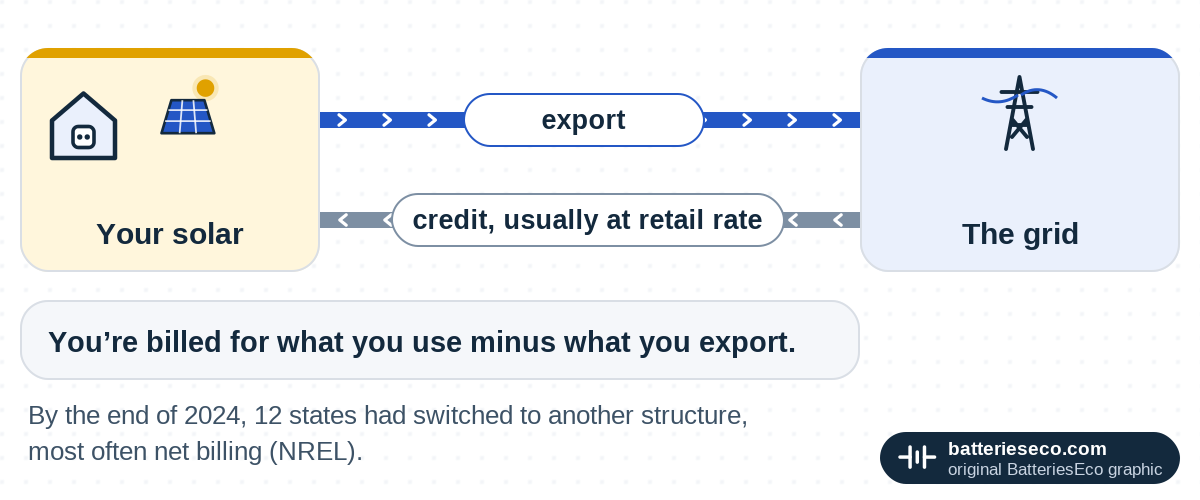
Net metering credits the solar power you export to the grid, usually at the retail rate, the same rate you’d pay to buy electricity from the grid 1. By the end of 2024, though, 12 states that had required it had switched to another structure, most often net billing, according to the National Renewable Energy Laboratory (NREL) 2. Which rules cover your exports depends on your state and your utility.
How net metering works
Net metering programs are mainly state-based, and they vary, the US Energy Information Administration (EIA) explains. In general, the utility bills you for the net electricity you used over a given period: your total consumption minus the electricity your solar system delivered to the grid 3.
As we read it, under net metering, a surplus sent to the grid on a sunny afternoon offsets power bought from the grid that evening. Both just have to fall in the same billing period.
The Department of Energy notes that the name dates from the 1990s, when the meter ran backward, “but it is rarely that simple today” 4.
Net metering vs net billing
A report by NREL for the DOE counts 43 states and Washington, DC, that have at some point required regulated utilities to credit exported rooftop solar at the retail rate. By the end of 2024, 12 of those states had replaced net metering with another structure that credits solar at a rate other than the full retail rate. NREL notes that Illinois was scheduled to become the 13th on January 1, 2025; its count doesn’t cover changes after 2024 2.
Most of the 12 use some form of net billing, which credits exports at a separate rate, often based on the utility’s estimated avoided costs. Some use value-of-solar tariffs. The revisions often add higher fixed charges or require time-of-use rates 2.
The share of US households living in states that require net metering fell from around 84% in 2014 to around 57% by the end of 2023, NREL says 2.
Why the state counts don’t match
Counts differ depending on what they measure. The EIA, citing DSIRE database figures as of the end of 2022, says 44 states and DC had “some form” of net metering policy. In that count, Idaho and Texas had no statewide rules, but several utilities there allowed it 3.
Our reading: that count includes states with modified versions, so it doesn’t contradict NREL’s count.
California and Minnesota, two different answers
California’s Net Billing Tariff
The Net Billing Tariff of the California Public Utilities Commission (CPUC) replaced the previous net metering tariff for customers who submitted an interconnection application (the request to connect a solar system to the grid) on or after April 15, 2023 5. The decision behind it covers the state’s three large investor-owned utilities, Pacific Gas and Electric, Southern California Edison and San Diego Gas & Electric 6 7.
Our reading: with one of those three utilities, the date your interconnection application was submitted tells you which tariff to look up. Customers of other utilities, such as municipal utilities, should check their own utility’s rules.
Imports and exports are counted separately, with no netting, and exports are valued using avoided-cost figures that vary with the grid’s needs 6. The CPUC’s announcement describes that value as what the utility avoids paying to buy electricity from clean sources elsewhere 7.
The decision was challenged in court 8. On March 9, 2026, after the California Supreme Court sent the case back in 2025, the Court of Appeal upheld it again 8. The CPUC’s Net Billing Tariff page still showed the tariff applying on November 4, 2026 5.
Minnesota’s retail energy rate for small systems
Under Minnesota statute, a system under 40 kW served by a public utility (the statute treats cooperatives and municipal utilities separately) may elect to have its net input credited at the average retail utility energy rate 9. That rate is the average of the retail energy rates for that class of customer, excluding special rates based on income, age or energy conservation 9.
Customers of cooperatives and municipal utilities with systems under 40 kW have the same option 9. Those utilities may charge them an extra fee to recover fixed costs, though 9.
Adding a battery
Our reading: storing your midday surplus to use in the evening is worth more where exports earn less than the retail rate. Where they earn the full retail rate and unused credits carry over, the grid works much like a battery for your surplus, and a home battery saves you less on your bill.
California’s regulator paired its net billing tariff with time-of-use rates designed to reward batteries and shift electricity use away from the evening 7. Our home battery guide looks at what a battery costs and when it pays off.
What to ask your utility
The DOE says whether your system qualifies depends on your state’s and your utility’s policies. It suggests asking your utility about availability, eligible system size and customer type, rates and how bill credits are designed 4.
As we read it, state rules don’t always treat every utility the same way, so a municipal utility or a cooperative may set different terms.
Checking a savings estimate
Our reading: find out which structure your utility uses and the rate it credits exports at. If a savings estimate you’ve been given assumes your exports earn the retail rate, check that assumption against your utility’s own rate plan.
Rules change, and some customers keep their terms for a set period. California locks in export values for nine years for customers of its three large investor-owned utilities who join during the first five years of its net billing tariff 6.
Those terms belong to the customer who had the system installed, not to the system 6. Someone who buys a home with an existing system doesn’t get them, unless they are or were the original customer’s spouse or domestic partner 6.
Our reading: if the California home you’re buying already has solar, ask the utility which export values will apply once the account is in your name.
If a company offers you a lease or a power purchase agreement instead, our solar lease and PPA guide explains what to check. For small kits that plug into an outlet, see our plug-in solar guide.
Sources
- Lower compensation rates for residential solar PV generation could reduce overall adoption (Today in Energy)
- Rooftop Solar Deployment, Potential Electricity Rate Impacts, and the Timing of Revisions to State Net Metering Policy (NREL/TP-6A20-91888)
- Renewable energy explained - incentives
- Homeowner’s Guide to Going Solar
- Net Billing Tariff
- Decision 22-12-056, Decision Revising Net Energy Metering Tariff and Subtariffs (R.20-08-020)
- CPUC Modernizes Solar Tariff To Support Reliability and Decarbonization (press release)
- Center for Biological Diversity, Inc. v. Public Utilities Commission, A167721 (Cal. Ct. App., filed March 9, 2026)
- Minnesota Statutes 2026, section 216B.164 Cogeneration and small power production