Plug-in (balcony) solar in the US: state laws, limits, renters, batteries and savings
Plug-in solar is a small solar kit that usually connects through an ordinary outlet. Not always, though: Maine’s law calls for a dedicated circuit above 420 watts, and the first edition of the UL 3700 safety outline covers kits that plug into a special, permanently installed receptacle.
By November 2026, at least eight states had laws that bar utilities from requiring their approval for such devices, most with a cap of 1,200 watts: Utah, Vermont, California, Maryland, Connecticut, Colorado, Maine and Virginia. Virginia’s takes effect on January 1, 2027, and California’s law gives no effective date.
Governors in New Jersey and New Hampshire have signed laws whose text we haven’t verified, and New York’s bill hasn’t been signed. The rules differ on whether you must notify your utility, what safety certification you need and who can install larger systems, so check your state’s law and your utility before you buy.


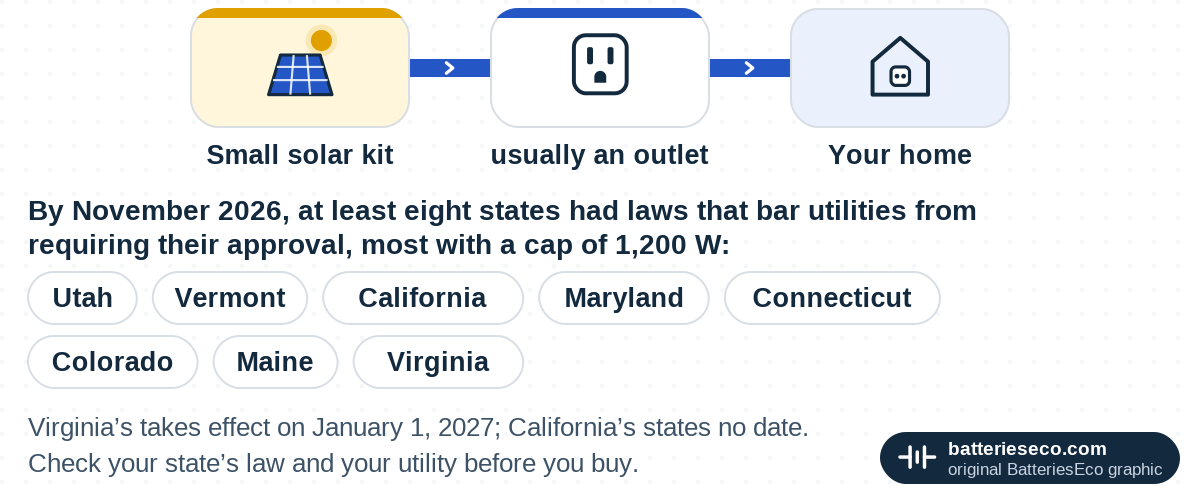
At least eight US states had a plug-in solar law by November 2026, and most of them cap a kit at 1,200 watts 1 2 3 4 5 6 7 8. Each one covers only its own state. Virginia’s takes effect on January 1, 2027, and California’s doesn’t state an effective date 8 3.
What is plug-in solar?
A plug-in solar kit is one or a few solar panels with an inverter that plugs into a standard outlet, so the power it makes feeds your home’s circuits. The state laws below use names such as “portable solar generation device” (Utah, California, Connecticut) and “plug-in photovoltaic device” (Vermont) 1 3 5 2.
A proposed amendment to the National Electrical Code (NEC), submitted by a manufacturer, says the 2020, 2023 and 2026 editions of the code don’t define a plug-in photovoltaic (PV) system 9. UL published an outline of investigation for these systems, UL 3700, on December 11, 2025 10. Its product page now lists Edition 2 as the active edition 10.
Which states have a plug-in solar law?
These are the laws we found as of November 4, 2026, state by state.
| State | Law | Limit | Effective |
|---|---|---|---|
| Utah | H.B. 340 (2025) | 1,200 W | May 7, 2025 |
| Maryland | Chapter 353 of 2026 | 1,200 W back to the building, one system per meter, residential use only | July 1, 2026 |
| Vermont | Act 149 of 2026 | 1,200 W combined per meter | July 1, 2026 |
| Maine | L.D. 1730 (Chapter 644, 2026) | 1,200 W combined per service address (licensed electrician and notice above 420 W) | July 29, 2026 (general effective date) |
| Colorado | H.B. 26-1007 | 1,920 W to the grid, one device per address | August 12, 2026 |
| Connecticut | Public Act 26-127, section 9 | 1,200 W, one device per meter | October 1, 2026 |
| Virginia | Code § 56-596.8 (2026) | 1,200 W per customer (per unit in multifamily housing) | January 1, 2027 |
| California | SB 868 (Chapter 985, 2026) | 1,200 W per dwelling; exemptions end January 1, 2030 | no effective date stated (see below) |
All eight laws say the utility can’t require its approval for a qualifying device 1 2 3 4 5 6 7 8. Most also bar fees and extra equipment, and require the device to stop feeding your home’s wiring during a power outage 1 2 3 4 5 6 7 8.
Utah’s law puts these duties on an “electrical corporation,” Connecticut’s on an “electric distribution company” 1 5. Neither text says whether a municipal utility is bound 1 5.
Our reading: if you’re on a municipal utility in Utah or Connecticut, ask it whether the law applies to you.
The bans on fees and extra equipment have exceptions:
- Maryland: if your system needs an automatic locking disconnect switch, you pay for installing it 4.
- Virginia: the utility may install an automatic locking disconnect switch where a property has more than one device or the local circuit requires it 8.
- Connecticut: the law still allows charges the device incurs through its use 5.
- Vermont: the law lets the utility recover the cost of any overloading of your service caused by a device 2.
Seven of the eight require a listing or certification from a nationally recognized testing laboratory, such as UL 1 2 3 4 5 6 8. Maine accepts that or a system configured under the electrical code instead 7. Maryland, Colorado and Virginia exempt devices of 391 watts or less from some listing provisions 4 6 8.
Vermont adds conditions of its own: the device must comply with UL 3700 or an equivalent certification, it may only be connected where the building has a smart meter, and it must be temporarily but securely attached to the ground or a structure 2. A customer who already has a net-metered system, such as rooftop solar, can’t also install one 2.
When each law takes effect
California’s law doesn’t state an effective date 3.
As we read it, California’s usual rule for laws passed without an urgency clause would make that date January 1, 2027.
California’s protections are temporary: the section that exempts these devices from interconnection rules and utility fees is repealed on January 1, 2030 3. A separate section bars sales in California, from that date, of plug-in solar devices that don’t meet the law’s code, certification and outage-isolation conditions 3.
Maryland’s chapter was signed on May 12, 2026, and the legislature’s bill page lists it as effective upon enactment 4. The chapter itself has two effective-date sections 4.
Section 23 makes the Act an emergency measure that takes effect on enactment, except as Section 22 provides 4. Section 22 makes Sections 1, 2, 3, 4, 6, 8, 19 and 20 effective July 1, 2026, and the portable solar rules (the new section 7-321) are in Section 4 4.
Our reading of the chapter’s structure: Maryland’s portable solar rules take effect on July 1, 2026.
Colorado’s law took effect on August 12, 2026, the date the legislature’s bill page lists 6. The act gave that date on the condition that no referendum petition was filed 6. From January 1, 2027, devices over 391 watts that aren’t UL labeled and listed can’t be sold, leased or rented in the state 6.
Maine’s law has no emergency clause, and the Legislature’s general effective date for that session’s nonemergency laws is July 29, 2026 7.
As we read it, that general date applies to Maine’s plug-in law.
Signed or pending: New Jersey, New Hampshire and New York
- New Jersey: the governor’s office says the Garden State Balcony Solar Act was signed on September 1, 2026 11. It describes devices of up to 1,200 watts that plug into a standard 120-volt outlet and says they’re exempt from utility interconnection and metering requirements 11. We couldn’t read the law itself, so we can’t confirm its effective date or conditions.
- New Hampshire: the governor’s office says SB 540, covering plug-in solar generation systems, was signed the week of July 2, 2026 12. We haven’t verified what it contains.
- New York: the Solar Up Now NY Act passed both houses on May 28, 2026 13. As of November 4, 2026, the Assembly’s bill page didn’t show it as signed, so it wasn’t law then 13.
If your state has no such law (our reading)
Where no such law exists, a device that sends power into your home’s wiring while it’s connected to the grid is generally covered by your utility’s interconnection rules. Ask your utility before you plug anything in.
Do you have to tell your utility?
Notice requirements vary by state:
- Maryland: you must notify the electric company before installing and certify the system’s safety features and maximum generating capacity 4.
- Virginia (from January 1, 2027): you must notify your utility on the State Corporation Commission’s form, online or by mail, before installing 8. The utility has 15 days to review it and flag any problems; if it doesn’t respond within that time, you may install the device 8.
- California (once the law takes effect): utilities may ask you to register the device through a simple online form 3.
- Colorado: your provider may require notice of the device and its size 6.
- Maine: you only need to notify your utility, within 30 days of installation, if your system is over 420 watts 7 14.
Who can install it
Maine’s law spells out who installs: above 420 watts per service address, each system must be installed by an electrician licensed in Maine, on a dedicated circuit with a single outlet 7. In Vermont, a landlord can require a tenant to pay for any electrical work and to have a licensed electrician do it 2.
Colorado exempts devices of 391 watts or less from the state’s solar installation requirements in section 40-2-128, which we haven’t read, and from code or listing provisions that would require changes to your wiring 6. Its law also says every installation must follow the fire code and local building codes 6.
Connecticut’s law keeps the State Building Code, the fire codes and local rules in force for these devices 5. For devices of 391 watts or less, Maryland and Virginia lift listing rules that would otherwise mean changes to your wiring or panel 4 8.
If you rent or have an HOA
Starting January 1, 2027, Virginia landlords who own more than four rental units in the state can’t stop tenants from installing a qualifying device on the exterior of the tenant’s premises, though they can set reasonable restrictions 15. You must give the landlord at least seven days’ notice, with documentation that the device qualifies and its proposed location 15.
You’re responsible for any damage it causes to the unit or the premises 15. Tenants can’t install one if their unit is subject to a ratio utility billing system, and a device that would need changes to the building’s wiring or panels needs the landlord’s express written approval 15.
In Vermont, a tenant must give the landlord at least 10 days’ notice 2. The landlord can respond with reasonable restrictions, and if the landlord doesn’t respond within 10 days, the tenant may go ahead 2. A tenant can’t have electrical work done for the device without the landlord’s permission 2.
Vermont also bars deed restrictions, covenants and similar agreements from prohibiting a plug-in device, including on patio railings in condominiums, cooperatives and apartments 2.
In Maine, if you install a system on a structure you don’t own, you must make sure it doesn’t compromise the structure or break building, fire or zoning codes 7. When you remove it, you must restore the structure 7.
In Colorado, starting January 1, 2027, no one may unreasonably ban the use of a qualifying device and unreasonable covenants are void, though property owners can set reasonable restrictions 6. New Jersey’s governor says its law stops landlords and homeowners associations from broadly prohibiting the devices 11. We haven’t read the law’s text.
Our reading: in other states, check your lease or your association’s rules.
Do the laws cover plug-in batteries?
Maine’s law covers plug-in battery systems as well as plug-in solar 7. They count toward the same 1,200-watt combined limit per service address, and above 420 watts the same licensed-electrician, dedicated-circuit and notice rules apply 7.
Our reading: the other laws we read cover solar devices only.
Safety certification and the electrical code
A manufacturer has proposed four amendments to the NEC 9 16. They would add a definition, limits on connecting at a receptacle outlet, labeling rules and rules on using the plug as a disconnect 9 16. According to that manufacturer, the NEC’s 2020, 2023 and 2026 editions have no definition of a plug-in PV system 9.
NFPA, which publishes the NEC, set a comment deadline of November 20, 2026; the proposals hadn’t been adopted when we checked 9 16 17.
Edition 1 of UL 3700 covers systems whose plug connects to a permanently installed plug-in PV receptacle 10. We haven’t read Edition 2’s scope 10.
The laws don’t all ask for the same certification:
- Vermont: UL 3700 or an equivalent, and installation to IEEE 1547-2018 2
- Maine: UL 3700 or a comparable standard 7
- California: certification as a plug-in photovoltaic system 3
- Connecticut: UL or equivalent certification, plus UL 1741, IEEE 1547, the State Building Code and the National Electrical Code (NFPA 70) 5
Utah, California and Virginia also require the device to meet the most recent National Electrical Code 1 3 8.
As we read it, a system certified to Edition 1 of UL 3700 may need an outlet installed by an electrician. The check to make before you buy is whether the kit’s listing matches your state’s law.
How much can a plug-in solar kit save?
A kit saves money on the power you use at home while it’s producing. Power you send to the grid may earn you nothing: Vermont’s and Maine’s laws exclude these devices from net metering 2 7. Connecticut requires the device to carry a warning that power it makes beyond what you use on site is charged to you as usage, unless your meter allows net metering 5.
Colorado’s average residential price was 16.80 cents per kWh from January through August 2026, a preliminary EIA figure 18.
Our calculation: an 800-watt kit hung vertically facing south on a balcony in Denver would make about 884 kWh a year (the PVWatts calculator, version 8, from the National Laboratory of the Rockies, formerly NREL; typical-year weather, 14% losses). If you used all of it at home at that Colorado price, it would save about $149 a year (884 kWh × 16.80 cents).
In our view, your actual savings can be lower, for two reasons. That price is an average of what homes paid, fixed charges included, so the rate you avoid per kWh may be lower. And if nobody’s home during the day, you’ll use less of the output at home.
You can look up the average price where you live in our electricity rates by state guide.
Plug-in vs rooftop solar
A plug-in kit is limited to about 1,200 watts in most of these states 1 8.
Our reading: a grid-tied rooftop system is connected under your utility’s interconnection rules. It can earn credit for the power it sends to the grid under net metering or net billing.
Our net metering guide explains how those credits work.
Sources
- H.B. 340 Solar Power Amendments, Enrolled Copy (Utah Code 54-15-102, 54-15-601)
- Act No. 149 (S.202), An act relating to plug-in photovoltaic devices, as enacted
- Senate Bill No. 868, Chapter 985 (2025-2026): Electricity: portable solar generation devices (chaptered text)
- Chapter 353 (House Bill 1532), 2026 Laws of Maryland, Utility RELIEF Act; bill page HB1532 2026RS
- Public Act No. 26-127, An Act Concerning Renewable Power Generation (House Bill No. 5340)
- House Bill 26-1007, signed act (Colorado General Assembly, 2026 Regular Session)
- Public Law 2026, Chapter 644 (LD 1730): An Act to Make Small Plug-in Solar Generation Devices Accessible for All Maine Residents to Address the Energy Affordability Crisis
- Code of Virginia § 56-596.8. (Effective January 1, 2027) Small portable solar generation devices; exempt from interconnection
- NFPA 70 Proposed TIA 1951 (Article 100, Plug-in Photovoltaic (PIPV) System; Part IV 705.100)
- UL 3700 Outline of Investigation for Interactive Plug-In PV (PIPV) Equipment and Systems (Edition 1 page)
- Governor Sherrill Signs Legislation Giving New Jerseyans Cleaner, More Affordable Energy at Their Fingertips (press release)
- Governor Signs 74 Bills into Law
- New York State Assembly, bill A09111 (2025-2026 session): summary, actions and text of A9111C
- Plug-In Solar
- Code of Virginia § 55.1-1212.1 (Effective January 1, 2027) Installation of small portable solar generation devices
- NFPA 70 Proposed TIA Log No. 1952 (705.12(C)), No. 1953 (705.20(H)) and No. 1954 (705.10)
- NFPA 70 (NEC) Code Development page
- Electric Power Monthly, Table 5.6.A (August 2026 and 2025) and Table 5.6.B (year-to-date through August 2026 and 2025)