Transfer switch or generator interlock: what they do, what local codes require and who can legally install them
OSHA says never to connect a generator to your home’s wiring unless a qualified electrician has installed it with a transfer switch. The local codes we checked call for a transfer switch or a listed interlock, to keep the generator from feeding power back into the utility’s lines.
The three local building departments we checked require a permit for a generator connected to the house wiring (Leon County’s rules cover permanent standby generators only). All three ask for a load calculation for a permanent standby generator.
Who may do the work depends on your state and city. Texas, for example, doesn’t require a state electrician’s license for work on a home you own and live in, but cities can override that exemption. West University Place only accepts permit applications for permanent generators from a licensed or registered contractor.
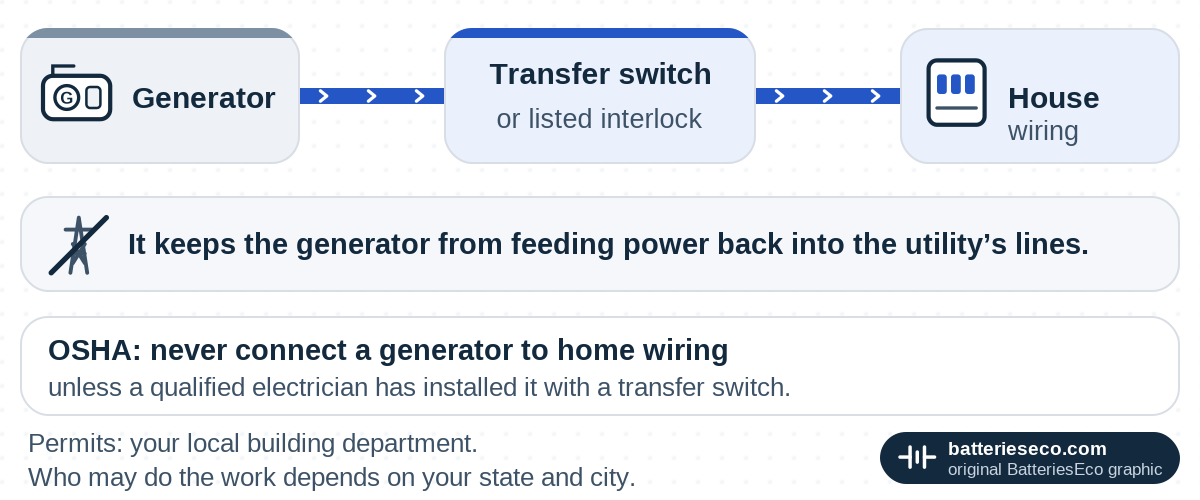
The local codes we checked call for a transfer switch or a listed generator interlock (listed: certified by a recognized testing lab) before a generator is connected to your home’s wiring. OSHA warns never to attach a generator to a building’s electrical system unless a qualified electrician has installed it with a transfer switch 1. Which permit you need, and who may do the work, depend on your city or county and on your state.
The risk of backfeeding
Without the right equipment, a generator connected to your home’s wiring can send power back into the utility’s lines. OSHA says it can then energize wiring systems for great distances and put utility workers and others in the area at risk of electrocution 1.
The CPSC calls backfeeding, plugging a generator into a wall outlet to power the house, extremely dangerous 2. Standby connections, Honda’s generator manual says, must be made by a qualified electrician, and the connection must keep generator power isolated from utility power 3. Honda warns that a wrong connection can make the generator explode, burn or start a fire when utility power comes back 3.
Transfer switch vs interlock: what local codes accept
Our reading: both keep your home from being connected to the utility and the generator at the same time.
An interlock goes on your existing breaker panel 4.
Local building departments describe the options in terms of the National Electrical Code (NEC), Article 702, which covers optional standby systems. Three of them, in three states, set out these rules:
- Leon County, Florida: citing NEC 702.5, the county requires a transfer switch rated for the connected load on every permanently installed standby generator 5. If you pair an automatic transfer switch with a generator whose output capacity is less than your main breaker’s rated ampacity, you also need a load management system 5. Generac says its own Load Manager temporarily pauses lower-priority loads to prevent overload 6, but the county’s sheet names no product 5.
- West University Place, Texas: the city says manual transfer equipment for a portable generator needs an interlock device suitable for the use 7. It has to be installed so that the normal and generator supplies can’t be connected together, and paired with a UL 231-listed power outlet as the connection device 7. All transfer equipment must be listed 7.
- Verona Township, New Jersey: the township requires interlocks to be listed and labeled by a recognized testing lab 4.
In the local rules we checked, neither device is reserved for one kind of generator. Verona’s checklist accepts a transfer switch or an interlock for a portable generator 4. West University Place lets a permanent generator with manual transfer use the interlock setup or, instead, a listed transfer switch or panelboard 7.
Verona asks for the interlock’s cut sheet with the permit 4.
The current edition is the 2026 NEC 8. The Leon County and West University Place documents are based on the 2020 edition 5 7.
As we read it, these are local summaries of the code: we didn’t read the NEC text itself. Each state adopts its own edition, so the one your inspector works from may not be the newest. Ask your building department which edition it enforces.
Do you need a permit?
All three building departments we checked require a permit to connect a generator to the house wiring, though Leon County’s rules cover only permanent standby generators. West University Place says a portable generator that powers equipment only through its own built-in outlets needs no permit or inspection 7.
In our view, that draws the line for a West University Place home: cords run from the generator’s own outlets need no permit, while a connection to the house wiring does.
Leon County asks for 5:
- a load calculation
- a riser diagram of the meter, panels, transfer switches and generator
- a sign at the service equipment showing the generator’s location
For a permanent generator, West University Place requires building and electrical permits, plus a plumbing permit for a gas connection 7. It wants the load calculations with the approved permit documents and on site at the inspection 7.
Verona Township asks for a load calculation of all the load connected to the generator, a wiring diagram and a test run of the generator at the final inspection. It also requires a permit for a portable generator’s inlet, transfer switch or interlock 4.
More generally, generator maker Generac notes that most jurisdictions require an electrical permit and an inspection for a transfer switch 6.
When the utility gets involved
Your utility may need to know too. West University Place asks for a CenterPoint Energy “ATF approval letter” along with the transfer switch specifications; the city’s guide doesn’t spell out “ATF” 7.
The city says the homeowner or installer must contact CenterPoint to arrange disconnection and reconnection 7. Its inspector must approve the work before CenterPoint restores power 7.
As we read it, if CenterPoint disconnects the service for the work, the home has no grid power until the inspector has approved it.
Honda’s manual adds that in some areas generators must be registered with the local utility, and says to consult the utility or a qualified electrician before making any connection 3.
Who can legally install a transfer switch or interlock?
As we read it, two separate rules apply. Your state, and in some places your city, decides who may do electrical work; your city or county building department decides which permit and inspection the job needs. A licensing exemption leaves the permit and the inspection in place.
- OSHA’s advice: a qualified electrician 1.
- Texas: the state licensing department says anyone doing electrical work must be licensed, but a person working on a home they own and live in isn’t required by the state to hold a license 9. It adds that city or regional rules may override that exemption 9. West University Place, for example, requires permit applications for permanent generators to come from a licensed or registered contractor 7.
- California, contractors: the Contractors State License Board’s classification rules, as amended by the regulation it adopted in 2024, say a Class C-10 electrical contractor’s work includes installing or connecting electrical apparatus 10.
- California, owner-builders: the contractor licensing law itself doesn’t apply to an owner who improves a structure on their own property and does all the work personally (or through their own employees, paid wages only), as long as none of the improvements is intended or offered for sale 11. Selling, or offering to sell, within a year of finishing the work is presumed to mean it was done for sale, unless you can show otherwise 11.
- California, your own home: the licensing law doesn’t apply to a homeowner improving the principal residence they’ve lived in for the 12 months before the work is completed, as long as the work is done before any sale, with limits on how often that exemption can be used 11.
If you’d do the work yourself
Our reading: being exempt from the license doesn’t exempt you from your building department’s permit and inspection. Before you buy the equipment, ask your city or county building department about owner-builder permits and the inspection the job needs.
As we read it, in Texas that means checking whether your city overrides the state exemption, as West University Place does for permanent generators. In California, the owner-builder exemption covers only work not intended or offered for sale. If you sell or offer the home for sale within a year of finishing, the work is presumed to have been done for sale unless you show otherwise.
Still choosing the generator? Our whole-home backup guide compares standby generators with home batteries, and our generator vs battery guide covers portable generators.
Sources
- Using Portable Generators Safely (OSHA Fact Sheet FS-3286)
- CPSC Safety Alert: Portable Generator Hazards (Publication 5123)
- Owner’s Manual, Generator EU2200i / EU2200i Companion
- Permit Requirements for Stand-by Generators
- Permitting Requirements for Permanently Installed Standby Generators - Based on FBC 8th Edition (2023) and NEC 2020
- What size generator do I need?
- Building - Electrical Generators Installation Guidelines (Electrical Generators Installation Guide)
- NFPA 70 (NEC) Code Development page
- Electricians: Frequently Asked Questions; Electricians: Exemptions
- Order of Adoption, 16 CCR 810, 832.10, 832.46 (Battery Energy Storage Systems)
- Business and Professions Code, Division 3, Chapter 9 (Contractors), Article 3 (Exemptions), section 7044