Portable generator or portable power station: running vs starting watts, inverter generators, noise, fuel and carbon monoxide
A portable generator runs as long as you have fuel. A portable power station has no engine but stops when its battery is empty.
On a generator, the running (rated) watts show what it can power continuously, and the starting watts cover motor surges. Every gas-powered generator makes carbon monoxide. The CPSC says to run one only outdoors, at least 20 feet from the house, and to look for a model with a CO shut-off feature.
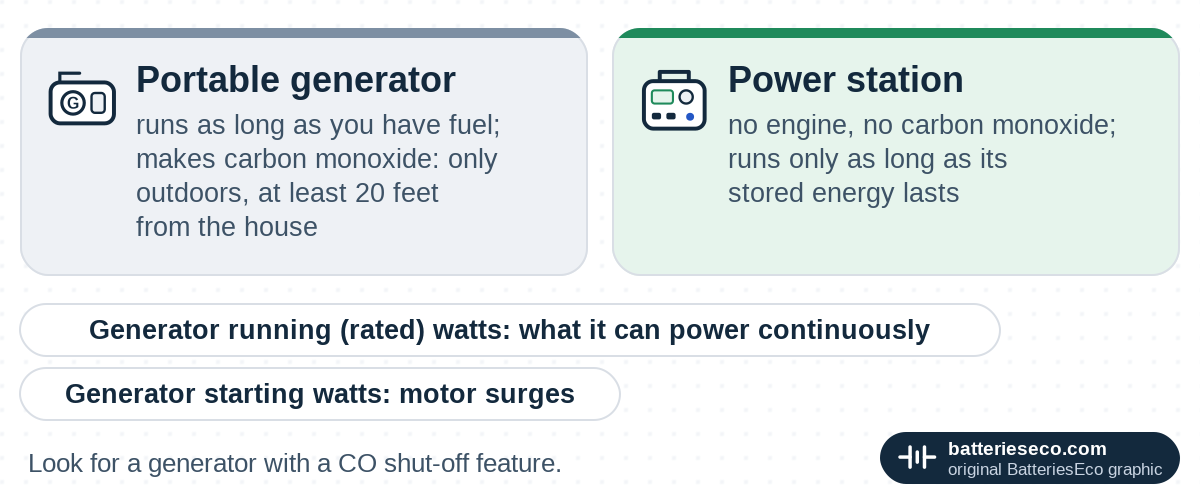
A portable generator runs as long as you have fuel, while a portable battery power station lasts only until its battery runs down. From 2012 to 2022, generators were associated with an estimated 892 non-fire carbon monoxide (CO) deaths in the US, according to a CPSC staff report 1.
Running watts and starting watts
A generator has two power ratings, and Honda’s EU2200i manual gives them in kVA: a rated power of 1.8 kVA and a maximum power of 2.2 kVA 2. It says not to exceed the rated power in continuous use, and warns that most appliance motors need more than their rated wattage to start 2.
Generac calls the same pair running and starting watts. Its GP3600 is rated at 3,600 running watts and 4,500 starting watts 3.
Our reading: add up the running watts of everything you’ll run at the same time. Then check that the starting watts cover that total plus the biggest motor’s starting surge.
Why inverter generators run quieter
Honda explains the difference between the two types this way 4:
- A conventional generator produces AC power directly and runs at full speed all the time, which makes it noisier and less fuel efficient.
- An inverter generator converts its output to DC and back to AC, and a microprocessor also matches engine speed to demand.
- The result is cleaner, more stable power for sensitive electronics, and a quieter, lighter and more compact machine.
Honda rates its EU2200i at 57 dB(A) at rated load and 48 dB(A) at 1/4 load, and says it runs 3.2 hours on its 0.95-gallon tank at rated load 5. Honda doesn’t state a measuring distance, so other brands’ figures may not be comparable.
Carbon monoxide and the CO shut-off
Both inverter and conventional generators produce carbon monoxide, Honda notes 4. For portable generators, the CPSC advises 6:
- Never run one inside a home, garage, basement, crawlspace or shed, even with doors or windows open.
- Use it outdoors only, at least 20 feet from the house, and point the exhaust away.
- Look for a model with a CO shut-off feature.
UL 2201 is a standard for testing that shut-off 7. According to UL Standards & Engagement, it sets procedures for measuring a portable generator’s CO emission rate and its shut-off at elevated CO levels 7.
According to Honda, its CO-MINDER stops the engine before CO levels around it exceed a set limit 2. Honda adds that the system can’t prevent all danger, and still recommends battery-operated CO alarms on every level of the home 2. The CDC recommends battery-operated or battery-backup CO detectors near every sleeping area 8.
How long gasoline keeps
Honda’s manual warns that gasoline can go stale in as little as 30 days, depending on the region 2.
No source we read gives an official US figure for how long gasoline stays fresh. Follow your generator’s manual.
A battery power station instead of a generator
A portable power station has no engine. In our view, it produces no fumes and no engine noise, and you can use it indoors.
Our power stations section explains capacity and output. EcoFlow’s manual, for example, gives its DELTA 3 Plus a capacity of 1,024 Wh and up to 1,800 W from its AC outlets 9. Our runtime calculator estimates how long a station like that runs the appliances you enter.
For frequent, short outages, batteries are typically best, according to a rule of thumb from the National Laboratory of the Rockies (formerly NREL) 10. For infrequent, long ones, it says, a generator may be the more economical choice 10. Our whole-home backup guide weighs the two for a whole house.
Connecting a generator to your home
The CPSC warns never to plug a generator into a wall outlet to power the house wiring, a practice called “backfeeding” 11. It says this is extremely dangerous and puts utility workers and neighbors at risk of electrocution 11. To run appliances, plug them into the generator with heavy-duty extension cords 12.
OSHA says a connection to your home’s wiring needs a transfer switch installed by a qualified electrician 13. Honda’s manual requires standby connections to be made by a qualified electrician and to isolate generator power from utility power 2.
Our transfer switch and interlock guide explains the local rules and who’s allowed to install a transfer switch or interlock. For the rest of your outage prep, see our power outage guide.
Sources
- Non-Fire Carbon Monoxide Deaths Associated with the Use of Consumer Products: 2022 Annual Estimates
- Owner’s Manual, Generator EU2200i / EU2200i Companion
- Portable Generator, 3600W | With COsense | 49ST (GP3600, model 7721)
- What is an Inverter Generator?
- EU2200i generator (product page and specifications)
- As Winter Storms Threaten Millions in the US, CPSC Issues Safety Tips to Help Families Prevent Carbon Monoxide Poisoning and Fires (Release 26-149)
- UL 2201, Carbon Monoxide (CO) Emission Rate of Portable Generators
- Carbon Monoxide (CO) Poisoning Basics
- EcoFlow DELTA 3 Plus User Manual (English, multi-region, examples based on the US version; PDF linked from manuals.ecoflow.com/us)
- Energy 101: Storage (presentation, NLR/PR-7A40-100986)
- CPSC Safety Alert: Portable Generator Hazards (Publication 5123)
- Power Outages
- Using Portable Generators Safely (OSHA Fact Sheet FS-3286)