How to prepare for a power outage: food, medicine, medical devices, carbon monoxide and backup power
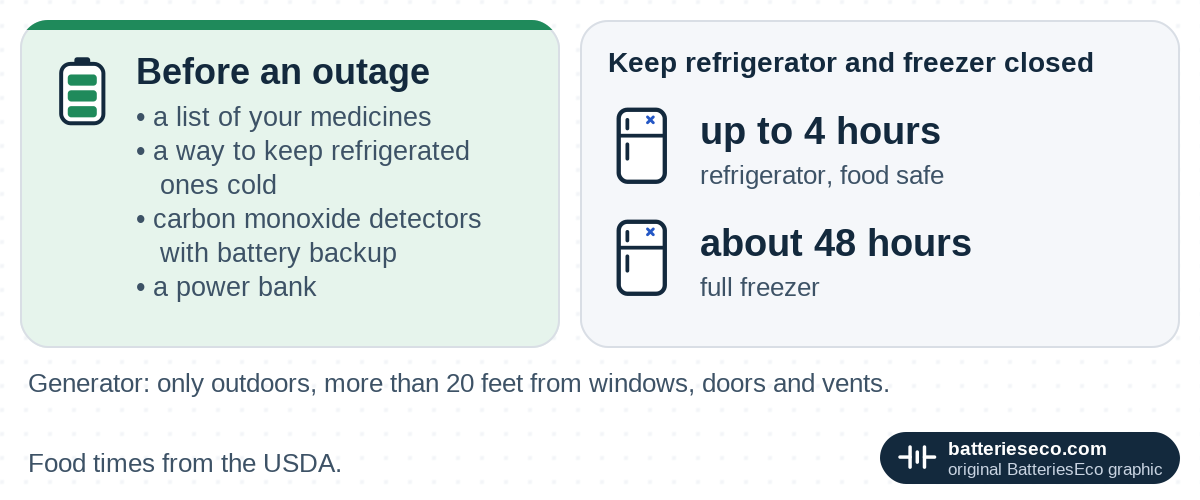
Before an outage hits, have a list of your medicines, a way to keep refrigerated ones cold, battery-backed carbon monoxide detectors and a power bank or other battery backup. During the outage, keep the refrigerator and freezer closed: the USDA says the refrigerator keeps food safe for up to 4 hours and a full freezer for about 48 hours. If you use a generator, run it only outdoors, more than 20 feet from windows, doors and vents.
This guide explains what to do before, during and after a power outage at home, and what backup power can and can’t do.
How long outages last
In 2025, the average US electricity customer was without power for 269.2 minutes over the year, counting major events such as storms, and 125.3 minutes without them (IEEE method). In 2024, the figure with major events was 662.6 minutes, the EIA reports 1. An average hides the long outages some areas get after a major storm (our reading).
Before an outage
- Medicines. The FDA advises keeping an up-to-date list of your medicines and a copy of your prescriptions with your emergency supplies, getting early refills if pharmacies may be disrupted, and having a plan to keep refrigerated medicines cold, for example with a cooler and ice or frozen gel packs 2.
- Medical devices. If you use a device that needs power, such as a ventilator, the FDA says to tell your electric company and fire department, and to ask the device manufacturer whether it can run on batteries or a generator 3. Ready.gov also advises discussing a plan for power-dependent devices with your medical provider 4.
- Carbon monoxide detectors. The CDC recommends battery-operated or battery-backup CO detectors near every sleeping area, checking their batteries when you change the clocks each spring and fall, and replacing the detectors every 5 years or as the manufacturer recommends 5. Ready.gov recommends one on every level of the home 4.
- Backup power. Ready.gov suggests planning for batteries and other alternative power sources, such as a portable charger or power bank 4.
- Food. The USDA advises keeping appliance thermometers in the refrigerator and freezer to check that the refrigerator stays at 40 °F or below and the freezer at 0 °F or below, and keeping the freezer full 6.
During an outage
Keep the refrigerator and freezer doors closed. The USDA says the refrigerator keeps food safe for up to 4 hours, and a full freezer holds its temperature for about 48 hours, or 24 hours if it’s half full. Fifty pounds of dry ice should hold an 18-cubic-foot freezer for 2 days 6.
If you depend on a life-sustaining medical device, the FDA says to seek emergency services immediately 3.
Insulin and refrigerated medicines
The FDA says the labels of all three US insulin manufacturers call for storing insulin in a refrigerator at about 36 °F to 46 °F. Insulin in its original vials or cartridges, opened or unopened, can be left unrefrigerated at 59 °F to 86 °F for up to 28 days and still work 7. If a medicine that needs refrigeration has gotten too warm, check its storage instructions or ask a pharmacist, your health care provider or the manufacturer whether it can still be used 2.
Generators and carbon monoxide
Portable generators produce carbon monoxide, an odorless, colorless gas. Each year, more than 400 Americans die from unintentional CO poisoning not linked to fires, the CDC says. Never use a generator inside your home or garage, even with the doors and windows open.
Run it only outdoors, more than 20 feet from any windows, doors and vents 5. Never connect it to your home’s wiring unless a qualified electrician has installed it with a transfer switch, OSHA warns 8. Our generator vs battery guide compares the options.
After an outage
Never taste food to decide whether it’s safe. The USDA says to throw out perishable refrigerated food, such as meat, poultry, fish, eggs, milk and soft cheeses, if the refrigerator was without power for more than 4 hours 6. When power comes back, check that your medical device’s settings haven’t changed: the FDA notes that devices often reset to a default mode after an outage 3.
Battery backup
A portable power station can run small loads such as a phone, a router or lights, and our runtime calculator estimates how long one lasts. For a CPAP or another medical device, the FDA says to check the user instructions or ask the manufacturer whether it can be used with batteries 3. For the whole house, see our whole-home backup guide; for a sump pump, see our sump pump backup guide.
Sources
- Electric Power Annual, Table 11.1 Reliability Metrics of U.S. Distribution System
- Safe Drug Use After a Natural Disaster
- FDA Offers Tips about Medical Devices and Natural Disasters
- Power Outages
- Carbon Monoxide (CO) Poisoning Basics
- Keep Your Food Safe During Emergencies: Power Outages, Floods & Fires
- Information Regarding Insulin Storage and Switching Between Products in an Emergency
- Using Portable Generators Safely (OSHA Fact Sheet FS-3286)