Sump pump and well pump backup in a power outage: battery, water-powered or generator
A sump pump stops when the power goes out, unless it has a backup, and FEMA’s advice is to choose one with a battery-operated backup. In the City of Ann Arbor’s guidance, a battery backup pump is usually less powerful than the main pump, and its battery generally gives 7 to 24 hours of pumping.
Ann Arbor’s guidance also describes a water-powered backup, which needs no electricity and works as long as there’s water pressure. On a private well, Michigan’s environment department warns that the system loses pressure in an outage if you open a faucet, and the water can become contaminated.
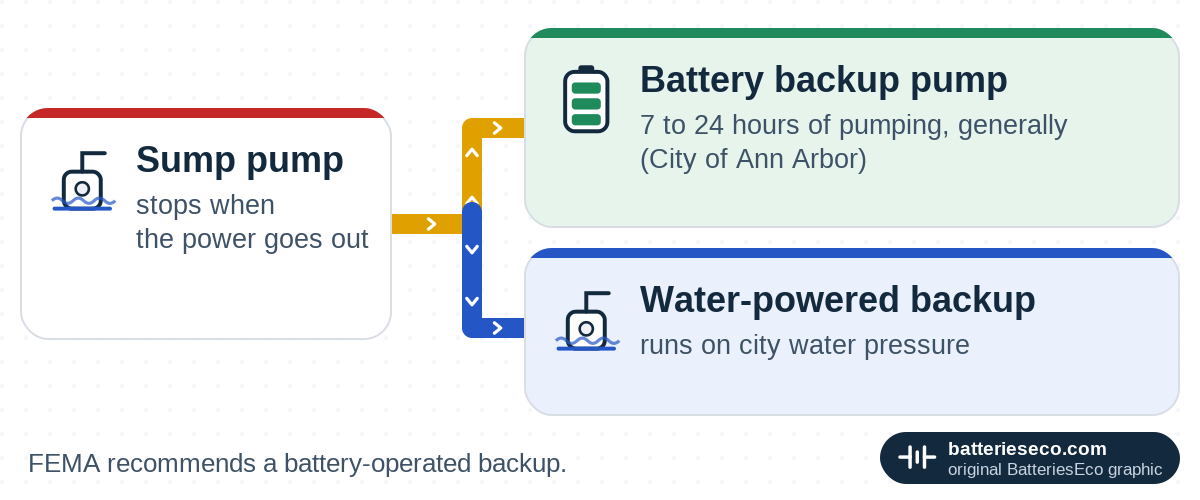
A sump pump battery backup generally gives 7 to 24 hours of pump operation on its battery, according to the City of Ann Arbor, Michigan 1. If you’re on a private well, an outage also puts your drinking water at risk 2.
Why a sump pump fails
A sump pump moves groundwater away from your home, and FEMA says it can be an excellent defense against basement seepage and flooding 3. It recommends choosing one with a battery-operated backup in case the power fails 3.
There are several ways a main pump fails, and the City of Ann Arbor lists them 1:
- a loss of power: a blackout, a blown fuse, a tripped breaker, a damaged cord or an unplugged pump
- a failed float switch
- a burned-out pump
- clogging
- more water than it can handle
- a failed check valve or a blocked discharge line
In our view, a backup covers some of these failures, not all.
Battery, water-powered or generator backup
Ann Arbor’s guidance describes several options, including these three 1:
- A battery backup pump, the most popular option. A second, emergency pump runs from a deep-cycle battery that a household outlet keeps charged, and it usually takes over automatically in an outage. It’s usually less powerful than the main pump: about 10 gallons per minute on average, compared with 30 or 60 for main pumps.
- A water-powered backup, which uses your home’s water pressure and needs no electricity. It works as long as there’s water pressure.
- A generator to run the main pump: a portable one you must be home to start, or an automatic standby generator, which must be professionally installed.
A water-powered backup runs on city water pressure 1.
Our reading of Michigan’s well guidance: on a private well, the well pump stops in the same outage, and drawing water then depressurizes the system. The private well section gives that guidance.
How long does a sump pump battery backup last?
Ann Arbor puts a backup pump’s battery life at generally 7 to 24 hours of pumping, and says the battery should be replaced every three years 1.
Makers’ runtime figures depend on the battery and on how often the pump cycles, so check the conditions behind each one. Zoeller gives the battery’s capacity as reserve capacity, which is counted in minutes, not amp-hours 4.
- Zoeller Aquanot Fit 508: 30 gallons a minute at 10 feet of head. Zoeller estimates that on a fully charged deep-cycle battery with 175 minutes of reserve capacity, it runs continuously for about 5.5 hours; it says most backup pumping is intermittent, so the battery lasts longer. Zoeller also warns that some makers publish flow figures from DC pump testing to marine industry standards, which can be 40% to 80% higher than actual battery-powered performance 4.
- Basement Watchdog Special: 1,850 gallons per hour at 10 feet; the manual doesn’t say how that figure was measured 5. Basement Watchdog’s manual says the Big Standby battery runs the system for 60 hours at a 10% duty cycle (the pump running 10% of the time), and for days of on-and-off pumping. It also warns against using a car battery and says to replace a battery more than five years old 5.
Our calculation: 1,850 gallons per hour is about 31 gallons a minute (1,850 ÷ 60). On paper, the two pumps are rated for about the same flow at 10 feet.
The two runtimes rest on different assumptions: 5.5 hours of continuous pumping for one, 60 hours at a 10% duty cycle for the other 4 5.
In our view, a backup that pumps continuously through a long storm runs down its battery much faster than a figure based on a 10% duty cycle suggests.
If you’re on a private well
Michigan’s environment department explains that an electric well pump keeps the tank and pipes under pressure, which acts as a barrier against contamination 2. In an outage, the system loses pressure if you open a faucet, and the water can become contaminated with no change in taste, smell or clarity 2.
During a long outage, the department advises against opening faucets, showering or flushing, since drawing off the few gallons in storage depressurizes the system 2. It suggests keeping bottled water and a few 5-gallon buckets of water for flushing 2.
The CDC’s guidance on private wells after a wildfire, written for health departments, gives these steps if the home lost power 6:
- Check whether the well lost pressure. You should do this even after the power is back on; water spurting from a faucet is a sign it did.
- If it did, don’t drink the water until it has been tested, at least for bacteria.
- Then prime the pump, disinfect and flush the well 6.
The CDC adds a precaution: turn off power to the pump before you inspect it 6. Michigan considers the water safe after two samples taken 8 hours apart show no coliform bacteria 2.
Our reading: other states may set different rules on when well water counts as safe again.
Running pumps from a generator
The CDC says a licensed well contractor, an electrician or the power company should determine the generator size for a well pump, to avoid damaging the pumping system 6.
Unless a qualified electrician has installed it with a transfer switch, never connect a generator to your home’s wiring, OSHA warns 7. OSHA adds that without the switch, the generator can energize the lines and put utility workers at risk of electrocution 7. The CPSC calls plugging a generator into a wall outlet, known as “backfeeding,” extremely dangerous 8.
The CPSC’s advice is to run a portable generator outdoors only, at least 20 feet from the house, with its exhaust directed away from your home 9. Between 2012 and 2022, an estimated 892 non-fire carbon monoxide deaths in the US were associated with generators, a CPSC staff report found 10.
Who should install a battery backup
A battery backup’s charger itself plugs into a household outlet 1. For controls, protection devices and wiring, Zoeller says all installation should be done by a qualified licensed electrician 4. In Ann Arbor, these backup installations generally require a permit from the local building department 1.
Our reading: adding a circuit, a transfer switch or a generator inlet is electrical work for a licensed electrician.
For keeping the rest of the house going in an outage, see our backup power section.
Sources
- Sump Pump Backup Options
- Protecting Your Private Water Supply in an Emergency (fact sheet)
- Protect Your Home from Flooding: Low-Cost Projects You Can Do Yourself (brochure)
- Technical Data Sheet, Model 508 12-Volt Backup Submersible Sump Pump System (FM3124)
- Basement Watchdog Special Backup Sump Pump System, instruction manual (BWSP-A controller)
- Private Wells After a Wildfire
- Using Portable Generators Safely (OSHA Fact Sheet FS-3286)
- CPSC Safety Alert: Portable Generator Hazards (Publication 5123)
- As Winter Storms Threaten Millions in the US, CPSC Issues Safety Tips to Help Families Prevent Carbon Monoxide Poisoning and Fires (Release 26-149)
- Non-Fire Carbon Monoxide Deaths Associated with the Use of Consumer Products: 2022 Annual Estimates