2026 is the first year without the federal residential clean energy credit for home solar panels and batteries
Since January 1, 2026, the federal residential clean energy credit (25D) no longer applies to home solar panels or batteries: what counts is when installation is completed, not when you paid. For systems installed in 2025 or earlier, the credit is claimed on Form 5695 for the year they were installed, and unused credit can be carried forward.
Published


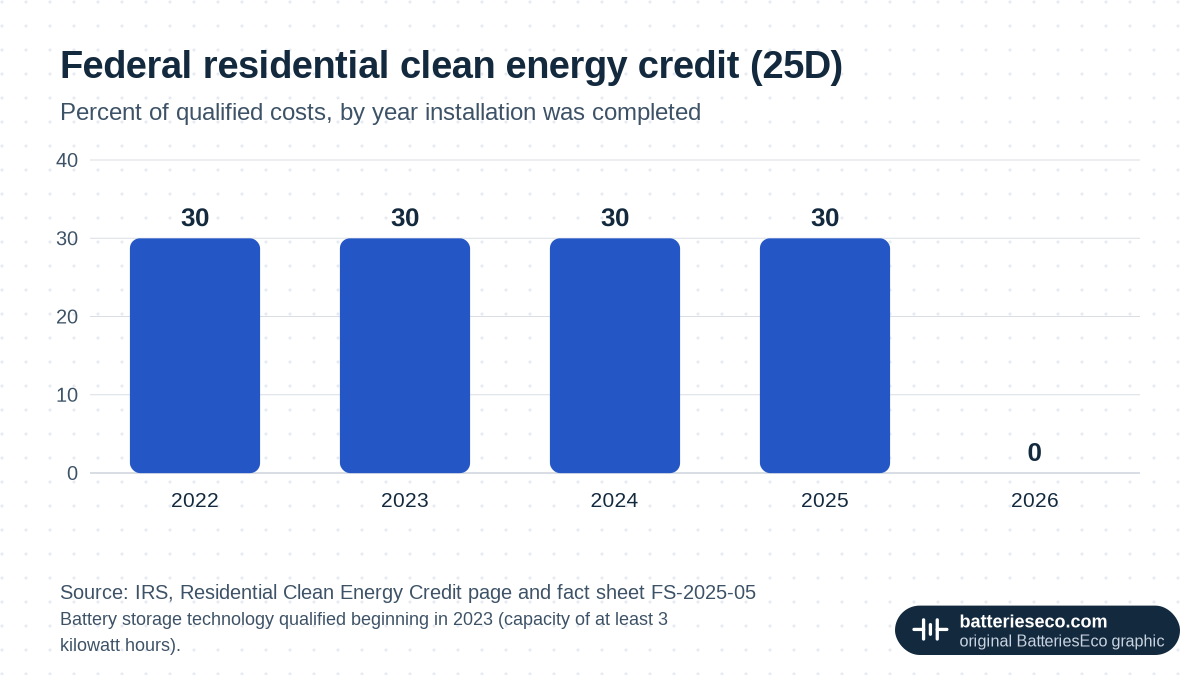
Solar panels and batteries installed at home on or after January 1, 2026, earn no federal solar tax credit: the residential clean energy credit doesn’t apply to them. A 2025 law ended it for any expenditures made after December 31, 2025 1 2.
The credit was worth 30% of the cost 3. It’s often called 25D, after its section of the tax code.
Is the solar tax credit still available in 2026?
Not for new systems. The credit equaled 30% of the costs of new, qualified clean energy property for your home installed anytime from 2022 through December 31, 2025 3. Qualified expenses included:
- solar electric panels
- battery storage with a capacity of at least 3 kilowatt-hours (from 2023)
- labor: onsite preparation, assembly or original installation of the property, and piping or wiring to connect it to the home
- solar water heaters, wind turbines, geothermal heat pumps and fuel cells
Before the 2025 law, the credit had much longer to run: the old law ruled out only property placed in service after December 31, 2034 1 4.
The installation date is what counts
Paying for a system on or before December 31, 2025, isn’t enough. An expenditure is treated as made when the original installation of the item is completed, so a system finished after December 31, 2025, counts as a later expenditure and earns no credit 2.
The IRS set this out in a fact sheet dated August 21, 2025 2. A new or rebuilt home follows its own rule: spending on building or rebuilding it is treated as made when your original use of the home begins 2.
| Your situation | Federal credit under 25D |
|---|---|
| Paid for and installed in 2025 or earlier | Yes, on the return for the year the installation was completed 3 |
| Paid for in 2025, installation completed in 2026 | No 2 |
| New or rebuilt home, your original use begins in 2026 | No 2 |
What still applies in 2026
A system installed in 2025 or earlier still earns the credit on that year’s return 3. The route is short:
- File Form 5695, Residential Energy Credits, with your tax return.
- Use the tax year when the property was installed, not the year it was merely purchased.
- If the credit is more than your tax, it can cut your tax to zero but won’t be paid out as a refund, because it’s nonrefundable. Carry any unused credit forward to reduce the tax you owe in future years.
If a company owns the panels on your roof
With a solar lease or a power purchase agreement (PPA), you host a system owned by a solar company and pay for the electricity it generates. In either case, you’re not entitled to tax benefits, since you don’t own the solar energy system 5.
The law behind the change
The change comes from Public Law 119-21 of July 4, 2025, commonly known as the One, Big, Beautiful Bill. It amended section 25D so that the credit doesn’t apply “with respect to any expenditures made after December 31, 2025” 1 2.
The current US Code text of section 25D, with the laws in effect through October 22, 2026, reads the same way 4. The same law also changed section 48E, the clean electricity investment credit, on a different timetable 1.
One official page lags behind. The IRS’s credit page, last reviewed or updated on July 4, 2026, still says you can claim the annual credit every year that you install eligible property “until the credit begins to phase out in 2033.” The same page says the credit is not available for any property placed in service after December 31, 2025 3.
What it means for your taxes
A home solar or battery system you buy outright and have installed in 2026 gets no federal tax credit, even if you paid a deposit or the full price in 2025. At the old rate, that’s $300 less for every $1,000 of qualified cost (1,000 × 30% = 300), so any payback estimate that counted on the credit, such as a quote prepared before 2026, now overstates what you’d save. Panels or a battery installed in 2025 belong on the 2025 return, and carrying forward an unused amount is the only way 25D can still lower your tax for 2026 and later years.
Because it’s a federal income tax credit, this applies to homeowners in every state. With a lease or a PPA, there was no credit to lose. And the 2033 phase-out line on the IRS page is out of date.
How much a battery saves also depends on how your utility credits the solar power you export. Our guide to net metering and net billing explains why storing your midday surplus is worth more where exports earn less than the retail rate.
Our home solar and battery storage guide covers how panels, a battery and the grid work together, and our solar batteries guide covers choosing the type and size. Tax and incentive changes for US households are tracked on our news page.
Sources
- Public Law 119-21 (139 Stat. 72), July 4, 2025: sections 70506 and 70513
- FAQs for modification of sections 25C, 25D, 25E, 30C, 30D, 45L, 45W, and 179D under Public Law 119-21 (FS-2025-05)
- Residential Clean Energy Credit
- 26 U.S.C. 25D: Residential clean energy credit (United States Code, Office of the Law Revision Counsel)
- Homeowner’s Guide to Going Solar