Power banks on flights: hand luggage only, two per person and no recharging on board since 27 March 2026
Since 27 March 2026, power banks carried by air passengers have had their own rules, set by ICAO and published by the UK Civil Aviation Authority: hand luggage only, protected when not in use, no recharging on board and no more than two per person. Check your power bank’s watt-hour rating and ask your airline before you fly with one above 100 Wh.
Published
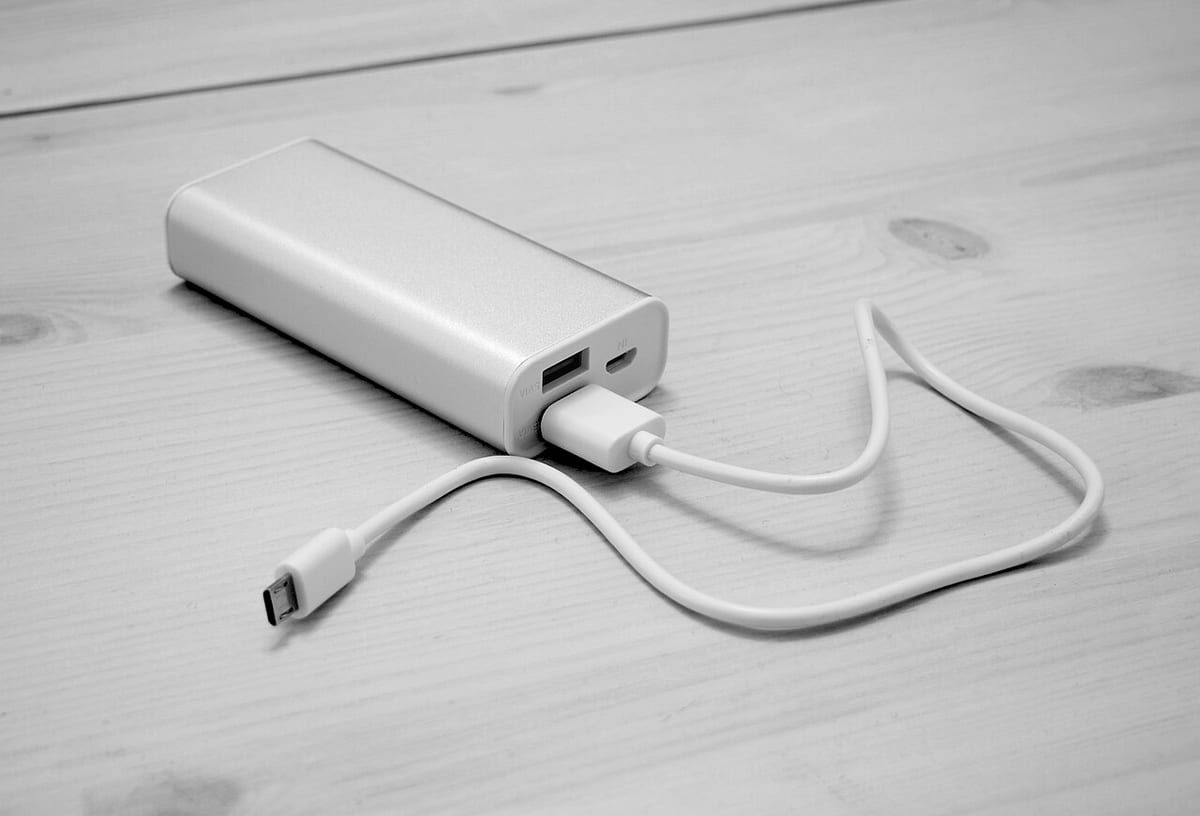

You can take no more than two power banks on a plane, only in your hand luggage, and you can’t recharge them on board. These rules have applied since 27 March 2026 1. They come from the International Civil Aviation Organization (ICAO), and the UK Civil Aviation Authority (CAA) sets them out for passengers and crew 2 1.
The power bank rules on a plane
Power banks 1:
- go in your hand luggage, never in hold luggage
- must be protected individually when you’re not using them
- must not be recharged on board
- should not be used to charge your phone, tablet or other devices on board
- are limited to two per person
So topping up the power bank itself from the plane is banned, while using it to charge your phone is something you “should not” do 1. Your airline can also set stricter conditions 3, and airlines and security staff can refuse certain items 2.
What’s the power bank limit on a plane?
It depends on the watt-hour (Wh) rating, and the answer is getting stricter in two steps. The CAA still allows a larger power bank with your airline’s approval, while IATA, the International Air Transport Association, already lists it as forbidden and drops it from its 2027 rules:
| Power bank rating | CAA, since 27 March 2026 | IATA guidance, 31 March 2026 | IATA rules, edition 68 (1 January 2027) |
|---|---|---|---|
| Up to 100 Wh | Allowed without airline approval 2 | Allowed, two at most 3 | Allowed, two at most 4 |
| Over 100 Wh, up to 160 Wh | Needs your airline’s approval 2 | Forbidden 3 | Not allowed: only power banks whose cells add up to 100 Wh or less 4 |
For a lithium-metal power bank, the limit is 2 g of lithium rather than a Wh rating 2. Above 160 Wh, IATA says a battery has to be prepared and sent as cargo under its Dangerous Goods Regulations 3. Whatever its size, the power bank must be a type that has passed every one of the UN’s lithium battery tests (UN Manual of Tests and Criteria, subsection 38.3) 2.
The CAA’s two pages don’t quite agree. Its page for airlines first says a lithium-ion power bank must not exceed 100 Wh, then lists the same 100 to 160 Wh approval route 1. If yours is above 100 Wh, contact your airline before you travel: the CAA asks passengers to do this for any item that needs the airline’s approval 2.
How to find your power bank’s Wh rating
- Look on the case. Manufacturers have had to mark lithium-ion batteries with their watt-hour rating “since 2009 and 2011 respectively” 2.
- If only the capacity is printed in milliampere-hours (mAh), divide it by 1000 to get ampere-hours (Ah): 4400 mAh is 4.4 Ah 2.
- Multiply the ampere-hours by the nominal voltage: Ah × V = Wh 2. Our watts, amps, Wh and Ah converter does the sum for you.
- Keep the rating readable. If staff can’t check it on the battery or its paperwork, the airline may refuse to carry it 3.
Before you fly
IATA’s practical tips 3:
- Airlines prefer power banks and spare batteries charged to less than 25%.
- If you charge your power bank before the flight, let it cool before packing it.
- Don’t put power banks in the overhead lockers.
- Keep each one in its original packaging, or tape over the terminals to prevent short circuits.
- If your cabin bag is taken at the gate to go in the hold, take all lithium batteries and devices out first.
- Check your airline’s own policy, as rules can differ.
Phones, laptops and other devices with a built-in battery follow different rules, and they should go in your hand luggage. If a device with a lithium-ion battery above 2.7 Wh goes in your hold luggage, it must be switched off completely, not left in sleep or hibernation mode 2. A power bank never goes in the hold 2.
Spare batteries for a camera or a laptop are a separate category too. IATA no longer counts power banks as spare batteries, and its 2026 guidance allows up to 20 spares of any type per person 3. From 1 January 2027 its limit is 18, in hand luggage only, each protected against short circuits 4.
Why the rules changed
The aim is to reduce the likelihood and impact of overheating incidents involving lithium batteries, and to bring the rules closer together around the world 1. If a device gets hot, smokes or looks damaged, tell the crew or airport staff straight away 3.
The warning signs of a failing battery are listed in our lithium battery fire safety guide, and our lithium-ion guide covers how these cells store energy. Our news page follows other rule changes for batteries and power banks.
Sources
- Changes to rules on the carriage of lithium cells/batteries and power banks (Commercial industry > Airlines > Dangerous goods)
- What items can I travel with and which are restricted (Air passengers > About your trip > Baggage)
- Passengers Travelling with Lithium Batteries - Guidance Document, Revised for the 2026 Regulations (IATA, 31/03/2026)
- Dangerous Goods Regulations, Edition 68 (1 January 2027): Table 2.3.A (Dangerous Goods Requiring Operator Approval) and Table 2.3.B (Dangerous Goods Operator Approval Not Required), English extracts