How much do solar panels cost in the UK? Price per kW, what drives it, VAT and payback
Official government statistics for Great Britain put the median installed cost of solar systems up to 4 kW at £1,780 per kW in 2025/26, including any VAT but not batteries. The Energy Saving Trust puts an average system of about 4.5 kWp at around £7,600.
The Trust’s payback estimates for four places in Great Britain, using July 2026 fuel prices and export payments, run from 9 to 12 years and depend on how much time you spend at home. Installing solar panels in a home carries 0% VAT until 31 March 2027, then 5%.
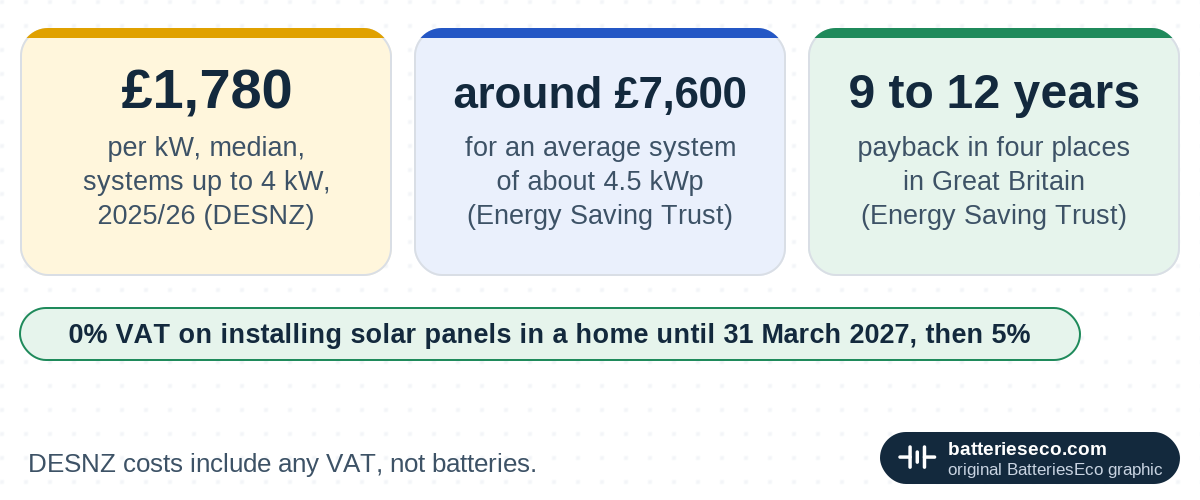
The government’s official figures on solar panel cost in the UK cover Great Britain, not Northern Ireland 1. In Great Britain, systems of 0-4 kW installed between April 2025 and March 2026 cost a median £1,780.25 per kW, including any VAT but not a battery 1. The Energy Saving Trust puts an average home system, about 4.5 kilowatt peak (kWp), at roughly £7,600 2.
Price per kW and for a typical home
The Department for Energy Security and Net Zero (DESNZ) publishes installation cost figures for Great Britain, drawn from the MCS installation database; Northern Ireland isn’t included 1. Its medians for April 2025 to March 2026, not adjusted for inflation:
| System size | Median cost per kW |
|---|---|
| 0-4 kW | £1,780.25 |
| 4-10 kW | £1,696.97 |
| 10-50 kW | £1,262.17 |
Our reading: smaller systems cost more per kW, as these medians show.
These figures cover the equipment, installation, connection and VAT where it applies, but not a battery 1. They’re measured per kW of declared net capacity. Measured per kW of total installed capacity instead, costs are typically 6% to 12% lower 3.
Our calculation: at the 0-4 kW median, a 4 kW system comes to 4 × £1,780.25 = £7,121.
According to the Energy Saving Trust, an average home system is about 4.5 kWp, typically covers 20 to 30 m² of roof with around 12 panels and costs roughly £7,600 to install 2. In Scotland, Home Energy Scotland puts the average system at around 4 kWp, costing about £6,500 4.
Why some quotes come in higher
The Energy Saving Trust lists these factors 2:
- the size of the system
- how hard the roof is to reach
- whether you choose panels or solar tiles
- whether they’re integrated into the building
- whether the roof covering needs renewing
It’s cheaper, the Trust adds, if scaffolding is already up for roof repairs or the house is a new build 2. Home Energy Scotland says panels mounted on top of the roof are the cheapest option, and solar tiles the most expensive for the same system 4.
0% VAT until March 2027, then 5%
Under the VAT Act 1994, installing solar panels in a home has been zero-rated for VAT since 1 April 2022 in Great Britain and since 1 May 2023 in Northern Ireland 5. In both, the zero rate lasts until 31 March 2027 5. Batteries installed in a home also qualify, whether they’re added to existing panels or installed on their own 6.
From 1 April 2027 the rate reverts to the reduced rate of 5%, under Schedule 7A of the same Act 7. Budget 2026 confirmed that return to 5% 8.
Our calculation: for an installation supplied on or after 1 April 2027, if the price before VAT stayed at the Trust’s £7,600, the 5% rate would add £380.
How much electricity the panels make
In our runs of the EU’s PVGIS tool, each kW of south-facing panels tilted at 35° generates about 1,019 kWh a year in London, 1,118 kWh in Plymouth and 904 kWh in Edinburgh. Our solar panels guide has the full table and explains tilt and shading.
Our calculation: for the Trust’s average 4.5 kWp system, that’s about 4,590 kWh a year in London (4.5 × 1,019) and about 4,070 kWh in Edinburgh (4.5 × 904).
How long solar panels take to pay back
The Energy Saving Trust’s payback estimates, based on export payments and fuel prices as of July 2026 2:
| Place | Payback |
|---|---|
| London | 9 years |
| Manchester | 10 to 11 years |
| Aberystwyth | 9 to 10 years |
| Stirling | 11 to 12 years |
The figures depend on how much time you spend at home. The Trust’s figures don’t cover Northern Ireland yet 2.
Home Energy Scotland gives two different figures on the same page: 5-10 years in its key facts and around 8-12 years in the main text. It says panels should last 30 years or more 4.
Our calculation: if the panels last the 30 years or more that Home Energy Scotland expects, that leaves at least 18 years after the Energy Saving Trust’s longest payback of 12 years (30 minus 12).
What sets the payback for your home
Our reading: payback turns on how much of the panels’ power you use yourself, as well as on your unit rate and your export rate. Before you compare quotes, note your own unit rate and the export rate you’d get. The more of your own power you use, the less the export rate matters.
To compare export offers, see what suppliers pay under the Smart Export Guarantee. For the price you pay per kWh, see what a kWh costs under the energy price cap.
Grants and loans
There are no dedicated UK government grants for solar panels, according to the Energy Saving Trust, though you may be able to get funding through other government schemes 2. One is the Warm Homes Loan Scheme, set out in a government factsheet on 27 October 2026 9.
Its government-backed no- and low-interest loans (not grants) go up to £15,000 for solar panels, across the UK including Northern Ireland, provided an MCS-certified installer does the work 9.
If you’re thinking of a battery too, read what adding home solar storage involves.
Sources
- Solar photovoltaic (PV) cost data: Solar PV cost data, DNC basis (Solar_Costs_2025-26__DNC_.xlsx)
- Solar panels: costs, savings and benefits explained
- Solar photovoltaic (PV) cost data: Solar PV cost data, TIC basis (Solar_Costs_2025-26__TIC_.xlsx)
- Solar panels
- Value Added Tax Act 1994, Schedule 8 (Zero-rating), Group 23: Installation of energy-saving materials (revised text); with the GOV.UK content record of VAT Notice 708/6
- Energy-saving materials and heating equipment (VAT Notice 708/6)
- Value Added Tax Act 1994, section 29A (Reduced rate) and Schedule 7A (Charge at reduced rate), Part 2, Group 2: Installation of energy-saving materials (revised text)
- Budget 2026
- Warm Homes Loan Scheme: Factsheet