A perovskite-silicon tandem solar cell from Zhejiang University is certified at 31.62% efficiency
A perovskite-silicon tandem solar cell from Zhejiang University was independently certified at 31.62% efficiency and kept 95% of its performance after about 3,000 hours of testing. Silicon panels on sale reach just under 25%. The cell, published in Nature Energy on November 2, 2026, was made in a lab: no panel built on it is on sale.
Published
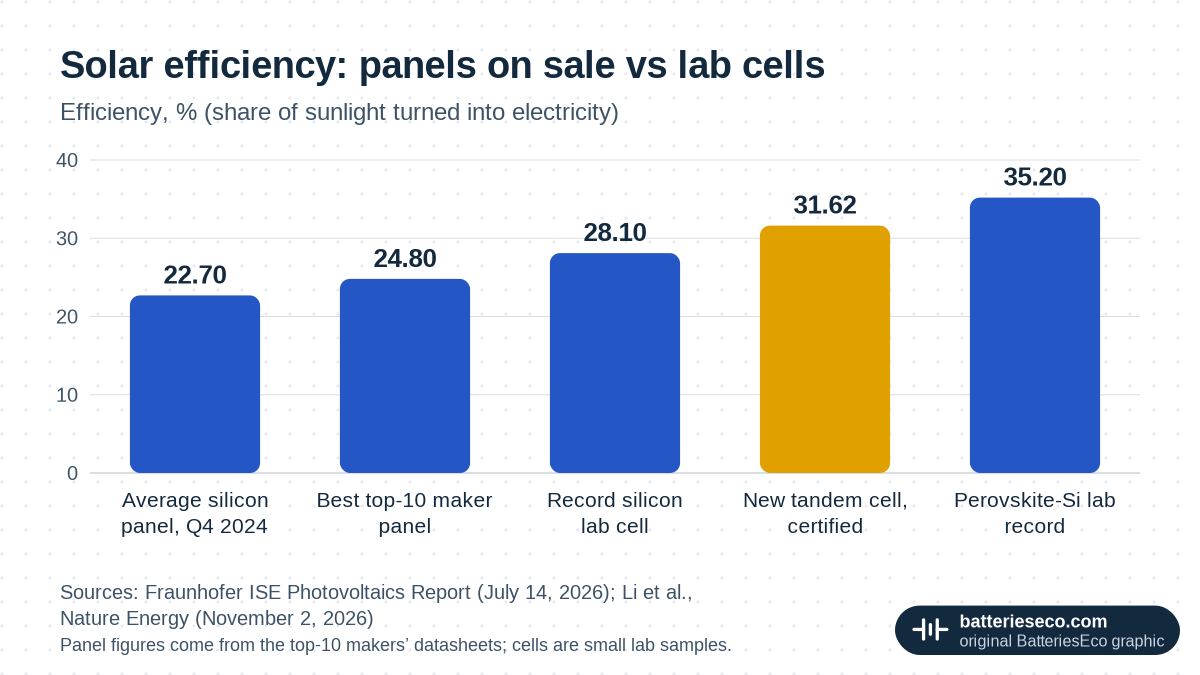
Solar panel efficiency on today’s silicon panels tops out just under 25%, and a lab cell from Zhejiang University in China has now been certified at 31.62% 1 2. The cell stacks a perovskite layer on top of a silicon cell, a design called a tandem 2.
The study appeared in Nature Energy on November 2, 2026. This is a cell made in a lab, and no panel built on it is on sale 2.
How a perovskite-silicon tandem cell works
A tandem cell puts two light absorbers one behind the other. Here the front one is a perovskite, a lead-based crystal film, and a silicon cell sits behind it 2.
The team picked caesium lead triiodide with a little formamidinium added, a mix written Cs(FA)PbI3. It’s a promising front layer for tandem cells because it holds up well, but good-quality films of it are hard to make 2.
The new cell isn’t a world record. In its July 14, 2026 report, Fraunhofer ISE put the best perovskite-silicon lab cell at 35.2%, compared with 28.1% for the best silicon-only lab cell 1.
Fixing the seams between crystals
A perovskite film is made of many tiny crystals, called grains, and the seams where they meet are grain boundaries. The formamidinium ions are oversized for the crystal, and even a sparse sprinkling of them badly distorts those boundaries. That helps defects form and drags down performance 2.
The fix is a lead-based additive called a metallomesogen. It forms a phase that behaves partly like a solid and partly like a liquid, which lets it spread evenly along the grain boundaries 2.
There it eases the distortion and strain, keeps the crystal structure intact and limits defects 2. The finished tandem cells also use a bromine-containing additive at the boundaries and a perovskite tuned to a band gap of 1.66 eV, the light energy it starts absorbing at 2.
How long did the new solar cells last in testing?
Stability is the other half of the result. These are the main figures 2:
| Test | Conditions | Result |
|---|---|---|
| Efficiency, the lab’s own measurement | best cell | 32.08% |
| Efficiency, independent test | Shanghai Institute of Microsystem and Information Technology, cell tested in air without encapsulation | 31.62% |
| Running at maximum power | about 3,000 hours | 95% of starting performance kept |
| Damp heat | 1,500 hours at 85% relative humidity and 185 °F (85 °C) | 93% of starting performance kept |
Encapsulation means the sealed layers that protect a cell. The certified cell, tested by an accredited PV center in China, had none. On the stability test cells, the encapsulation cut the incoming light and lowered their current 2.
“Maximum power point tracking” means the cell was kept at the voltage where it gives the most power, the same point an MPPT charge controller hunts for on a real panel. Our guide to MPPT and PWM charge controllers explains how that works with batteries.
How far is this from solar panels you can buy?
Still some way. The results come from lab cells, and panels score below the best cells: Fraunhofer ISE lists the best silicon lab panel at 26.0%, compared with 28.1% for the best silicon lab cell 1.
Silicon also dominates the market. Wafer-based silicon made up about 98% of world solar production in 2025 3.
Over the past decade, commercial monocrystalline silicon panels went from about 17% to just under 25% efficiency 1. Among the top 10 makers, the shipment-weighted average was 22.7% at the end of 2024, with the best panel in that group at 24.8% 1.
Yong Wang of Zhejiang University led the work. Four of the authors are inventors on a provisional Chinese patent related to it 2.
What a 31.62% cell could mean for your roof
Panels are rated under 1,000 W of sunlight per square meter 4. At that light, a 22.7% panel gives about 227 W per square meter (1,000 × 22.7%), and a surface at 31.62% would give about 316 W (1,000 × 31.62%) 1 2. If tandem panels ever keep most of that edge, the same roof could carry more watts.
What you pay for is watts, and DOE’s benchmark for a home rooftop system without a battery was $2.95 per watt in early 2025, before tax credits 5. Tandems may only pay off at home if they come close to that price.
Durability is the other open question: 3,000 hours is about 125 days of running (3,000 ÷ 24), while silicon panels in the field lose a median 0.5% to 0.6% of their power a year 6.
If you’re sizing a system now, our solar panels guide gives what 1 kW of panels makes a year in US and UK cities and how long panels last. Pairing them with a battery is covered in our home solar and storage section. Earlier battery lab results are on our news page.
Sources
- Photovoltaics Report
- Grain boundary engineering using metallomesogen in formamidinium–caesium lead triiodide for stable perovskite/silicon tandem solar cells
- Photovoltaics Report
- PVGIS 5 user manual (sections 2 Using horizon information; PV technology; Installed peak power; Mounting position)
- Solar Photovoltaic System Cost Benchmarks (2025Q1 benchmarks)
- Compendium of photovoltaic degradation rates